
Functional training focuses on improving how your body moves in everyday life – think lifting groceries, climbing stairs, or reaching overhead. Unlike gym workouts that isolate muscles, this approach trains movement patterns like squats, lunges, and pushes. It boosts strength, balance, agility, and helps prevent injuries.
Key Takeaways:
- Core Movements: Squat, hinge, push, pull, carry, rotate, and gait mimic daily activities.
- Benefits: Improves coordination, strengthens stabilizers, and reduces injury risks.
- Getting Started: Begin with bodyweight exercises, assess your fitness, and focus on proper form.
- Progression: Gradually add weights, increase intensity, or try single-leg and multi-planar exercises.
Functional training isn’t about lifting the heaviest weights – it’s about moving better, staying strong, and preparing your body for real-life challenges. Complement your training with personalized nutrition coaching to fuel your performance and recovery.
Strong 20 Day 10: 20-Minute Full Body Functional Training
sbb-itb-29cdcd8
What Is Functional Training?
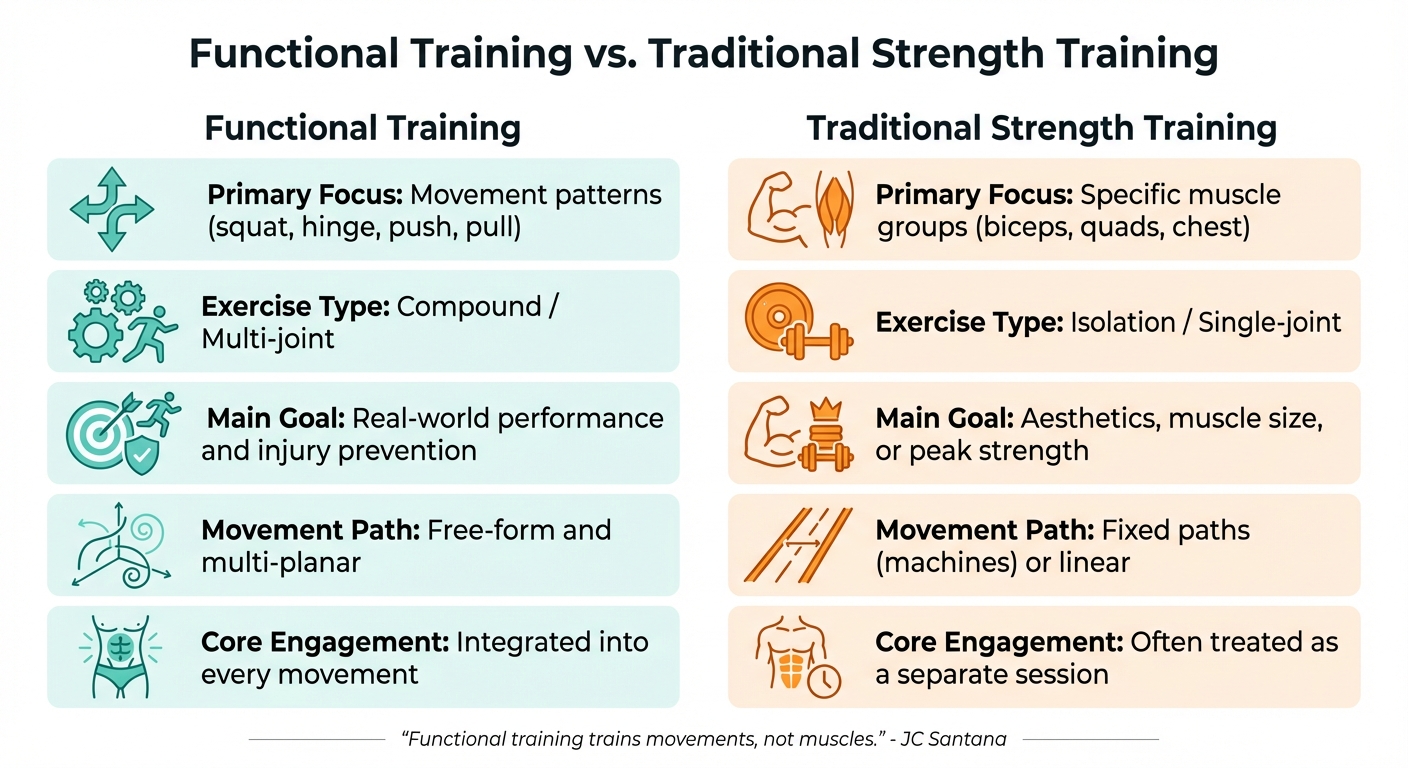
Functional Training vs Traditional Strength Training: Key Differences
Functional training focuses on improving movement patterns rather than isolating individual muscles. Instead of targeting specific areas like your biceps or quads, it prepares your body for everyday activities – like squatting to tie your shoes, bending to lift a box, or pushing open a heavy door.
As JC Santana, Founder of the Institute of Human Performance, explains:
"Functional training trains movements, not muscles."
This method relies on compound exercises that replicate natural movements. For example, when you reach for something in an overhead compartment, your body engages multiple muscles, joints, and stabilizers to perform the action efficiently.
To see how functional training stands out, let’s compare it with traditional strength training.
Functional Training vs. Traditional Strength Training
The main difference comes down to purpose and application. Traditional strength training typically focuses on building specific muscles or improving aesthetics through isolation exercises like bicep curls or leg extensions. These are often performed on machines that follow fixed movement paths. Functional training, on the other hand, emphasizes preparing your body for the diverse physical demands of daily life.
| Feature | Functional Training | Traditional Strength Training |
|---|---|---|
| Primary Focus | Movement patterns (squat, hinge, push, pull) | Specific muscle groups (biceps, quads, chest) |
| Exercise Type | Compound / Multi-joint | Isolation / Single-joint |
| Main Goal | Real-world performance and injury prevention | Aesthetics, muscle size, or peak strength |
| Movement Path | Free-form and multi-planar | Fixed paths (machines) or linear |
| Core Engagement | Integrated into every movement | Often treated as a separate session |
Using free weights like dumbbells or kettlebells in functional training requires balance and control, mimicking the challenges you face in everyday life. In contrast, machines with guided paths limit the need for stabilization.
Now, let’s dive into the essential movement patterns that form the backbone of functional training.
Core Movement Patterns You Need to Know
Functional training revolves around seven key movement patterns: Squat, Hinge, Push, Pull, Carry, Rotate, and Gait (locomotion). These patterns are the foundation of countless exercises and mirror the physical tasks you encounter daily.
| Movement Pattern | Daily Activity | Functional Exercise Example |
|---|---|---|
| Squat | Sitting down and standing up from a chair | Goblet Squat, Bodyweight Squat |
| Hinge | Picking up a box or a pet from the floor | Deadlift, Kettlebell Swing |
| Push | Stowing luggage overhead or closing a heavy door | Overhead Press, Push-up |
| Pull | Opening a heavy door or lifting a bag | Row, Pull-up |
| Rotate | Checking your blind spot while driving | Wood Chop, Medicine Ball Throw |
| Lunge | Climbing stairs or recovering balance after a slip | Forward Lunge, Step-up |
| Carry | Hauling grocery bags or rolling luggage | Farmer’s Walk, Suitcase Carry |
Training across multiple planes of motion is key. Life rarely happens in a straight line – you twist, step sideways, or rotate your torso while moving. Functional training incorporates sagittal (forward-backward), frontal (side-to-side), and transverse (rotational) movements to prepare your body for these dynamic challenges.
Additionally, functional training treats your core as a stabilizer, transferring force between your upper and lower body during these movements. This is different from isolating the core with exercises like crunches. By integrating core strength into every action, functional training builds a body that’s strong and capable in everyday situations.
Evaluate Your Current Fitness Level
Before diving into a new fitness plan, it’s important to take stock of where you’re starting. Knowing your baseline fitness can help you figure out which movement patterns need attention and prevent you from pushing too hard, too soon. As GMB Fitness explains:
"If you don’t have a lot of understanding about what is specifically holding you back, a lot of decisions you make about what sort of training to focus on are just guesswork."
To get a clear picture, assess your fitness across three key areas: strength, flexibility, and motor control (which includes coordination and balance). A simple way to begin is with the "Get Down and Get Back Up" test – try sitting on the floor and standing up without using your hands. This provides a quick snapshot of your functional movement abilities.
How to Test Your Baseline Fitness
Start with a warm-up, such as a 400-meter jog or two minutes of jumping jacks, to loosen up and avoid stiffness impacting your results. Then, perform basic movement tests to evaluate your current abilities.
One widely used method is the Functional Movement Screen (FMS), which consists of seven tests designed to highlight compensations, imbalances, and potential injury risks. Each movement is scored on a scale from 0 to 3:
- 0: Pain during the movement (a sign to consult a professional)
- 1: Unable to perform the movement
- 2: Movement completed with compensations
- 3: Movement performed perfectly
Here’s a breakdown of some FMS tests and what they assess:
| Test Name | Primary Area Assessed | Success Criteria |
|---|---|---|
| Deep Squat | Hips, Ankles, Thoracic Spine | Upper torso stays parallel to shins; heels remain down |
| Active Straight-Leg Raise | Hamstrings, Hip Mobility | Lifted leg reaches vertical while the other leg stays grounded |
| Shoulder Mobility | Scapular & Thoracic Mobility | Fists come within one hand-length of each other behind the back |
| One-Leg Stand | Balance, Core/Ankle Stability | Hold for 45 seconds (ages 15–29) or 40+ seconds (ages 30–59) |
| Trunk Stability Push-Up | Core Stability | Body lifts as a single rigid unit without hips lagging |
Recording yourself on video while performing these movements can be incredibly helpful. You might notice small form issues – like your heels lifting during a squat or your chest leaning forward – that are easy to miss in the moment. You can also rate each movement on a scale of 1 to 10 for both quality and ease.
Once you’ve completed these tests, you’ll have a clearer idea of where to focus your efforts.
Find Your Mobility and Strength Gaps
Analyzing your test results can reveal areas where mobility or strength is lacking. Look for patterns that highlight weaknesses. For example:
- If your heels lift during a squat, this could indicate limited ankle mobility.
- If your arms fall forward during an overhead squat, tight lats or restricted shoulder and thoracic spine mobility might be the issue.
- A sagging lower back during push-ups may point to weak core stabilizers.
A quick test for shoulder mobility is the "Wall Lat" test: sit with your lower back pressed against a wall and reach your arms overhead. If you can’t touch the wall without arching your back, your lats may be too tight for safe overhead movements.
Be sure to test both sides of your body. Functional training often focuses on correcting asymmetries, so single-leg exercises can help you compare strength and stability between your left and right sides.
Ashley Crosby, a strength-and-conditioning coach at Cressey Sports Performance, emphasizes the benefits of this approach:
"Once people learn how to move, they tend to make huge strides very quickly."
Select Exercises That Match Your Goals
Once you’ve assessed your fitness level and identified areas for improvement, it’s time to pick exercises that align with your goals. Functional training focuses on movement patterns that prepare your body for everyday tasks – whether it’s carrying groceries, climbing stairs, or playing with your kids.
A key focus should be on compound exercises. These movements work multiple joints and muscle groups at the same time, burning between 300–600 calories per hour while building strength for daily activities. As Steve Kamb, founder of Nerd Fitness, explains:
"Functional fitness means training your body for everyday activities, and to make daily motion easier and safer."
Lower Body and Core Exercises
When it comes to lower body training, three movement patterns take center stage: Squat, Lunge, and Hinge. Each of these mimics motions you perform regularly, making them essential for building strength and improving mobility.
- Squats replicate sitting and standing motions. Start with bodyweight squats or goblet squats, where you hold a dumbbell or kettlebell at chest height. This helps maintain proper form by keeping your heels down and your torso upright.
- Lunges focus on one leg at a time, improving balance and coordination – key for walking or climbing stairs. Beginners can try eccentric-only split squats (lowering slowly into a lunge) or use a wall for support before advancing to walking or weighted lunges.
- Hinge movements, like deadlifts, strengthen your posterior chain – glutes, hamstrings, and lower back – critical for lifting items safely. Start with kettlebell or dumbbell deadlifts to learn the hip hinge motion, then progress to barbell or trap bar variations. For extra stability and single-leg strength, try single-leg Romanian deadlifts (RDLs) or step-ups.
Another great addition is the Prisoner Get-Up, where you rise from the floor without using your arms. This builds lower-body mobility while helping you control your body weight.
Upper Body Exercises for Strength and Mobility
Upper body exercises complement lower body work by enhancing strength and mobility in your arms, shoulders, and core.
- Push-ups are a staple for targeting your chest, shoulders, and triceps while also engaging your core. If regular push-ups feel too difficult, start with incline push-ups (using a bench) or knee push-ups.
- Overhead presses, performed with dumbbells, a barbell, or kettlebells, strengthen your shoulders and core. These mimic real-life actions, like reaching for items on high shelves.
- Farmer’s carries are straightforward yet effective. Simply walk while holding heavy weights at your sides. This builds grip strength, improves posture, and trains your core and shoulders to stabilize under load. For an added challenge, try a suitcase carry, which works your core even harder by loading one side of your body.
Full-Body Compound Movements
Full-body exercises take functional training to the next level by engaging multiple muscle groups at once.
- Kettlebell swings are explosive hip-driven movements that build power in your glutes and hips while also boosting your heart rate – great for fat loss.
- The Turkish get-up is a standout functional exercise. It involves lying on the ground with a weight overhead and then transitioning to a standing position while keeping the weight stable. This movement challenges coordination, shoulder stability, core strength, and overall body control. While it may seem complex, breaking it into smaller steps makes it manageable for beginners.
If your goal is fat loss, exercises like mountain climbers and sled pushes combine strength training with cardiovascular intensity, burning calories while building lean muscle. As Dr. Thomas Fliedner from North Texas Vitality puts it:
"Functional exercise is not about chasing numbers. It is about moving well so you can enjoy your day."
Tailor your exercise selection to your goals, but always prioritize quality of movement over lifting heavier weights. Start with bodyweight exercises or lighter loads to master proper form, and gradually increase intensity as your strength and coordination grow.
How to Structure Your Functional Training Workouts
After picking your exercises, it’s time to organize your workout in a way that matches your fitness level. The structure you choose plays a big role in how quickly you progress and whether you can stick with the program long-term.
To get the most out of your sessions, include the six key movement patterns: squat, lunge, hinge, push, pull, and rotation. As Nicole Davis, CPT, explains:
"Depending on your goals, every exercise has the potential to be functional in some way, but multi-muscle, multi-joint movements tend to provide the most bang for your buck."
For beginners, aim for 2–3 full-body workouts per week, with 24–48 hours of rest between sessions to recover properly. Once you’ve built a foundation, intermediate lifters can increase to a 4-day upper-lower split, while advanced trainees might progress to a 5-day schedule, including days for power and agility. Starting with beginner routines lays the groundwork for more advanced programs.
Beginner Workout Template
If you’re just starting functional training, keep it simple. Stick to bodyweight exercises and train 2–3 times a week using the same full-body circuit. This helps you build consistency and focus on mastering form before adding weights.
Each session should begin with a 5–10 minute dynamic warm-up. Movements like arm circles, leg swings, and jumping jacks prepare your joints for the workout ahead. Then, move into the main workout, which can be done as a circuit (performing all exercises back-to-back with little rest) or in traditional sets (completing all sets of one exercise before moving to the next).
Here’s an example of a beginner-friendly circuit that covers all six movement patterns:
| Exercise | Target Pattern | Suggested Volume |
|---|---|---|
| Air Squats | Squat | 3 sets of 12–15 reps |
| Incline Push-Ups | Push | 3 sets of 10–12 reps |
| Bodyweight Rows | Pull | 3 sets of 10–12 reps |
| Glute Bridges | Hinge | 3 sets of 15 reps |
| Bird Dog | Core/Stability | 2 sets of 10 reps/side |
| Plank | Core/Stability | 3 sets of 30–60 seconds |
Rest for 30–60 seconds between sets and 1–2 minutes between exercises to maintain good form. If an exercise becomes too difficult, modify it mid-set – for instance, switch from full push-ups to incline push-ups using a bench.
Use tools to help with stability if needed. A chair can assist with squat depth, a wall can provide balance for lunges, and a broomstick can help you practice hip hinges. As personal trainer Adam Sinicki notes:
"The aim of this functional training workout for beginners is not to immediately become an athlete. Aim to get to the point where you or the client is able to perform the kinds of exercises you’d ideally like them to be doing."
Once you’ve mastered the basics, gradually add complexity and resistance.
Intermediate and Advanced Workout Progressions
As you gain strength and coordination, your workouts should evolve. Intermediate lifters can move to a 4-day upper-lower split, incorporating tools like barbells, kettlebells, and dumbbells. This allows for more training volume while ensuring enough recovery time.
Advanced trainees often follow a 5-day Push-Pull-Legs (PPL) split, adding two days focused on power, agility, and speed. These sessions should be carefully structured to manage fatigue. For example, start with mobility work, progress to motor control drills, then tackle plyometrics or power exercises, followed by heavy strength work and ending with core exercises. This sequence ensures you’re tackling the most demanding movements, like cleans or snatches, when you’re fresh.
To keep progressing, adjust these variables:
| Progression Method | How to Implement |
|---|---|
| Load | Increase the weight or resistance used |
| Volume | Add more sets or repetitions |
| Density | Reduce rest time between sets |
| Complexity | Shift from stable to unstable surfaces or bilateral to unilateral movements |
| Tempo | Slow down the eccentric phase or add isometric holds |
For example, transitioning from bilateral exercises like standard squats to unilateral ones like Bulgarian split squats will challenge your stability and help correct muscle imbalances. Additionally, incorporate movements in all three planes of motion: sagittal (forward/backward), frontal (side-to-side), and transverse (rotational).
If you’re focusing on balance, progress gradually. Start with stable surfaces, then move to a half foam roll, balance disk, and eventually a BOSU ball. You can also intensify your workouts by cutting rest times – for instance, reducing rest from 60 seconds to 30 seconds.
As science-based coach Jeff Nippard explains:
"If you’re a well-trained lifter, the more frequently you can hit a muscle, the more spikes you’ll see in muscle protein synthesis and the better muscle growth you’ll get as a result."
How to Progress Your Functional Training
Once you’ve got your workout routine in place, the next step is to take it up a notch by making thoughtful adjustments. Unlike traditional strength training, which often focuses on simply lifting heavier weights, functional training is about more than just raw strength. It emphasizes movement quality, stability, and how effectively exercises carry over to everyday activities.
Progression is key to seeing continued improvement. As fitness trainer Robyn Provencal puts it:
"Progression isn’t optional – it’s the biological mechanism of improvement."
Your body gets used to familiar challenges over time, so it’s important to keep introducing new stimuli. But that doesn’t mean rushing to add more weight every session.
Track Your Progress and Set Goals
To progress effectively, you need to keep tabs on your workouts. Use a simple 1–5 scale to rate your form and technique for each set. A score of 1 means your form is poor and could lead to injury, while a 5 means you’re nailing perfect execution. Only increase intensity when you’re consistently scoring 4s and 5s.
Here are some key metrics to monitor in your training log:
- Load and volume: Record the weight, sets, and total reps.
- Movement quality: Rate your form for each exercise.
- Range of motion: Note improvements in depth (like squats) or reach (like rows).
- Rest periods: Track how long you rest between sets.
- Non-numerical wins: Celebrate improvements like better sleep, higher energy levels, or increased confidence in specific movements.
Surprisingly, around 90% of gym-goers don’t track their workouts effectively, often relying on memory – which tends to be only about 20% accurate. A simple notebook or an app can make a huge difference, helping you move from guesswork to a clear picture of your progress.
Setting SMART goals (Specific, Measurable, Achievable, Realistic, and Time-bound) can also keep you on track. Instead of saying, "I want to get stronger at squats", try something more concrete, like: "Increase my goblet squat from 35 lbs to 45 lbs for 3 sets of 12 reps within 6 weeks while maintaining a form rating of 4 or higher."
For more advanced athletes, studies suggest that 10–20 sets per muscle group per week yield the best muscle growth results.
With clear goals and consistent tracking, you’ll know when it’s time to safely increase the intensity of your workouts.
When and How to Add More Intensity
Figuring out when to step up your training is just as important as knowing how. A good sign that you’re ready to progress is when you can complete all your target reps with 1–2 reps left in reserve, all while keeping excellent form.
The Rate of Perceived Exertion (RPE) can help guide you. If you finish a set with only 2 reps left in the tank (RPE 8), it’s time to increase the weight. On the other hand, if you still have 3 or more reps in reserve (RPE 7), the weight is too light, and you should bump it up.
When increasing weight, stick to the Small Increase Rule: add 2–5 lbs for upper-body exercises and 5–10 lbs for lower-body exercises. If you’re not ready to add weight, focus on increasing reps or sets over 2–3 weeks before restarting your rep scheme with a heavier load.
Another way to ramp up intensity without adding weight is to slow down the eccentric (lowering) phase of your movements. Taking 3–4 seconds to lower the weight increases time under tension, which builds strength and reinforces proper technique.
Every 4–8 weeks, take a deload week by cutting your training volume or intensity by 30–50%. This helps your body recover from accumulated fatigue and can prevent plateaus. As coach Akash Vaghela explains:
"The driving principle behind all my training programmes is simple: progressive overload with perfect technique."
Keep an eye out for signs that you’re pushing too hard, such as constant soreness, poor form, persistent plateaus, or joint discomfort. If you hit a plateau, try the "Two-Step" Rule: reduce your load by 10–20% and gradually build back up. This approach often helps you surpass your previous limits.
Conclusion
Functional training is all about building strength that translates directly into everyday activities – whether it’s carrying groceries, lifting your kids, or hoisting luggage into an overhead compartment. By focusing on full-body movement patterns, you don’t just improve how you function day-to-day; you also set the stage for steady fitness progress. Training your body to work as one coordinated system makes a real difference in how you move and feel.
As Dr. Thomas Fliedner from North Texas Vitality explains:
"Functional exercise is not about chasing numbers. It is about moving well so you can enjoy your day. Build simple patterns, add a little weight when you are ready… Small, steady steps create big changes in how you feel."
The key is to start with the basics. Bodyweight exercises are a great entry point – focus on mastering proper form before introducing resistance. Two to three sessions per week are enough to build consistency, and as your skills improve, you can gradually increase the challenge.
If you’re unsure about your technique, reaching out to a certified trainer can help you avoid injury and get the most out of your workouts.
Whether your goal is to reduce back pain, prevent falls as you age, or simply move more confidently, functional training provides a straightforward and efficient way to get there. The effort you put in today builds the foundation for how your body will perform tomorrow. Start where you are, take small steps forward, and enjoy the process of creating a stronger, more capable version of yourself.
For more personalized advice on incorporating functional training into your lifestyle, visit N The Mix Nutrition (https://nthemixnutrition.com) to connect with certified coaches.
FAQs
How do I know if functional training is right for me?
Functional training could be a great fit if you’re looking to boost your strength, balance, and ability to move efficiently in daily life. It focuses on improving how your body handles everyday motions – like lifting, bending, or twisting – while also helping with mobility, stability, and coordination. The best part? These exercises can be tailored to suit anyone, whether you’re a seasoned athlete or just beginning your fitness journey.
What equipment do I actually need to start functional training?
Functional training doesn’t demand a lot of gear – just a few basics that replicate everyday movements. Popular options include resistance bands, kettlebells, dumbbells, stability balls, and exercise mats. That said, you don’t need fancy equipment to get started. Many functional exercises, like squats, lunges, and push-ups, rely solely on bodyweight, making them perfect for beginners or those without access to equipment. The key is to work on building strength, balance, and mobility using whatever tools – or space – you have on hand.
How do I add functional training without overtraining?
To keep overtraining at bay, begin with 2–3 sessions per week focused on functional exercises like bodyweight movements or kettlebell routines. Prioritize gradual progression and always include proper warm-ups and cool-downs in your routine. As your body adjusts, you can slowly increase the intensity and frequency of your workouts.
Pay attention to how your body feels – if you’re dealing with excessive fatigue or soreness, it’s a signal to focus on recovery. Adding variety to your exercises and concentrating on movement patterns rather than sheer volume can help maintain balance and keep overtraining in check.