
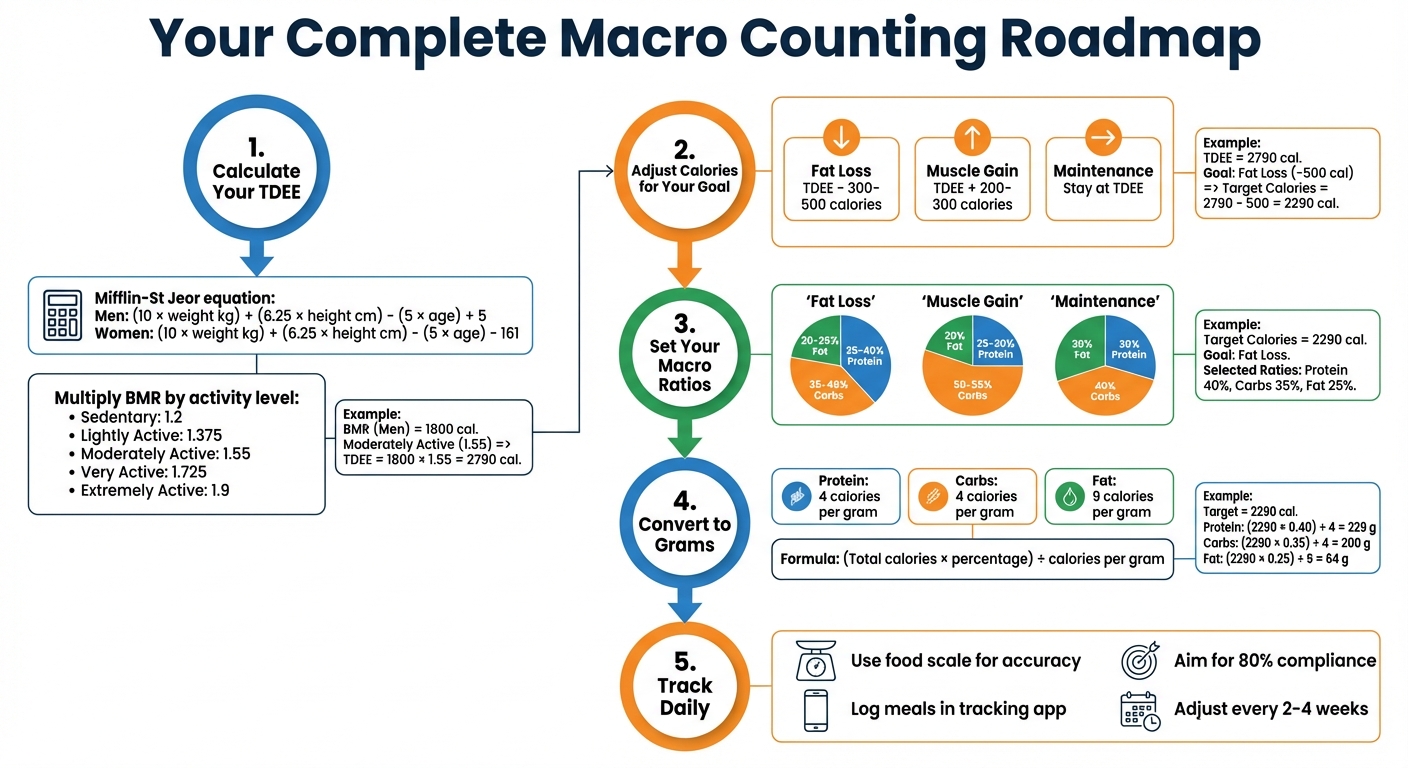
Macro counting is a flexible way to track your nutrition by focusing on protein, carbs, and fats instead of just calories. This method helps you achieve goals like fat loss, muscle building, or better energy by balancing your macronutrient intake. Here’s how it works:
- Step 1: Calculate your Total Daily Energy Expenditure (TDEE) to understand how many calories you burn daily.
- Step 2: Set your macro ratio based on your goal (e.g., fat loss, muscle gain, or maintenance). Common starting points are:
- Fat loss: Higher protein (35–40%), moderate carbs (35–40%), lower fat (20–25%).
- Muscle gain: Moderate protein (25–30%), higher carbs (50–55%), moderate fat (20%).
- Step 3: Track your food intake using apps like MyFitnessPal or Cronometer. A food scale can improve accuracy.
Why it works: Macro counting ensures you’re eating the right balance of nutrients to support your goals without cutting out entire food groups. For example, protein helps preserve muscle, carbs fuel workouts, and fats regulate hormones.
Quick tip: Start by tracking protein first, then gradually include carbs and fats. Adjust your macros every 2–4 weeks based on progress.
This approach offers a structured way to manage your diet while still enjoying flexibility in food choices. Ready to dive deeper? Let’s explore how to calculate your TDEE, set your macros, and track them effectively.
How to Calculate and Set Your Macros: Step-by-Step Guide
Your Essential Guide to Macros
sbb-itb-29cdcd8
What Are Macronutrients and Why They Matter
Macronutrients are the nutrients your body requires in large amounts to function properly. Unlike vitamins and minerals – needed only in small doses – macronutrients make up the bulk of your diet. These include protein, carbohydrates, and fats, which are essential for energy, structure, and overall health.
Each macronutrient plays a distinct role in keeping your body running. Protein is vital for tissue repair, muscle building, and producing enzymes, antibodies, and hormones. Carbohydrates are your primary energy source, fueling your brain and high-intensity activities. During exercise, your muscles rely on stored glycogen, which comes from carbs. Fats, on the other hand, are crucial for regulating hormones, protecting organs, and helping your body absorb vitamins like A, D, E, and K.
"I like to think of the three macros as the three legs of a stool – they support each other and keep the base balanced." – Bonnie Taub-Dix, RDN
To reach your fitness goals – whether it’s losing fat, building muscle, or simply feeling more energetic – understanding how these macronutrients work together is essential.
The 3 Macronutrients Explained
- Protein: This is your body’s repair crew. Protein helps rebuild muscle fibers after workouts and supports vital processes like enzyme and hormone production. You can find it in foods like chicken, eggs, tofu, Greek yogurt, and fish.
- Carbohydrates: Think of carbs as your body’s fuel. They power your brain and give you the energy for high-intensity activities. Without enough carbs, you might feel lethargic and struggle to perform physically. Good sources include oats, fruits, potatoes, rice, and whole grains.
- Fats: Fats do more than just provide energy – they regulate hormones, protect your organs, and help absorb key vitamins. They also play a role in keeping you feeling full by activating satiety hormones like leptin. Healthy fat sources include avocado, nuts, olive oil, and fatty fish like salmon.
Here’s a quick overview of these macronutrients:
| Macronutrient | Calories per Gram | Primary Role | Common Sources |
|---|---|---|---|
| Protein | 4 kcal | Muscle repair; enzyme and hormone production | Chicken, eggs, tofu, Greek yogurt |
| Carbohydrates | 4 kcal | Immediate energy; brain function | Oats, fruit, potatoes, rice |
| Fats | 9 kcal | Hormone regulation; vitamin absorption | Avocado, nuts, olive oil, fatty fish |
Protein stands out because it has the highest thermic effect – your body burns 20–30% of its calories during digestion, compared to just 5–10% for carbs and 0–3% for fats. This makes protein especially useful for fat loss while maintaining muscle.
Macros vs. Calories: What’s the Difference?
Calories measure the total energy you consume, while macronutrients determine where that energy comes from. If you’re eating more calories than you burn, you’ll gain weight; eat fewer, and you’ll lose weight. However, the type of weight you gain or lose – muscle versus fat – depends on your macronutrient balance.
"To lose weight, calories are king. To lose fat and keep muscle, macros are king." – Anthony Collova, Founder, IIFYM.com
Think of calories as your spending budget and macronutrients as the materials you buy. For example, sticking to a calorie limit but eating only carbs might leave you short on the protein needed to build muscle or the fats essential for hormone health. Protein and carbs each provide 4 calories per gram, while fats are more calorie-dense at 9 calories per gram. Even alcohol, sometimes called the "fourth macro", provides 7 calories per gram but offers no structural or functional benefits.
How Macro Balance Affects Your Results
The balance of protein, carbs, and fats directly influences your progress. For fat loss, a higher protein intake – around 35% of your total calories – can help preserve muscle while keeping you fuller longer, reducing the likelihood of developing a "skinny-fat" look. On the other hand, building muscle often requires increasing carbs to 45–55% of your total calories to fuel resistance training and replenish glycogen. Endurance athletes may need even more.
Fat intake is equally important for hormonal health. Women, for instance, should aim for at least 20% of their daily calories from fat to maintain regular menstrual cycles and support hormone production. Extremely low-fat diets can disrupt estrogen levels, leading to fatigue and slower recovery.
Research backs this up: A 2025 study found that diets balanced in macronutrients retained 25% more fat loss compared to low-carb diets, while also preserving 20–30% more lean muscle during weight loss phases. The Acceptable Macronutrient Distribution Ranges (AMDR) suggest that adults get 45–65% of their calories from carbs, 10–35% from protein, and 20–35% from fat. In addition, the 2025–2030 U.S. Dietary Guidelines recommend a protein intake of 1.2 to 1.6 grams per kilogram of body weight daily.
To start, set your protein goal to support muscle retention and satiety. Then, adjust carbs and fats based on your activity level and personal preferences. The goal is to create a plan that works for you and is sustainable in the long run. Up next, we’ll break down how to calculate your daily calorie needs to set your macro targets seamlessly.
How to Calculate Your Daily Calorie Needs
Before setting your macro targets, you need to figure out how many calories your body burns each day. This number, known as your Total Daily Energy Expenditure (TDEE), serves as the foundation for any effective nutrition plan.
"Understanding your TDEE is the difference between guessing and knowing." – TDEE Calculator Online
TDEE isn’t just about workouts. It’s made up of four components: Basal Metabolic Rate (BMR), which includes essential functions like breathing and cell repair (60-70% of TDEE); Non-Exercise Activity Thermogenesis (NEAT), covering daily movements like walking or standing (15-30%); the Thermic Effect of Food (TEF), which is the energy used to digest food (8-10%); and Exercise Activity Thermogenesis (EAT), or calories burned during intentional exercise (5-10%). Surprisingly, exercise contributes far less to your daily burn than most people expect – your everyday movement plays a bigger role.
Understanding TDEE and Its Calculation
TDEE represents the total calories your body uses in a 24-hour period. Knowing this number is crucial for setting health and fitness goals, whether you’re aiming to lose fat, build muscle, or maintain your weight. Without it, you’re essentially guessing – eating too little can drain your energy and lead to muscle loss, while eating too much can stall progress.
The process begins with calculating your BMR, which you can determine using the Mifflin-St Jeor equation, widely regarded as the gold standard. Here’s how it works:
- For men: (10 × weight in kg) + (6.25 × height in cm) – (5 × age) + 5
- For women: (10 × weight in kg) + (6.25 × height in cm) – (5 × age) – 161
Once you have your BMR, multiply it by an activity multiplier that reflects your lifestyle. For instance, if you have a desk job and rarely exercise, you’d use 1.2 (sedentary). If you’re moderately active – going to the gym 3-5 days a week and walking 6,000-10,000 steps daily – you’d use 1.55.
Keep in mind that TDEE isn’t static. As you lose or gain weight, your calorie needs shift. A good rule of thumb is to recalculate your TDEE whenever your weight changes by 5-10 lbs. This ensures your macro targets stay aligned with your body and fitness goals.
"Your TDEE is your starting line, not the finish line. It’s a living number that changes with your body, lifestyle, and training." – Marc Lobliner, IFBB Pro, Tiger Fitness
TDEE Calculators and Tools
The good news? You don’t have to do all the math yourself. Several online tools can calculate your TDEE quickly and accurately.
- TDEE Calculator Online provides insights into your BMI and macronutrient ratios.
- UseCalcPro uses a "Reverse Calculation Method" to determine your TDEE based on actual weight changes over time.
- TigerFitness TDEE Calculator is a simple tool for setting calorie targets.
- MyFitnessPal helps track your daily intake to validate your TDEE estimate.
If you know your body fat percentage, look for calculators that use the Katch-McArdle formula, which is more precise for athletes since it accounts for lean body mass. These tools provide quick and convenient estimates based on your inputs.
One common mistake is overestimating activity levels. If you’re unsure, it’s better to choose a lower activity level. For example, a desk job with 3-4 gym sessions per week usually falls under "Lightly Active", not "Moderately Active", since NEAT remains low. To test your TDEE, eat at the calculated number for two weeks. If your weight stays stable within 1 lb, you’ve nailed it. If you’re losing weight, your real TDEE is higher; if you’re gaining, it’s lower.
| Activity Level | Multiplier | Description |
|---|---|---|
| Sedentary | 1.2 | Desk job, minimal exercise, <2,000 steps/day |
| Lightly Active | 1.375 | Light exercise 1-3 days/week, 3,000-6,000 steps/day |
| Moderately Active | 1.55 | Moderate exercise 3-5 days/week, 6,000-10,000 steps/day |
| Very Active | 1.725 | Hard exercise 6-7 days/week, 10,000-15,000 steps/day |
| Extremely Active | 1.9 | Physically demanding job + exercise, 15,000+ steps/day |
Adjusting Calories Based on Your Goals
Once you know your TDEE, you can adjust your calorie intake to match your goals. For fat loss, reduce your intake by 300-500 calories, creating a deficit that typically leads to about 1 lb of weight loss per week. For muscle gain, add 200-300 calories to support recovery and training.
A smaller deficit (10-15% below TDEE) is easier to maintain over time and helps preserve muscle mass. On the other hand, a more aggressive deficit (greater than 25%) can speed up fat loss but risks muscle breakdown and reduced performance.
Your TDEE is just a starting point. Track your weight and food intake for 2-4 weeks, then reassess. If you’re losing weight too quickly (more than 1-2 lbs per week), increase your calories slightly. If progress stalls, recalculate your TDEE – your body may have adapted, and your targets might need an adjustment. From here, you can translate your calorie goals into specific macronutrient targets.
How to Set Your Macro Targets
Once you’ve determined your daily calorie needs, the next step is to break those calories down into specific macronutrient targets. This gives you a clear blueprint for your daily intake, beyond just focusing on calories.
Picking the Right Macro Ratios
There’s no universal macro ratio that works for everyone – your ideal split depends on your goals and activity level. However, the National Academies of Sciences, Engineering, and Medicine offers a helpful guideline called the Acceptable Macronutrient Distribution Ranges (AMDR): 45–65% carbohydrates, 20–35% fats, and 10–35% proteins. These ranges are a solid starting point, but you can tweak them to better align with your personal objectives.
"There is no single ‘best’ macro ratio for everyone. The optimal split depends on your goal, activity level, and personal preferences." – macronutrients.com
For fat loss, aim for a higher protein intake (35–40%) to help maintain muscle and keep you feeling full. A typical breakdown might look like 40% protein, 35% carbs, and 25% fat. For muscle gain, you’ll need more carbs (around 50–55%) to fuel your workouts and recovery, with a split like 30% protein, 50% carbs, and 20% fat. If your goal is maintenance, a balanced ratio of 30% protein, 40% carbs, and 30% fat is a practical choice.
Start by setting your protein target first. Protein is essential for preserving muscle and promoting fullness. For fat loss, aim for 0.7–1.0 grams of protein per pound of body weight. For muscle gain, increase this to 0.8–1.3 grams per pound. Don’t let your fat intake dip below 15–20% of your total calories (about 0.3 grams per pound), as fats are crucial for hormonal balance and nutrient absorption. The remaining calories can then be allocated to carbohydrates.
| Goal | Protein % | Carb % | Fat % | Primary Benefit |
|---|---|---|---|---|
| Fat Loss | 35–40% | 35–40% | 20–25% | Supports muscle preservation and satiety |
| Muscle Gain | 25–30% | 50–55% | 20% | Fuels intense training and recovery |
| Maintenance | 30% | 40% | 30% | Offers a balanced approach for long-term health |
| Endurance | 25% | 60% | 15% | Optimizes glycogen replenishment for performance |
Converting Percentages to Grams
Once you’ve chosen your macro percentages, you can calculate how many grams of each macronutrient you need daily. Here’s the breakdown:
- Protein and carbohydrates each provide 4 calories per gram.
- Fat provides 9 calories per gram.
To convert percentages into grams:
- Multiply your total daily calories by the percentage allocated to each macro.
- Divide that number by the calories per gram for the specific macronutrient.
For example, if you’re eating 2,000 calories per day and your goal is 30% protein:
- 2,000 × 0.30 = 600 calories from protein
- 600 ÷ 4 = 150 grams of protein
"Calculating your macros lets you know what to shoot for – what your target is. There are so many messages and approaches out there and knowing what those numbers are can give someone something to aim at." – Molly Kimball, R.D., C.S.S.D., Ochsner Fitness Center
Using the same method, you can calculate your carb and fat targets. For instance, if 40% of your calories come from carbs, that’s 2,000 × 0.40 = 800 calories, or 200 grams of carbs. For fat, 30% translates to 2,000 × 0.30 = 600 calories, which equals about 67 grams of fat.
Sample Macro Calculations
Example 1: 2,000 Calories for Maintenance
With a 30% protein, 40% carbs, and 30% fat split:
- Protein: 2,000 × 0.30 = 600 calories ÷ 4 = 150 grams
- Carbs: 2,000 × 0.40 = 800 calories ÷ 4 = 200 grams
- Fat: 2,000 × 0.30 = 600 calories ÷ 9 ≈ 67 grams
Example 2: 1,600 Calories for Fat Loss
With a 400-calorie deficit from a 2,000-calorie TDEE and a 40% protein, 30% carbs, and 30% fat split:
- Protein: 1,600 × 0.40 = 640 calories ÷ 4 = 160 grams
- Carbs: 1,600 × 0.30 = 480 calories ÷ 4 = 120 grams
- Fat: 1,600 × 0.30 = 480 calories ÷ 9 ≈ 53 grams
Now that you’ve established your macro targets, the next step is figuring out how to track them effectively in your daily routine.
How to Track Your Macros
Once you’ve set your macro targets, the next step is tracking your food intake. Keeping tabs on what you eat helps ensure your nutrition stays aligned with your goals. These tools and strategies can make the process easier and more accurate.
Using a Food Scale and Reading Labels
A food scale is your best friend when it comes to precise tracking. Guessing portion sizes can lead to errors – like underestimating how much peanut butter fits in a tablespoon. A digital scale removes the guesswork entirely.
To weigh multiple ingredients, use the tare method. Place your plate on the scale, press "tare" to reset it to zero, add one ingredient, record its weight, and repeat for each additional item. For sticky foods, reverse weighing works well: set the full container on the scale, zero it out, scoop out what you need, and record the negative value.
Whenever possible, weigh foods in their raw state. Cooking changes water content, which can throw off measurements, though it doesn’t affect macronutrients. If you’re weighing cooked food, make sure to select the "cooked" option in your tracking app (e.g., "grilled chicken breast" instead of "raw chicken breast"). Also, stick to grams for more precise measurements, as most nutrition databases default to this unit.
"If you’re serious about tracking and hitting your macros, you’re going to want to get familiar with a food scale as it’s the most accurate way to measure how much food you’re actually eating." – Tami Smith, NASM Certified Personal Trainer
Best Apps for Tracking Macros
Apps can simplify the tracking process and save you time. Here are some popular options:
- MyFitnessPal: Known for its massive database of over 18 million foods, though many features now require a subscription.
- Cronometer: Offers highly accurate data and tracks more than 80 nutrients, making it ideal for those who want detailed micronutrient tracking.
- MacroFactor: Features an adaptive algorithm that adjusts your macro targets based on your metabolism and progress.
- Lose It!: Beginner-friendly with a clean interface and a photo logging feature.
- Carb Manager: Perfect for keto followers, focusing on net carb tracking.
Test out a few apps to see which one fits your needs. Look for verified entries in the food database, often marked with a green checkmark, to ensure accuracy.
Common Tracking Mistakes to Avoid
Tracking mistakes can derail your progress, even if you’re diligent. One frequent error is overlooking "hidden" macros in items like cooking oils, butter, salad dressings, and condiments. These extras can add up quickly and impact your calorie count. Even small bites or "tastes" throughout the day can sneak in an extra 200–400 calories.
Another issue is relying on inaccurate database entries. Many apps include crowdsourced data, which isn’t always reliable. Cross-check these entries with the nutrition label on your food package. Keep in mind that the FDA allows for a margin of error up to 20% on labels.
To avoid scrambling at the end of the day, try pre-logging your meals either the night before or in the morning. If you’re new to tracking, start with just protein for the first couple of weeks, then gradually add carbs and fats .
"Macro tracking isn’t meant to create anxiety. It’s meant to create awareness." – Anthony Collova, Founder, IIFYM.com
Aim to stay within 5–10 grams of your macro targets for sustainable results. And don’t forget to adjust your goals as your weight or activity level changes – sticking with outdated targets can lead to a plateau.
Next, we’ll dive into strategies for overcoming common challenges in macro tracking.
Common Challenges and How to Solve Them
Sticking to macro counting requires consistent habits, but it’s not always smooth sailing. Social events, busy schedules, and plateaus can disrupt your rhythm. Fortunately, these hurdles are predictable, and with some planning, you can navigate them effectively.
Building Consistency with Macro Counting
One of the most common pitfalls for beginners is striving for perfection. Instead, aim for 80% compliance over time. Research shows that adopting an 80/20 flexibility approach can lower diet dropout rates by 60%.
To make things easier, pre-log your meals and create a few go-to meal plans. For example, have templates for a "busy weekday", "weekend brunch", or "travel day." This not only simplifies grocery shopping but also helps you stick to your macro goals. Focus on "anchor meals" high in protein – like breakfast or lunch – to tackle the toughest macro early in the day [49,35].
"Fail to plan? Plan to fail." – Zach Anderson, Nutrition Coach
Batch cooking can also save you a ton of time. Prep a few staples, like 3 to 4 lbs of chicken, a dozen hard-boiled eggs, or grains, on Sunday. Having these ready-to-go options makes it easier to stick to your plan when life gets hectic. Stock your fridge with macro-friendly snacks like Greek yogurt, pre-cut veggies with hummus, or protein bars to avoid less healthy choices [8,48].
These strategies are especially helpful when facing the challenges of dining out.
Tracking Macros When Eating Out
Dining out can feel tricky since restaurants don’t usually provide detailed nutritional info. The key? Focus on logging individual ingredients rather than the dish as a whole. For instance, instead of logging "burrito", break it down into 4 oz of grilled chicken, 1/2 cup of rice, 1 tablespoon of cheese, and 2 tablespoons of sour cream [50,52].
To account for hidden fats (like butter or oil), add an extra teaspoon to tablespoon in your log. Opt for grilled, baked, or blackened proteins instead of fried or breaded ones, and ask for sauces and dressings on the side [8,50].
When you don’t have a scale, use your hands to estimate portions: your palm equals about 3 oz of protein, a closed fist is roughly 1 cup of veggies, a cupped hand is about 1/2 cup of starch, and your thumb tip represents 1 tablespoon of fat [35,50]. Taking a quick photo of your plate can also help with portion accuracy.
If you exceed one macro – like carbs – balance it out by eating less of another, like fats, to stay within your calorie target. A helpful rule of thumb: 2 grams of carbs equal about 1 gram of fat in calories. And if eating out is rare, it’s okay to simply enjoy the meal without tracking, as long as you get back on track the next day.
"Estimating is better than nothing… continuing to log your food can be the most helpful tool for staying on track." – Kate Lyman
With consistent tracking and adjustments, you’ll be better equipped to tackle plateaus.
Adjusting Your Macros When Progress Stalls
If your weight hasn’t changed in two weeks, it’s time to check for tracking errors. Small things like cooking oils, salad dressings, or those "BLTs" (bites, licks, and tastes) can sneak in an extra 200 to 400 calories [44,54].
Before making changes, ensure you’ve been hitting your macro targets within 5 to 10 grams consistently for at least 2 to 4 weeks [53,54].
"The goal of macros is to eat as MUCH as possible, not as little. If you tighten up your adherence to your current macros before you cut them down, you might just start to see results." – Tami Smith, NASM Certified Personal Trainer
If you’re still stuck, it might be time to adjust your macros. Weight loss often slows due to metabolic adaptation, meaning your body needs fewer calories as you lose weight. Recalculate your TDEE (Total Daily Energy Expenditure) whenever you lose or gain 10 to 15 lbs [44,54].
To break a plateau, consider increasing your calorie deficit by 5%. For example, if you’re at a 10% deficit, bump it to 15%. Keep protein intake high to preserve muscle and adjust carbs, fats, or both accordingly [53,54]. If transitioning from a fat-loss phase to maintenance, try a reverse diet – adding 100 to 150 calories per week to avoid regaining fat [53,7].
Don’t forget to monitor other progress markers like sleep quality, workout energy, and how your clothes fit – not just the scale [53,7]. Interestingly, macro-balanced diets have been shown to retain 25% more fat loss compared to low-carb fad diets.
Getting Started with Macro Counting
Once you’ve tackled the basics and worked through common hurdles, it’s time to establish your macro counting routine. Start by figuring out your Total Daily Energy Expenditure (TDEE) – this involves plugging in details like your age, weight, height, biological sex, and activity level. From there, identify your goal: are you aiming to lose fat, gain muscle, or maintain your current weight? With your calorie target in hand, set your macro ratios to match your objective. Now, it’s all about weaving these steps into your everyday life.
To get started, grab a reliable macro-tracking app and a digital food scale. These tools will help you track your food intake accurately. Begin by easing into the process – log just one meal a day to build the habit. Once you’re comfortable, start tracking all your meals. Pre-logging meals can also make daily tracking much less overwhelming.
"Consistency beats perfection. Trying is always better than not trying." – Leigh Peele, Author
Make protein a priority – it’s the most filling nutrient and essential for maintaining muscle. Follow the 80/20 rule: aim for 80% of your diet to come from whole, nutrient-rich foods, while leaving 20% room for indulgences. This balance helps ensure your approach is sustainable over the long haul. In fact, proper macro tracking can improve diet adherence by up to 40% compared to basic calorie counting.
Check in with yourself every two to four weeks. Pay attention to how you feel – your energy levels, sleep patterns, and how your clothes fit. Adjust your macros as needed. With this structured method, macro counting becomes a flexible system tailored to your lifestyle and goals, keeping your nutrition on track with the personalized strategies outlined in this guide.
FAQs
Do I need to hit my macros exactly every day?
No, you don’t need to hit your macros perfectly every single day. What really counts is staying consistent over time. Small fluctuations are completely normal and often balance out over the course of a week. This flexibility not only helps you stay on track with your goals but also makes the process feel less restrictive. And when it feels less restrictive, it’s much easier to stick with healthy habits for the long haul.
Should I track net carbs or total carbs?
Tracking net carbs or total carbs comes down to your personal goals and dietary needs. Net carbs are calculated by subtracting fiber and sugar alcohols from total carbs, focusing on the carbs that affect blood sugar levels – this approach is often favored in low-carb or keto diets. On the other hand, total carbs include all carbohydrates, providing a full picture of your intake. This method is particularly important for those monitoring overall health or managing insulin levels with precision. The choice depends entirely on your health objectives, specific conditions, and personal preferences.
How do I set macros if I’m strength training and doing cardio?
To plan your macros for strength training and cardio, start by calculating your daily calorie needs based on your fitness goals. Once you have that number, divide it among protein, carbs, and fats like this:
- Protein: Aim for 1.6–2.2g per kilogram of body weight. This supports muscle recovery and repair.
- Carbohydrates: Target 3–7g per kilogram of body weight to fuel your workouts and maintain energy levels.
- Fats: Include 0.8–1.2g per kilogram of body weight to support overall health and hormonal function.
Keep an eye on your progress and energy levels, and tweak these amounts as needed to align with your activity level and results.