
You don’t need hours in the gym to build muscle. Research shows that short, focused workouts – just 20–30 minutes per session – can deliver measurable strength and muscle gains. By prioritizing effective exercises, training close to failure, and eating the right foods, you can make real progress even with a busy schedule.
Key Takeaways:
- Short Workouts Work: 1–4 sets per muscle group weekly can deliver 64% of maximum gains.
- Focus on Compound Movements: Exercises like squats, deadlifts, and bench presses save time by targeting multiple muscles.
- High-Intensity Effort: Push sets to near failure for maximum results.
- Efficient Nutrition: Eat 0.7–1.0g of protein per pound of body weight daily and maintain a slight calorie surplus.
- Recovery Matters: Sleep 7–9 hours nightly and manage stress for better muscle repair.
Even one hour a week can make a difference. Stick to the basics, train hard, and fuel your body properly.
The Best Science-Based Minimalist Workout Plan (Under 45 Mins)
sbb-itb-29cdcd8
How Muscle Growth Works with Less Time
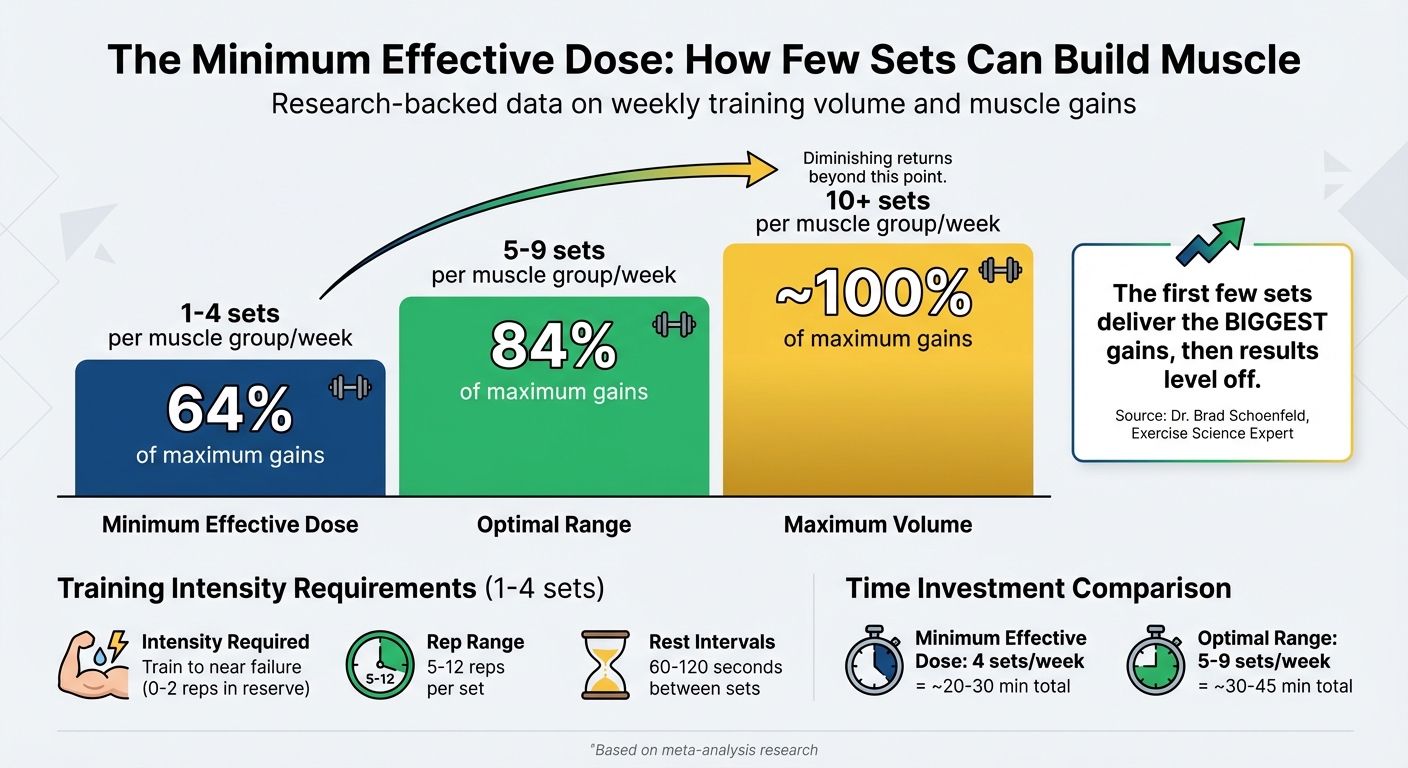
Minimum Effective Dose for Muscle Growth: Sets vs Gains
The Minimum Effective Dose Concept
The Minimum Effective Dose (MED) refers to the smallest amount of training needed to spark muscle growth. For building muscle (hypertrophy), this threshold is roughly four sets per muscle group per week. It’s all about finding the sweet spot where you stimulate growth without overdoing it.
Research shows that doing just 1–4 sets per muscle group each week can deliver about 64% of the maximum possible muscle gains. If you bump that up to 5–9 sets, you can achieve around 84% of maximum gains. The gains from the first few sets are the most impactful, while the benefits taper off as you add more volume. Dr. Brad Schoenfeld, a leading expert in exercise science, puts it this way:
You see the biggest increase in the first few sets, and then you see it leveling off.
When you’re working with fewer sets, intensity becomes crucial. To maximize muscle recruitment and growth, you need to push your sets close to failure – leaving only 0–2 reps in reserve.
These principles lay the groundwork for building short, effective workouts that deliver results.
Training Variables That Matter Most
To make shorter workouts effective for muscle growth, focus on four key variables: intensity of effort, volume, frequency, and rest intervals. When time is tight, dialing up intensity is non-negotiable.
Intensity of effort is the most critical factor. Exercise scientist James Steele emphasizes this point:
Effort is probably the more important determinant… It should feel like it’s hard work to actually try and move that weight.
In other words, your workouts should feel challenging and push your muscles to their limits.
For volume, aim for about 4 sets per muscle group each week as a starting point. Stick to the 5–12 rep range for most exercises, as this range helps you gauge how close you are to failure better than very high-rep sets. When it comes to frequency, it’s less about how often you train and more about hitting your total weekly volume.
Keep rest intervals between 60 and 120 seconds. This allows for efficient recovery while keeping your workouts moving.
By focusing on these variables, you can see why shorter, focused sessions can still pack a punch.
Research on Shorter Workout Sessions
Studies back up the idea that you don’t need hours in the gym to see results. One study involving nearly 15,000 participants doing just 20 minutes of machine-based exercises weekly showed 30%–50% strength gains in the first year.
More recently, a 2025 study led by Dr. Luke Pryor (University at Buffalo) and Dr. Brad Schoenfeld (Lehman College) looked at 42 adults performing nine full-body exercises twice a week for eight weeks. Each 30-minute session included one set of 8–10 reps per exercise. The results? Both the group that trained to total fatigue and the group that stopped short saw similar, significant gains in muscle mass and strength.
The message is simple: the quality of your workouts matters more than how long you spend in the gym. Research consistently shows that short, focused sessions can deliver impressive muscle and strength gains. Plus, once you’ve built muscle, maintaining it is surprisingly low-effort – you can hold onto your gains for up to eight months with just 1/9th of your original training volume.
This evidence highlights how effective and time-efficient training can fit seamlessly into a busy lifestyle.
Workout Strategies That Save Time
High-Intensity Resistance Training (HIRT)
High-Intensity Resistance Training (HIRT) is all about pushing yourself to near-maximal effort during strength exercises, but with carefully planned rest breaks in between. Unlike HIIT, which focuses on cardio, HIRT uses resistance-based movements – think weights, resistance bands, or even your own bodyweight – to build strength and muscle.
What makes HIRT stand out? It skips the endless sets and focuses on fewer, high-quality efforts. This means you can knock out a workout in just 20–40 minutes and still see serious results. As Jeremy Fox, CNC and CPT, puts it:
HIRT is high-intensity and low-volume.
You’ll work harder, not longer, but the payoff is worth it. HIRT also triggers the "afterburn effect" (excess post-exercise oxygen consumption), which keeps your metabolism revved up and burning calories long after your workout ends. To get the most out of HIRT, aim for a work-to-rest ratio that pushes both your strength and metabolic limits. Plan for 2–3 full-body HIRT sessions each week, with at least 48 hours of recovery between them. As Vijay Daryanani from the Spaulding Rehabilitation Network explains:
The key is that you have to put in the necessary effort. You have to crush it during that time.
To make HIRT even more efficient, include compound movements that engage multiple muscle groups at once.
Compound Movements for Efficiency
Compound exercises are a time-saver’s dream. They target multiple major muscle groups in one go, making them perfect for building strength and saving time. Key examples include squats, deadlifts, and bench presses – these are your go-to moves for total-body strength.
For lower-body strength, focus on exercises like barbell or goblet squats, Romanian deadlifts, and lunges. For upper-body pushing movements, prioritize the bench press, push press, and dips. And for pulling exercises, think pull-ups, lat pulldowns, and seated cable rows.
Want to save even more time? Combine exercises into one fluid motion. For example, pair a squat with an overhead press or a Romanian deadlift with a bent-over row. Another smart technique is antagonist supersets – pairing exercises that target opposing muscle groups, like bench presses and rows, with minimal rest between sets. This approach cuts down workout time without compromising results.
Since HIRT focuses on lower-volume training, every set counts. Push each set close to failure to maximize muscle engagement. You can also use drop sets to extend the intensity: after reaching failure, lower the weight by about 20% and keep going for extra reps.
Sample Weekly Training Schedules
Here are some sample schedules to help you integrate these efficient strategies into your routine. Full-body workouts are especially effective for hitting all muscle groups in a limited amount of time.
Option 1: Two-Day Full-Body Split
Work out on Monday and Thursday. Each session lasts 30–40 minutes and includes one squat, one press, and one pull exercise, with 1–2 sets taken to failure. This plan ensures 48–72 hours of recovery between sessions.
Option 2: Three-Day Push-Pull-Legs Split
Break your week into three focused sessions:
- Monday: Upper body push (bench press, shoulder press, dips)
- Wednesday: Upper body pull (lat pulldowns, rows, barbell curls)
- Friday: Lower body (squats, Romanian deadlifts, calf raises)
Each session can be wrapped up in 20–30 minutes.
Option 3: Circuit Training for Maximum Efficiency
Perform 8–10 compound exercises back-to-back with minimal rest. This method combines strength and cardio in a single 30-minute session. It’s perfect for those days when you’re short on time but still want a full-body workout.
The most important part? Stick to the plan. Find a schedule that works for you, give it your all, and trust the process to deliver results.
Macro-Based Nutrition for Muscle Growth
How Macronutrients Support Muscle Gain
Your workouts lay the groundwork for building muscle, but nutrition is what makes it happen. Each macronutrient plays a specific role in fueling muscle growth. Protein provides the amino acids your body needs to repair the microtears caused by training and to drive muscle protein synthesis. Without enough protein, your body can’t build muscle effectively and may even start breaking it down.
Carbs are your go-to energy source, breaking down into glucose to power intense workouts. They also help replenish muscle glycogen after exercise, speeding up recovery. Fats, on the other hand, are key for hormone production – like testosterone, which signals your body to build muscle – and they help absorb fat-soluble vitamins that keep your metabolism humming.
To see results, aim for 0.7–1.0 grams of protein per pound of body weight daily. Carbs should make up about 45–50% of your total calories, with fats accounting for 20–25%. You’ll also need to eat in a caloric surplus – 250–500 calories above your Total Daily Energy Expenditure (TDEE) – to give your body the extra energy it needs to build new muscle tissue. As Dezi Abeyta, R.D., Men’s Health Nutrition Advisor, puts it:
Protein is the main macronutrient your body uses to create more muscle. Without it, not only does new growth stunt, but formed muscle will start to diminish.
Pairing this nutrition strategy with efficient workouts is a powerful way to maximize muscle growth.
Adjusting Macros to Your Schedule
Your specific macro needs depend on how active you are. Start by calculating your TDEE: figure out your Basal Metabolic Rate (BMR), then multiply it by an activity factor – 1.2 for a sedentary lifestyle and up to 1.9 for very active schedules. From there, add your caloric surplus.
For those with packed schedules, a simple formula works well: set protein at 0.8g per pound of body weight, fats at 0.35g per pound, and use the remaining calories for carbs to fuel your workouts. Spread your protein intake across 4–6 meals (around 30–50g per meal) to keep muscle protein synthesis steady throughout the day. This keeps your body in a muscle-building state without needing overly complex tracking.
Check your progress every two weeks using the "14-Day Rule." Track your 7-day weight averages, gym performance, and how you look in the mirror rather than obsessing over daily fluctuations. If your weight doesn’t budge for 2–3 weeks, increase your daily calories by 100–150. If you’re gaining more than 0.5% of your body weight per week, cut back by the same amount.
Quick Meal Planning for Busy People
Once your macros are set, meal planning becomes essential – especially on busy days. Stick to a straightforward formula: one lean protein, one complex carb, and two vegetables. This covers your macro needs while keeping things simple.
For protein, go for easy options like rotisserie chicken, canned tuna, Greek yogurt, or cottage cheese. Dedicate 2–3 hours once a week to meal prep. Roast proteins and vegetables in the oven while cooking grains like rice or quinoa on the stovetop. Store your cooked proteins in airtight containers for up to 3–4 days in the fridge or freeze portions for up to 3 months.
If you’re constantly on the move, grab-and-go options like Greek yogurt, hard-boiled eggs, jerky, protein shakes, or string cheese can help you hit your protein goals during busy days. For optimal performance, eat a pre-workout meal 1–2 hours before training, with a mix of carbs and protein, and follow up with another meal within 2 hours after your workout to replenish glycogen and aid recovery.
Recovery and Lifestyle Tips to Maximize Results
Sleep and Stress Management
Sleep is the cornerstone of muscle recovery and growth. During the deepest stages of sleep, your body releases most of its daily growth hormone, which repairs muscle tissue and replenishes glycogen stores. To support this process, aim for 7–9 hours of quality sleep each night. This also helps stabilize testosterone levels and keeps cortisol – a hormone that can break down muscle – in check. Chris Ryan, a fitness coach, explains the importance of sleep vividly:
If you’re consistently running on five or six hours of sleep… you’re hitting the stimulus, but skipping the adaptation – like downloading a file and closing your laptop at 63 percent.
To enhance sleep quality, turn off screens at least 60 minutes before bed to prevent melatonin suppression. Keep your bedroom cool – around 65°F – and consider a small portion of slow-digesting carbs, like oats, 60–90 minutes before bedtime to manage nighttime cortisol spikes. Stress management is just as crucial. High cortisol levels from daily pressures can hinder muscle growth, but simple practices like deep breathing or short 10-minute walks can help reset your nervous system, creating an environment for recovery and growth. Combine quality sleep with light recovery exercises for the best results.
Simple Recovery Practices
Small recovery habits can make a big difference. A quick 10-minute walk can reduce cortisol levels and improve blood flow. Spending 5–10 minutes on mobility exercises or foam rolling helps maintain joint health and eases stiffness. Staying hydrated is equally important – drink enough water to keep your urine a pale yellow, supporting nutrient delivery and muscle repair.
Supplements like magnesium glycinate can also aid in muscle relaxation and promote deeper sleep when taken in the evening. Over time, these small efforts add up, improving how you feel and perform both in and out of the gym.
Adjusting Training During Busy Periods
When life gets hectic, it’s better to adapt your training than to stop altogether. Research shows that performing just 3–6 sets per major lift each week is enough to maintain your gains. Even after 2–3 months of reduced training, strength loss is usually limited to about 10%. On particularly stressful or sleep-deprived days, adjust your weights based on how you feel rather than sticking to rigid plans.
To save time, limit your main lifts to 20 minutes and fit in a quick 15-minute bodyweight circuit when needed. As exercise scientist Pak Androulakis-Korakakis, Ph.D., advises:
The number one hurdle to get over when you’re in a busy season is accepting that something is better than nothing, even if you’re only doing the minimum effective training dose.
Key Takeaways for Building Muscle on a Busy Schedule
Building muscle when you’re short on time boils down to three main principles: smart training, efficient nutrition, and strategic recovery. Start by focusing on compound exercises like squats, deadlifts, and presses. These movements target multiple muscle groups at once, making your workouts more effective. To get the most out of your sessions, train close to failure with 1–2 reps left in the tank. Surprisingly, even a minimal training volume – just 1–4 sets per muscle group per week – can yield about 64% of the maximum gains, meaning you don’t need to spend hours in the gym to see results.
When it comes to nutrition, simplicity is key. Aim for 1.6–2.2 g/kg (0.7–1.0 g/lb) of protein daily to support muscle growth. To save time, create a "Core Four" meal rotation by picking two go-to options for breakfast, lunch, and dinner. Stock up on high-protein staples like rotisserie chicken, Greek yogurt, and whey protein isolate to ensure you hit your macros without spending hours in the kitchen. As Kate Holliday from 3V Training wisely says:
You wouldn’t wing a board meeting – why wing your health?
Recovery is just as important as training and nutrition. Make sure you’re getting quality sleep and managing stress effectively, as muscle repair and growth primarily happen during rest. Without proper recovery, even the best workout routine can fall short.
By combining smart training, streamlined nutrition, and intentional recovery, you can make serious progress – even with limited time. For those looking to eliminate the guesswork, N The Mix Nutrition offers personalized coaching, including custom macro-based nutrition plans, tailored workout programs, and bundled options with weekly check-ins for expert support.
In just 30–60 minutes of lifting per week, you can achieve noticeable muscle growth by focusing on compound exercises, eating enough protein, and prioritizing recovery. It’s not about being perfect – it’s about staying consistent and making the most of your time, even when life gets hectic.
FAQs
How do I know I’m training close enough to failure?
When you train close to failure, you’re pushing yourself to the point where completing another rep with proper form becomes impossible. The goal is to approach muscular fatigue without necessarily hitting complete failure every time. To make the most of your workouts, techniques like supersets and drop sets can ramp up intensity while saving time. This method promotes effective muscle growth while helping to prevent overtraining – perfect for when you’re working with a tight schedule.
What’s the fastest full-body workout I can do in 20–30 minutes?
A fast and efficient way to work your entire body in just 20–30 minutes is through a high-intensity workout that blends resistance exercises with circuit training. For example, you could try a 20-minute HIIT session featuring moves like jump squats, push-ups, and burpees. Alternatively, a 30-minute circuit workout with minimal rest between exercises can deliver similar results. Both approaches help build muscle, boost conditioning, and fit perfectly into a packed schedule.
How can I build muscle without gaining too much fat?
To build muscle while keeping fat gain in check, aim for a small calorie surplus – just enough to fuel muscle growth without overdoing it. Include 1.6–2.2 grams of protein per kilogram of body weight in your daily diet, and spread that protein across meals to maximize muscle synthesis.
Focus on progressive strength training, gradually increasing the weight or intensity of your workouts. Prioritize compound exercises like squats, deadlifts, and bench presses, as they target multiple muscle groups and promote efficient growth.
Track your progress by monitoring your strength levels, taking waist measurements, or using progress photos. This approach helps you fine-tune your routine for muscle growth while minimizing fat gain.