'N The Mix Nutrition & Coaching

Macros (protein, carbs, and fats) are key to losing fat while keeping muscle. Here’s how to calculate them:
- Find Your Maintenance Calories (TDEE): Use the Harris-Benedict formula to calculate your Basal Metabolic Rate (BMR) and multiply it by an activity factor (e.g., 1.55 for moderate exercise).
Example: A 35-year-old woman, 165 lbs, 5’6", moderately active, has a TDEE of ~2,356 calories. - Set a Calorie Deficit: Subtract 300–500 calories (or 20% of TDEE) for steady fat loss.
Example: With a TDEE of 2,356, aim for ~1,885 calories daily. - Calculate Protein Needs: Eat 0.8–1.2g per pound of body weight (or goal weight if overweight).
Example: At 165 lbs, aim for 132–198g protein/day. - Distribute Remaining Calories: After protein, split calories between carbs (40–50%) and fats (20–30%), adjusting based on activity.
Example: For 1,885 calories, ~720 calories (180g) for carbs, ~540 calories (135g) for protein, and ~540 calories (60g) for fats. - Track and Adjust: Use apps like MyFitnessPal to monitor intake. Weigh yourself weekly and tweak calories if progress stalls.
This method ensures fat loss while maintaining muscle and energy levels. Stick to your plan, track progress, and adjust as needed.
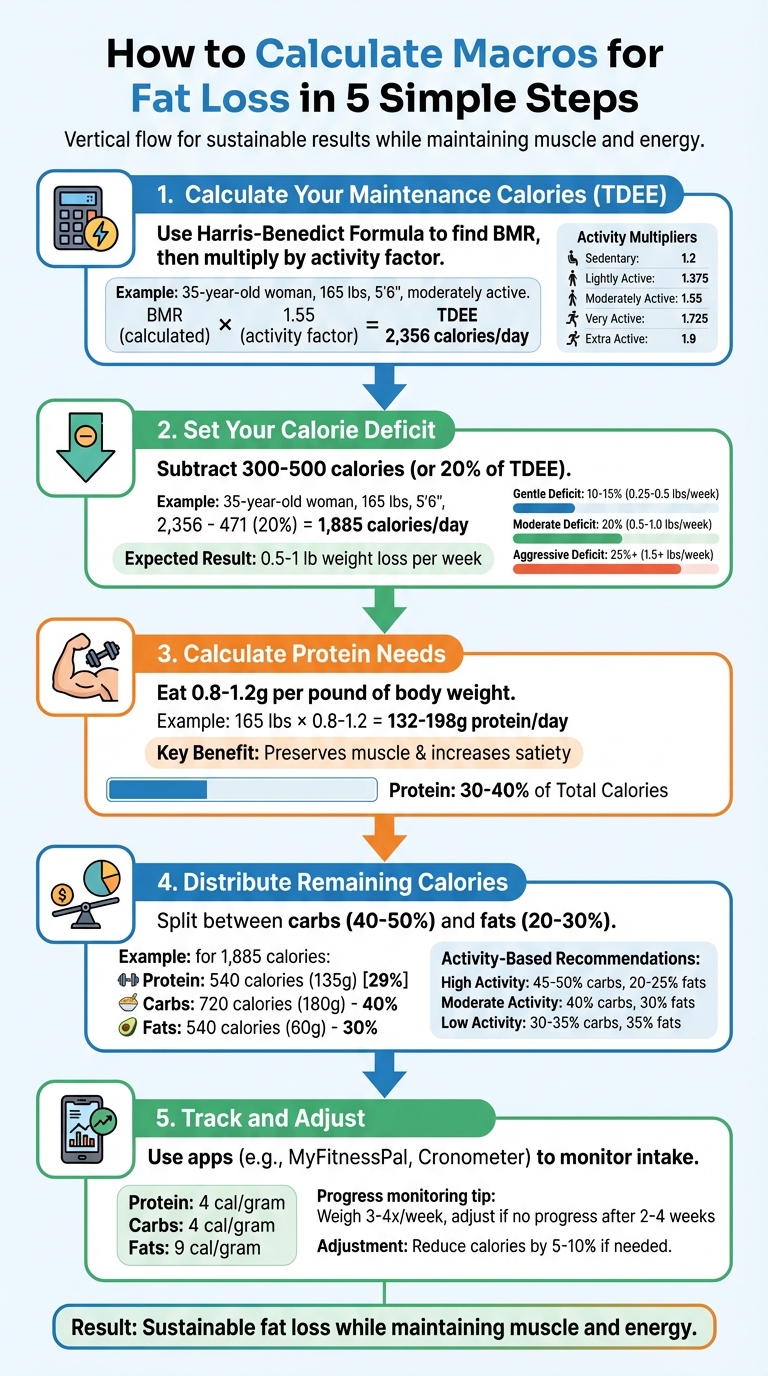
5-Step Macro Calculation Guide for Fat Loss
How to Calculate Macros – Fat Loss and Muscle Gain
sbb-itb-29cdcd8
Step 1: Calculate Your Maintenance Calories
To kick things off, you’ll need to figure out your maintenance calories – essentially, the amount of energy your body uses daily. This is also called your Total Daily Energy Expenditure (TDEE). As TDEE Calculator Online puts it, "Think of it as your body’s budgetary baseline". This number is a critical starting point for achieving sustainable fat loss.
Using the Harris-Benedict Formula
The first step in determining your TDEE is calculating your Basal Metabolic Rate (BMR). This is the number of calories your body needs to perform basic functions like breathing and circulating blood, even if you were resting all day. One of the most common methods for estimating BMR is the Harris-Benedict Formula.
Here’s the updated equation:
For men:
BMR = 88.362 + (13.397 × weight in kg) + (4.799 × height in cm) – (5.677 × age)
For women:
BMR = 447.593 + (9.247 × weight in kg) + (3.098 × height in cm) – (4.330 × age)
For example, let’s take a 35-year-old woman who weighs 165 lbs (75 kg) and is 5’6" (168 cm) tall. Her BMR would be approximately 1,520 calories. This is the energy her body burns at rest. But since daily life involves more than just lying around, the next step is to account for her activity level.
Finding Your TDEE with Activity Multipliers
Once you have your BMR, multiply it by an activity factor that matches your daily movement and exercise habits. This step gives you your TDEE, which represents the number of calories you need to maintain your current weight.
| Activity Level | Multiplier | Description |
|---|---|---|
| Sedentary | 1.2 | Desk job; little to no exercise |
| Lightly Active | 1.375 | 1–3 hours of light exercise per week |
| Moderately Active | 1.55 | 3–5 days of moderate exercise per week |
| Very Active | 1.725 | 6–7 days of hard exercise or a physical job |
| Extra Active | 1.9 | Athlete-level activity or training twice daily |
Let’s revisit the example of the 35-year-old woman. If she works a desk job but exercises four times a week, she would fall under the "Moderately Active" category. Her TDEE would then be:
1,520 × 1.55 = 2,356 calories per day. This is the amount she can eat to maintain her weight.
It’s important to assess your activity level accurately to avoid overestimating your calorie needs, which is a common reason people fail to see results despite eating healthy. For instance, if you spend most of your day sitting and only work out 3–4 times a week, you’re likely in the "Lightly Active" or "Moderately Active" range, not "Very Active". Starting with a conservative multiplier is a good way to avoid miscalculations.
Your TDEE serves as a baseline, but it’s not set in stone. Test it over 10–14 days by monitoring your weight. If your weight stays steady, you’ve likely found your true maintenance level. If it goes up, try reducing your calorie estimate by 100–200. If it drops, consider adding 100–200 calories. Getting this number right is crucial for setting a safe and effective calorie deficit in the next step.
With your TDEE established, you’re ready to move on to Step 2 and create your calorie deficit.
Step 2: Set Your Calorie Deficit
To lose fat, you need to create a calorie deficit – this means eating fewer calories than your body burns. This forces your body to tap into stored fat for energy. But the deficit has to be carefully managed to avoid side effects like hunger, fatigue, or muscle loss.
Choosing a Deficit Range
For most people, a moderate calorie deficit of 300–500 calories per day works well. This typically amounts to about 20% below your Total Daily Energy Expenditure (TDEE) and translates to a fat loss of roughly 0.5–1 pound per week.
Take the example from Step 1: a 35-year-old woman with a TDEE of 2,356 calories. Reducing her intake by 20% would set her daily calories at about 1,885, which promotes steady fat loss without leaving her feeling drained or overly hungry.
"A moderate, sustainable deficit of around 300-500 calories per day is the sweet spot for most people. It’s enough to trigger steady fat loss without causing ravenous hunger or sacrificing hard-earned muscle." – Zing Coach
If you’re already lean, under high stress, or focused on maintaining performance, a smaller deficit of 10–15% (200–300 calories) is a better starting point. On the flip side, more aggressive deficits – 25% or higher – can be effective for short periods (4–6 weeks), but they come with risks like slower metabolism, irritability, and binge eating. Overdoing it can lower your metabolic rate by 15–20%, making it harder to sustain your results long-term.
| Deficit Level | Calorie Reduction | Estimated Weight Loss | Best For |
|---|---|---|---|
| Gentle | 200–300 kcal (10–15%) | 0.25–0.5 lbs/week | Lean individuals, high-stress lifestyles, performance goals |
| Moderate | 300–500 kcal (20%) | 0.5–1.0 lbs/week | Most people; balances speed and adherence |
| Aggressive | 700+ kcal (25%+) | 1.5+ lbs/week | Short "sprints" only; those with significant fat to lose |
Once you’ve determined your target calorie reduction, the next step is to protect your muscle mass while shedding fat.
Balancing Fat Loss and Muscle Retention
A moderate calorie deficit is key to losing fat while keeping your muscle intact. Why does this matter? Because muscle burns calories even when you’re at rest. If you lose muscle during your diet, your metabolism slows down, making it harder to maintain your progress.
By sticking to a moderate deficit, you give your body enough energy to preserve muscle while still burning fat. To maximize this effect, pair your calorie deficit with adequate protein intake (covered in Step 3). If you notice a drop in energy, strength, or sleep quality, bump up your calories by 100–200 and reassess after a week.
The goal isn’t just to lose weight – it’s to lose fat while holding onto the muscle that keeps your metabolism running smoothly. A moderate deficit helps you achieve this balance without turning your diet into a punishing experience.
Next, learn how to calculate your protein needs to protect muscle and fuel your fat loss journey.
Step 3: Calculate Your Protein Needs
Now that you’ve set your calorie target, it’s time to figure out your protein intake. Getting this part right is crucial when you’re in a calorie deficit. Why? Because without enough protein, your body might break down muscle tissue for energy. Protein provides the amino acids your body needs to repair and maintain muscle.
Protein Intake Recommendations
To preserve muscle while losing fat, aim for 0.8 to 1.2 grams of protein per pound of body weight. If you’re carrying extra weight – over 20% body fat for men or 28% for women – use your goal body weight instead of your current weight. This helps avoid consuming more protein than necessary.
Here’s an example: If you weigh 180 pounds, your daily protein target would be between 144 and 216 grams. On the other hand, if you’re very lean (under 8% body fat for men or 16% for women), you may need to increase your intake to 1.2 to 1.5 grams per pound to protect your muscle mass.
"Protein intake should be 0.8-1.2 grams of protein per pound of body weight, or goal body weight if you’re over about 20% body fat for men, and 28% for women."
– Mike Gettier, Founder, GettFit
Another way to calculate is by using protein as a percentage of your daily calories. Aim for 30% to 40% of your total intake. For instance, if you’re consuming 1,885 calories per day, 30% would equal 566 calories from protein. Since protein has 4 calories per gram, that works out to about 142 grams of protein daily.
| Body Weight (lbs) | Protein Target (0.8g/lb) | Protein Target (1.0g/lb) | Protein Target (1.2g/lb) |
|---|---|---|---|
| 130 lbs | 104g | 130g | 156g |
| 150 lbs | 120g | 150g | 180g |
| 180 lbs | 144g | 180g | 216g |
| 200 lbs | 160g | 200g | 240g |
Benefits of High Protein Intake
Protein isn’t just about muscle – it’s also the most filling macronutrient. It keeps you satisfied longer, which can help curb cravings when you’re eating fewer calories. Plus, protein has a higher thermic effect compared to carbs or fats, meaning your body burns more energy digesting it. While this boost isn’t massive, it adds up over time. Maintaining muscle through high protein intake also helps prevent the dip in metabolism that often comes with dieting.
"Protein is so important when it comes to fat loss for 3 main reasons: it helps you stay full, it helps you preserve muscle, and it ‘costs’ more to digest."
– Jonathan Fletcher, Coach, Digital Barbell
If you’re lifting weights or doing high-intensity training, protein becomes even more critical. It supports recovery and helps you maintain strength. Research shows that diets prioritizing protein can help retain 20% to 30% more lean mass compared to those that only focus on calorie reduction.
With your protein intake sorted, you can now decide how to split up the rest of your calories between carbs and fats.
Step 4: Distribute Remaining Calories to Carbs and Fats
Once you’ve set your protein intake, the remaining calories can be divided between carbohydrates and fats. These two macronutrients have an inverse relationship – if you increase one, the other must decrease to stay within your calorie target. There’s no one-size-fits-all ratio. Your activity level, preferences, and daily energy needs should guide your choices.
Setting Carbohydrate Intake
Carbs are your body’s primary energy source, especially for workouts. They also help protect muscle during calorie deficits. If you’re lifting weights or doing high-intensity exercise regularly, consider assigning 40% to 50% of your remaining calories to carbs. This ensures you have enough energy to perform well during training. For example, if you’re eating 2,000 calories a day and 600 calories come from protein (150 grams), you have 1,400 calories left. Allocating 50% of those calories to carbs gives you 700 calories. Since carbs have 4 calories per gram, that totals 175 grams of carbs per day.
For those with lower activity levels, a 30% to 35% allocation for carbs might be more appropriate. Adjust your intake based on how active you are. Intense training benefits from the protein-sparing effect of carbs, where your body uses glucose for energy instead of breaking down muscle tissue.
Once you’ve determined your carbohydrate needs, the next step is to allocate the remaining calories to fats.
Setting Fat Intake
After assigning calories to carbs, use the rest for dietary fats. Fats are often underestimated but are critical for hormone production – like testosterone – and for absorbing key vitamins such as A, D, E, and K. Aim for 20% to 30% of your total daily calories to come from fats, but don’t go below 20% to maintain hormonal health.
Using the same 2,000-calorie example, if 25% of the remaining 1,400 calories go to fats, that equals 350 calories. Since fats provide 9 calories per gram, this works out to about 39 grams of fat per day.
If you find yourself struggling with hunger during a calorie deficit, increasing your fat intake might help you feel fuller and stick to your plan. A higher fat percentage can also support energy levels if your training intensity is low. Start with a balanced split – like 40% carbs and 30% fats – and test it for two to four weeks. Adjust by 5% to 10% based on how you feel and perform. As long as your calorie and protein targets remain consistent, the exact carb-to-fat ratio won’t have a massive impact on fat loss. The key is finding a balance that works for you long-term.
| Activity Level | Carb % (of remaining) | Fat % (of remaining) | Primary Benefit |
|---|---|---|---|
| High (Lifting/Sports) | 45–50% | 20–25% | Performance & Muscle Retention |
| Moderate (General Fitness) | 40% | 30% | Balanced Energy & Satiety |
| Low (Sedentary) | 30–35% | 35% | Satiety & Hormonal Support |
Step 5: Convert Macros to Grams and Track Progress
Converting Calories to Grams
Breaking down your calorie targets into grams makes tracking easier. The math is simple: protein and carbohydrates each provide 4 calories per gram, while fats provide 9 calories per gram. To calculate, divide the calories assigned to each macronutrient by its respective calorie-per-gram value.
Here’s an example for an 1,800-calorie diet with a 40% carbohydrates, 30% protein, and 30% fat split:
- Carbohydrates: 1,800 × 0.40 = 720 calories; 720 ÷ 4 = 180 grams
- Protein: 1,800 × 0.30 = 540 calories; 540 ÷ 4 = 135 grams
- Fats: 1,800 × 0.30 = 540 calories; 540 ÷ 9 = 60 grams
| Macronutrient | Calories per Gram | Conversion Formula |
|---|---|---|
| Protein | 4 | (Total Calories × % Protein) ÷ 4 |
| Carbohydrates | 4 | (Total Calories × % Carbs) ÷ 4 |
| Fats | 9 | (Total Calories × % Fat) ÷ 9 |
Once you’ve calculated your targets in grams, you’ll have a clear blueprint for tracking your intake.
Using Tools to Track Macros
With your gram targets set, tracking your food becomes much more manageable. A digital food scale is key for precise portion measurements. To simplify the process, consider using popular apps like MyFitnessPal, Cronometer, or Lose It!. These tools make logging meals straightforward. Newer AI-powered tools, like Taia or ChatGPT Health, even offer features like photo or voice-based logging, cutting down on manual entry.
"Counting macros is a way to track food intake using grams of protein, carbs, and fats (macronutrients) instead of calories."
- Brian St. Pierre, MS, RD, Precision Nutrition
For progress tracking, weigh yourself 3–4 times a week and calculate a weekly average. If your weight isn’t dropping by 0.5% to 1% of your body weight per week after two to four weeks, consider reducing your daily calorie intake by 5% to 10%. Pay attention to how your body feels – monitor energy levels, sleep quality, hunger, and workout performance. If you’re constantly tired or overly hungry, your calorie deficit might be too aggressive. In that case, adjust your carbohydrate or fat intake by 5% to 10% and observe changes over the next two weeks.
Tracking macros can improve diet adherence by about 40% and help preserve 20% to 30% more lean muscle during fat loss compared to focusing on calories alone. Consistently monitoring and fine-tuning your plan will help you stay aligned with your fat-loss goals.
Conclusion
Calculating macros for fat loss becomes manageable when broken into five clear steps. By learning to identify your maintenance calories, set a calorie deficit, focus on protein intake, balance carbs and fats, and translate everything into measurable grams, you set yourself up for success.
The real key to progress lies in consistency and patience. Stick to your macro plan for 2–4 weeks without making changes, giving your body time to adjust. Remember, daily weight fluctuations are completely normal. If fat loss slows down after this period, try reducing your daily intake by about 100 calories and evaluate again after two more weeks. Small, data-driven adjustments are far more effective than drastic changes.
This steady approach not only helps maintain muscle but also supports better overall performance.
"Macro counting… shifts the focus from restriction to balance."
- Jodi Yerta, Lead Coach at N The Mix Nutrition & Coaching
Don’t just rely on the scale to gauge progress. Track your energy levels, sleep, hunger, and workout performance. If you find yourself constantly fatigued or losing strength in the gym, your calorie deficit might be too steep. To keep things on track, plan a maintenance break every 8–12 weeks, lasting 1–2 weeks. This helps reset hormones and prevents metabolic adaptation. Keeping an eye on these factors ensures you’re building a sustainable path to fat-loss success.
FAQs
What if my TDEE estimate seems wrong?
TDEE calculations provide an estimate, but they might not always hit the mark because of individual variables like BMR (Basal Metabolic Rate), NEAT (Non-Exercise Activity Thermogenesis), exercise levels, and TEF (Thermic Effect of Food). If your estimate seems off, try tracking your calorie intake alongside your weight changes over a few weeks. Use this data to fine-tune your TDEE, making it more aligned with your specific goals. Regularly reviewing and adjusting ensures your calorie deficit or surplus effectively supports your fat-loss plan.
How do I set macros if I’m not trying to lose weight fast?
If you’re aiming for steady and lasting fat loss, start by determining your maintenance calories – the number of calories your body needs to maintain its current weight. This calculation should factor in your activity level and personal stats like age, weight, and height. Once you have that number, set your macros (protein, carbs, and fats) slightly below maintenance calories.
This method helps you avoid extreme calorie cuts, which can harm your metabolism and make it harder to stick with your plan. Instead, it supports a balanced, sustainable approach to reaching your goals while prioritizing your overall health.
Should I adjust carbs or fats first if I feel tired or hungry?
If you’re feeling tired or hungry, tweaking your carbohydrate intake is often a good place to start. Adding more carbs earlier in the day can help stabilize your energy levels and support your body’s ability to adapt to different energy demands. On the other hand, keeping carb portions smaller later in the day might help curb hunger. The key is ensuring your overall carb intake aligns with your energy needs to keep things balanced.