
If you’re deciding between fat loss and muscle gain, the best approach depends on your body composition, fitness level, and lifestyle. Here’s the quick answer:
- Start with fat loss if:
- Men: Body fat is over 20%
- Women: Body fat is over 30%
- Health issues like insulin resistance or joint strain are a concern.
- Focus on muscle gain if:
- Men: Body fat is under 15%
- Women: Body fat is under 25%
- You’re already lean but want to improve tone and metabolism.
Key points:
- Fat loss works with a calorie deficit and preserves muscle through high protein intake and resistance training.
- Muscle gain requires a calorie surplus, progressive overload, and balanced macronutrients.
- Beginners and those returning to training can sometimes achieve both goals (body recomposition).
Quick Comparison
| Goal | Calorie Target | Weekly Weight Change | Protein Intake | Best For |
|---|---|---|---|---|
| Fat Loss | 200–500 deficit | Lose 0.5–1% body weight | 0.8–1g per lb | Higher body fat, improving health |
| Muscle Gain | 100–200 surplus | Gain 0.25–0.5% body weight | 0.8–1g per lb | Lean individuals, building strength |
Pick one goal, stick with it for 12–16 weeks, and adjust based on progress. Trying to do both simultaneously often leads to minimal results unless you’re new to training.
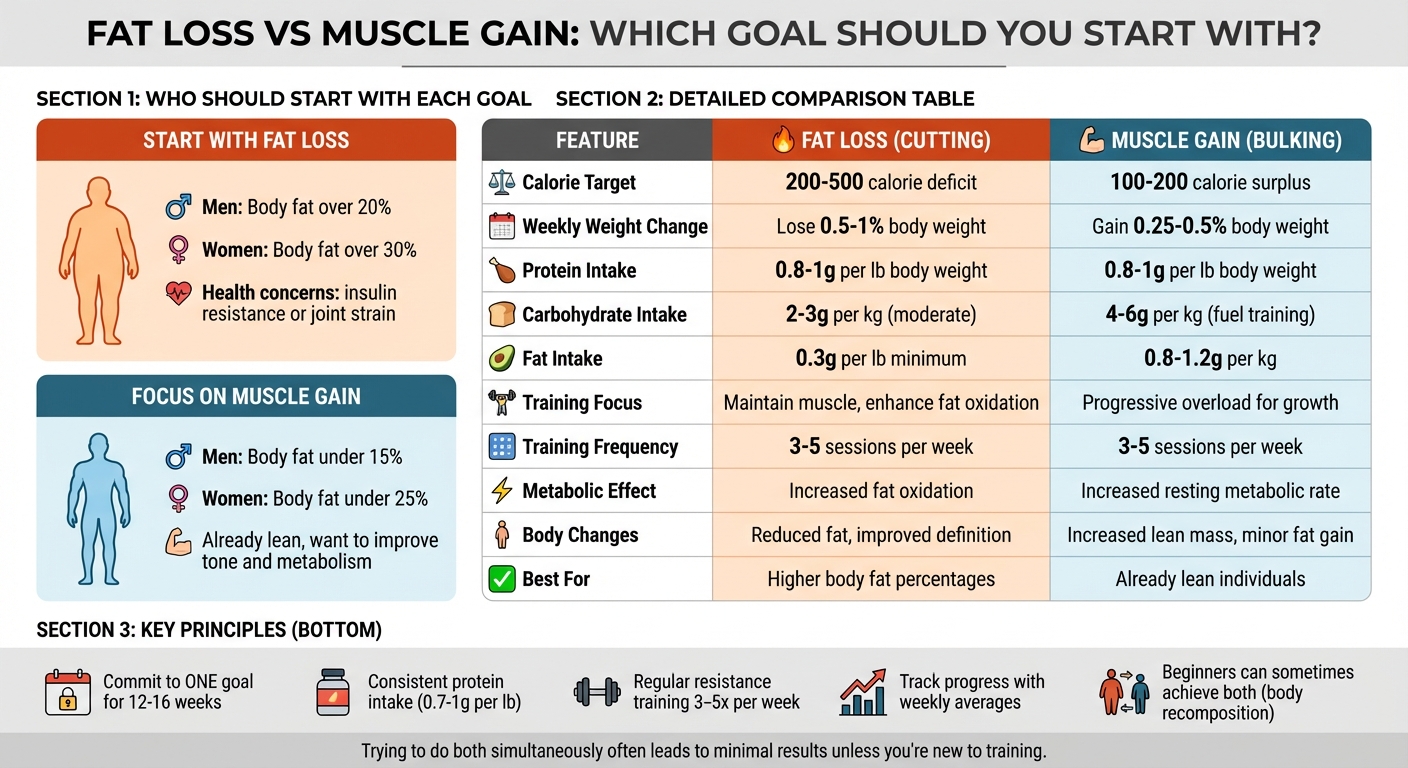
Fat Loss vs Muscle Gain: Complete Comparison Guide
Should You Lose Weight Or Bulk First? | GET RIPPED BY SUMMER!
Evaluating Your Starting Point
Before diving into your fitness journey, it’s essential to assess where you’re starting from. Your body composition, training history, and lifestyle all play a role in determining the best approach for your goals – whether that’s shedding fat, building muscle, or a combination of both.
Measuring Body Fat Percentage
Understanding your body fat percentage is a great way to figure out your starting point. For men with over 20% body fat or women with over 30%, focusing on fat loss first can improve health and insulin sensitivity. On the other hand, men below 15% or women below 25% body fat are in a good position to shift their focus to muscle building.
There are several ways to measure body fat, each with its own level of accuracy and cost:
- DEXA scans: Known as the most accurate method, with an error margin of ±1–2%. These scans typically cost $40–$150.
- Navy Tape Method: This free method involves measuring your waist, neck, and height. When done correctly, it’s accurate within ±3–4%.
- BIA scales: Convenient but less reliable, these scales can have error rates of ±5–8% depending on factors like hydration.
"The trend is more important than any single measurement. Pick one method, use it consistently, and track your progress over time." – BodyFatPercentageCalc
Regardless of the method you choose, consistency is key. Measure under the same conditions every time – first thing in the morning, on an empty stomach, and after using the restroom. For DEXA scans, every 3–6 months is sufficient, while home methods like tape measures or calipers can be done every 2–4 weeks to monitor trends without fixating on daily changes.
Your Fitness Level and Training Experience
Your training background plays a huge role in shaping your strategy. Beginners often experience "newbie gains," where they can simultaneously build muscle and lose fat. This phase usually lasts 6–12 months, offering a unique opportunity for rapid progress.
For more experienced lifters, the approach changes. Those closer to their genetic potential typically see better results by focusing on one goal at a time – either bulking with a calorie surplus or cutting with a deficit. However, if you’re returning to training after a break, muscle memory can help you regain muscle while losing fat.
"Despite the common belief that building muscle and losing fat at the same time is only plausible in novice/obese individuals, the literature provided supports that trained individuals can also experience body recomposition." – Barakat et al., Researchers
Age is another important factor. After age 35, adults naturally lose 1–2% of muscle mass per year, with this rate increasing to 3% annually by age 60. If you’re in this age group, prioritizing muscle preservation or growth – even while losing fat – is crucial for maintaining strength and metabolic health.
Lifestyle Factors and Personal Preferences
Your daily habits and preferences are just as important as your fitness goals. Building muscle requires 3–5 resistance training sessions per week. If your schedule doesn’t allow for that, focusing on fat loss through dietary changes and increasing daily movement – like aiming for 10,000 steps – may be more practical.
Stress and sleep also play a big role. High stress raises cortisol levels, which can lead to fat storage and muscle breakdown. Similarly, getting less than 7 hours of sleep can disrupt hunger hormones and impair muscle recovery, making progress harder to achieve.
Your appetite and eating habits matter too. If eating enough to support muscle growth feels overwhelming, bulking might not be the right focus for now. On the flip side, if you have a big appetite, extreme calorie restriction during a fat-loss phase may be difficult to sustain.
"80% adherence to a solid plan beats 95% adherence to a perfect plan you can only maintain for 3 weeks." – Will Duru, Level 4 Qualified Personal Training Coach
Ultimately, the best approach is the one that fits your lifestyle. Consistency beats perfection every time. Focus on what works for you right now, not what sounds ideal on paper.
How Fat Loss and Muscle Gain Work
Once you’ve assessed your starting point, understanding how fat loss and muscle gain function can help you set clear, achievable goals.
The Science Behind Fat Loss
At its core, fat loss hinges on one principle: a caloric deficit. When your body burns more energy than you consume, it turns to stored fat for fuel. Since one pound of body fat equals roughly 3,500 calories, a daily deficit of 200–500 calories is a sustainable way to lose fat while preserving muscle. This approach typically results in losing 0.5–1% of your body weight per week. However, cutting more than 500 calories daily can backfire, leading to muscle loss and low energy levels.
"Energy deficits larger than 500kcal/day should be avoided by people who wish to simultaneously pursue muscle growth." – Murphy and Koehler
Protein intake is critical during fat loss. Consuming 0.8–1 gram of protein per pound of body weight (or 1.6–2.2 grams per kilogram) helps protect lean muscle mass. To maximize muscle protein synthesis, spread your protein intake across the day in 20–40 gram servings. Pairing this with resistance training sends a strong signal to your body to preserve muscle while in a calorie deficit.
During a deficit, insulin levels naturally drop between meals, prompting fat cells to release fatty acids for energy. This process, known as fat oxidation, is essential for reducing fat stores. If you’re carrying higher body fat – over 20% for men or 30% for women – focusing on fat loss can also boost insulin sensitivity, which may improve muscle-building efforts later on.
The Science Behind Muscle Gain
Building muscle requires a different strategy: a caloric surplus. To grow new muscle tissue, your body needs extra energy to fuel hypertrophy – the process of increasing muscle fiber size. Adding one pound of muscle takes about 2,000–2,500 calories, so gaining 0.5 pounds per week means consuming an additional 1,000 calories spread over the week.
A modest daily surplus of 100–200 calories (5–10% above maintenance) is ideal for building muscle while minimizing fat gain. As nutrition expert Natalie Rizzo, MS, RD, puts it:
"To gain as much muscle and minimize as much fat as possible, I’d suggest an extra 100 to 200 calories per day."
Progressive overload is essential. Gradually increasing the weight, reps, or sets in your resistance training provides the mechanical tension your muscles need to grow. Without this stimulus, even a calorie surplus won’t lead to significant muscle gain. Aim to train 3–5 times per week, focusing on compound movements for maximum efficiency.
Protein remains a key player during a surplus, supporting both repair and growth. Stick to 0.8–1 gram per pound of body weight. Carbohydrates are equally important, with 4–6 grams per kilogram of body weight recommended to fuel workouts and replenish glycogen stores. Don’t overlook dietary fats either – 0.8–1.2 grams per kilogram supports hormone production, including testosterone, which aids muscle growth.
Interestingly, beginners or those with higher body fat levels can sometimes achieve both fat loss and muscle gain simultaneously, a phenomenon called body recomposition. As Steve Kamb from Nerd Fitness explains:
"If you have fat stores… you do not need to be in a ‘caloric surplus’ to rebuild muscle. The calories stored in your fat cells act as this required energy."
Fat Loss vs Muscle Gain: Side-by-Side Comparison
The table below highlights the key differences between these two processes:
| Feature | Fat Loss (Cutting) | Muscle Gain (Bulking) |
|---|---|---|
| Calorie Requirement | 200–500 calorie deficit below maintenance | 100–200 calorie surplus above maintenance |
| Weekly Weight Change | Lose 0.5–1% of body weight | Gain 0.25–0.5% of body weight |
| Protein Intake | 0.8–1g per lb (to protect muscle) | 0.8–1g per lb (for tissue repair) |
| Carbohydrate Intake | 2–3g per kg (moderate restriction) | 4–6g per kg (to fuel training) |
| Primary Training Goal | Maintain muscle while enhancing fat oxidation | Progressive overload to stimulate growth |
| Metabolic Effect | Increased fat oxidation; potential BMR decrease if deficit is too steep | Increased resting metabolic rate from added muscle |
| Body Changes | Reduced body fat; improved muscle definition | Increased lean mass; minor fat gain possible |
| Best For | Those with higher body fat percentages | Those who are already lean or at maintenance |
This breakdown highlights the distinct energy and nutritional needs of each goal. While fat loss relies on using stored energy, muscle gain demands extra fuel to build new tissue. It’s worth noting that your body can’t fully optimize both processes at the same time – except in specific cases, like early training stages or returning after a break. Understanding these differences will help you set realistic goals and prioritize what works best for your current situation.
Deciding Which Goal to Prioritize
Now that you’ve got a handle on how fat loss and muscle gain work, it’s time to figure out which one should take center stage for you. Your starting point, overall health, and daily habits will guide this decision.
Body Composition and Health Status
Your body fat percentage is a key factor here. For men with over 20% body fat or women with over 30%, it’s wise to focus on fat loss first. This can help lower risks like insulin resistance, inflammation, and metabolic issues. Even shedding just 5% of your body weight can lead to noticeable health improvements. On the other hand, if your body fat is under 15% (for men) or 25% (for women) but you’re lacking muscle tone, building muscle may be the better route. It not only boosts your metabolism but also improves overall muscle definition.
For those with a normal BMI but a higher fat percentage and lower muscle mass (sometimes called “normal weight obesity”), building muscle can help improve your body composition. However, if your BMI is 30 or higher, fat loss should be the priority to reduce joint strain and improve heart health markers.
"It’s common to focus on weight loss at the expense of lean muscle. This is problematic because less muscle will lead to a reduction in basal metabolic rate, as well as strength, mobility, and tone."
From here, you’ll also want to factor in how age and hormones could play a role.
Age, Gender, and Hormones
Muscle loss becomes a challenge as you age. After 30, your metabolism slows, and strength declines due to a natural process called sarcopenia. For older adults, maintaining or building muscle is essential for staying mobile. Women over 40, especially those with a history of chronic dieting, might benefit more from focusing on muscle building to “reset” their metabolism. Research shows that around 30% of adults over 70 struggle with basic tasks like climbing stairs because they lack sufficient muscle mass. As personal trainer Julia Schaefer points out:
"Building muscle is perhaps one of the closest secrets we have to fighting off the aging process."
Diet also plays a big part. Eating enough dietary fat – around 0.8 to 1.2 grams per kilogram of body weight – can help support testosterone levels and maintain hormonal balance. If you’re older and relatively lean, muscle building is a smart move to preserve strength and mobility. On the flip side, if you’re carrying extra weight and dealing with metabolic challenges, fat loss should take priority.
Matching Your Goal to Your Lifestyle
Your day-to-day routine is the final piece of the puzzle. How much time you can dedicate to training, plus your ability to recover, will influence your choice. If you can’t commit to 3–5 resistance training sessions per week, focusing on fat loss through calorie control might be a better fit. Also, don’t underestimate the importance of sleep and stress management – chronic stress and poor rest can raise cortisol levels, which can interfere with muscle growth.
Whether you decide to build muscle to boost strength or lose fat to improve energy and overall health, stick to one goal for a few months before reevaluating your progress.
sbb-itb-29cdcd8
Getting Started: Action Steps
You’ve set your goal – now it’s all about making it happen. Whether you’re aiming for fat loss or building muscle, the key lies in fine-tuning your nutrition, organizing your workouts, and tracking progress in a meaningful way.
Setting Up Your Nutrition Plan
Start by calculating your Basal Metabolic Rate (BMR) using the Mifflin-St Jeor formula. For men, the formula is:
(10 × weight in kg) + (6.25 × height in cm) – (5 × age in years) + 5.
For women, subtract 161 instead of adding 5. Multiply your BMR by an activity factor (like 1.2 for sedentary lifestyles or 1.55 for moderate activity) to find your Total Daily Energy Expenditure (TDEE).
Adjust your TDEE to match your goal. For fat loss, create a calorie deficit of 20–25% (around 300–500 fewer calories per day). For muscle gain, add 5–10% (about 150–500 extra calories daily). A 2025 study published in the Journal of the International Society of Sports Nutrition revealed that macro-balanced diets resulted in 25% better fat retention compared to low-carb fad diets.
Next, set your macronutrient targets. Start with protein – aim for 0.7–1.2 grams per pound of body weight. For fats, stick to at least 0.3 grams per pound (or 20–30% of total calories) to support hormonal health. Use the remaining calories for carbohydrates to fuel your workouts. Strength coach Liam "Taku" Bauer puts it best:
"Calories determine how much your weight changes. Macronutrients determine what that change is made of."
Reassess your plan every two weeks using the 14-Day Rule. Check your 7-day weight average: if you’re not gaining at least 0.25% of your body weight weekly for muscle gain, add 100–150 calories. For fat loss, if progress stalls, reduce calories by 100–150.
Creating Your Training Program
Once your nutrition is in check, design a training plan to match your goal. Resistance training is essential – it helps maintain muscle during fat loss and stimulates growth when you’re building muscle. Aim for 3–5 sessions per week, ensuring each muscle group is trained at least twice.
For muscle gain, focus on compound exercises like squats, deadlifts, and presses. Gradually increase your weights, reps, or sets to achieve progressive overload. Aim for 10–20 working sets per muscle group each week.
If fat loss is your priority, resistance training remains crucial. Add 10–15 minutes of High-Intensity Interval Training (HIIT) at the end of your workout to maximize calorie burn. A 15- to 30-minute HIIT session can torch more fat than an hour of steady-state cardio, thanks to the afterburn effect (EPOC), which keeps your metabolism elevated for 24–48 hours. Also, aim for at least 10,000 steps daily to boost your non-exercise activity thermogenesis (NEAT) without compromising recovery.
Tracking Progress and Staying on Track
With your diet and training in place, systematic tracking will keep you on course. The scale can give you some insight, but it doesn’t tell the whole story. Weigh yourself daily under consistent conditions and use weekly averages to account for natural fluctuations. Keep in mind that initial weight changes might be 35–84% water loss, which stabilizes after the first two weeks.
Supplement weight tracking with other tools. Take progress photos every 2–4 weeks under the same lighting and conditions. Use a tape measure to track changes in your waist, hips, chest, arms, and thighs. A shrinking waist combined with growing limbs is a strong indicator of successful body recomposition. Plus, if your lifting numbers are improving, it’s a clear sign you’re building muscle. As Kazi Habib, founder of FitFixLife, explains:
"The bathroom scale is the worst tool for tracking body recomposition. When you lose 2 lbs of fat and gain 2 lbs of muscle, the scale reads zero change, yet your body looks and performs dramatically different."
Accurate tracking ensures your plan stays aligned with your goals. Give it at least 14 days before making any changes, allowing enough time to gather reliable data.
How N The Mix Nutrition Can Help

N The Mix Nutrition offers expert coaching to turn your fitness goals into measurable results. Whether your focus is on fat loss or building muscle, they provide personalized one-on-one coaching tailored to your unique needs. With a team of 16 certified coaches spread across Kansas, Missouri, Florida, and Georgia, you’ll receive a custom macro plan designed specifically for your body composition, training schedule, and goals – no cookie-cutter templates here.
Your coach will check in weekly to review your food logs, monitor key biofeedback markers like sleep quality, energy levels, and strength, and adjust your nutrition targets to keep you progressing. This feedback-driven approach helps you avoid plateaus and stay on track. A combination of AI tracking and expert coaching has been shown to improve success rates by 50%. As Jodi Yerta, Owner & Lead Coach at N The Mix Nutrition & Coaching, explains:
"Macro counting remains the gold standard for achieving sustainable fat loss without the pitfalls of fad diets."
For $179 per month, the Bundle Package includes both nutrition coaching and personalized training programs aimed at body recomposition or balancing fat loss with muscle preservation. It’s even HSA/FSA eligible and comes with a 14-day free trial, allowing you to build habits before committing. You’ll also get meal templates, shopping lists, and high-protein recipes. Specialized protocols can adjust your maintenance calories by 200–500 over 8–16 weeks to support your goals.
The team includes experts like Crystal Williams, who specializes in helping women over 40 address muscle loss and hormonal changes. Here’s a real-world example: In February 2026, a Kansas City client followed a personalized plan of 2,200 calories (180g carbs, 140g protein, 73g fat) and lost 15 lbs in 12 weeks – all without feeling hungry.
If you’re looking for a comprehensive, science-backed approach to nutrition and fitness, N The Mix Nutrition provides the tools and support to make it happen.
Conclusion: Choosing the Right Goal for You
There’s no one-size-fits-all answer here. If you’re a man with over 20–25% body fat or a woman with over 30–35%, focusing on fat loss can improve insulin sensitivity and lower health risks. On the other hand, if you’re already lean (men under 15%, women under 25%), shifting your focus to building muscle can rev up your metabolism and set a solid base for the future.
The key is to commit to one goal for 12–16 weeks. Trying to tackle both fat loss and muscle building at the same time often slows progress and leads to frustration – especially if you’re not a beginner. As Will Duru, a Level 4 Qualified Personal Training Coach, puts it:
"Pick one goal. Do it properly for 12+ weeks. Then switch to the other goal. Trying to do both produces mediocre results on both fronts."
If you’re on the fence and don’t have pressing health issues, go with the goal that excites you the most – motivation plays a huge role. Regardless of whether you’re in a calorie deficit or surplus, success depends on a few core principles: consistent protein intake (aim for 0.7–1g per pound of body weight), regular resistance training, and tracking your progress using weekly averages. This kind of focus helps you build momentum and see real, lasting results.
FAQs
What if I don’t know my body fat percentage?
If you’re unsure about your body fat percentage, you can still get a sense of your starting point by relying on visual cues, taking measurements, or seeking advice from a fitness professional. A straightforward way to monitor changes is by paying attention to how your clothes fit, measuring your waist circumference, or taking progress photos. Even without precise figures, you can establish realistic goals and tweak your training and nutrition plans to stay on track.
How do I find my maintenance calories (TDEE) accurately?
To figure out your maintenance calories (TDEE), the easiest approach is to use an online TDEE calculator. You’ll need to input details such as your age, gender, height, weight, and activity level. Some calculators also allow you to include your body fat percentage, which can make the estimate even more accurate.
If you’re looking for a more precise measurement, tools like a DXA scan can provide detailed insights. However, for most people, online calculators are the simplest and most convenient way to go.
When should I switch from a cut to a bulk (or vice versa)?
When to switch between cutting and bulking depends on your current physique, progress, and overall goals. If you’ve hit your target for fat loss or muscle growth – or if your progress has plateaued – it might be time to transition. Before starting a lean bulk, stabilize your body at maintenance calories for 2–3 weeks. Then, gradually increase your calorie intake by 5–10%. The key is to match your strategy to your goals, whether that’s maintaining your current fat levels while building muscle or focusing on shedding more fat before bulking.