
Walking into a gym without a plan is a surefire way to waste time and energy. A well-thought-out workout plan is your roadmap to achieving fitness goals efficiently and safely. Here’s a quick rundown of the six key elements to get started:
- Set Clear Goals: Use the SMART framework (Specific, Measurable, Achievable, Relevant, Time-bound) to define realistic targets based on your fitness level.
- Pick Effective Exercises: Focus on compound movements (e.g., squats, deadlifts) and ensure all major muscle groups are covered.
- Plan Frequency and Duration: Start with 3–4 workouts per week, each lasting 30–60 minutes, to balance effort and recovery.
- Structure Your Sessions: Warm up dynamically, prioritize strength training, and finish with cardio for well-rounded results.
- Prioritize Recovery: Include 2–3 rest days weekly and consider active recovery (like walking or yoga) to support muscle repair.
- Track Progress: Keep a workout log to monitor weights, reps, and overall performance, adjusting your plan as needed.
Consistency is key. Follow these steps, tweak your plan every 4–6 weeks, and you’ll be on track to hit your fitness goals.
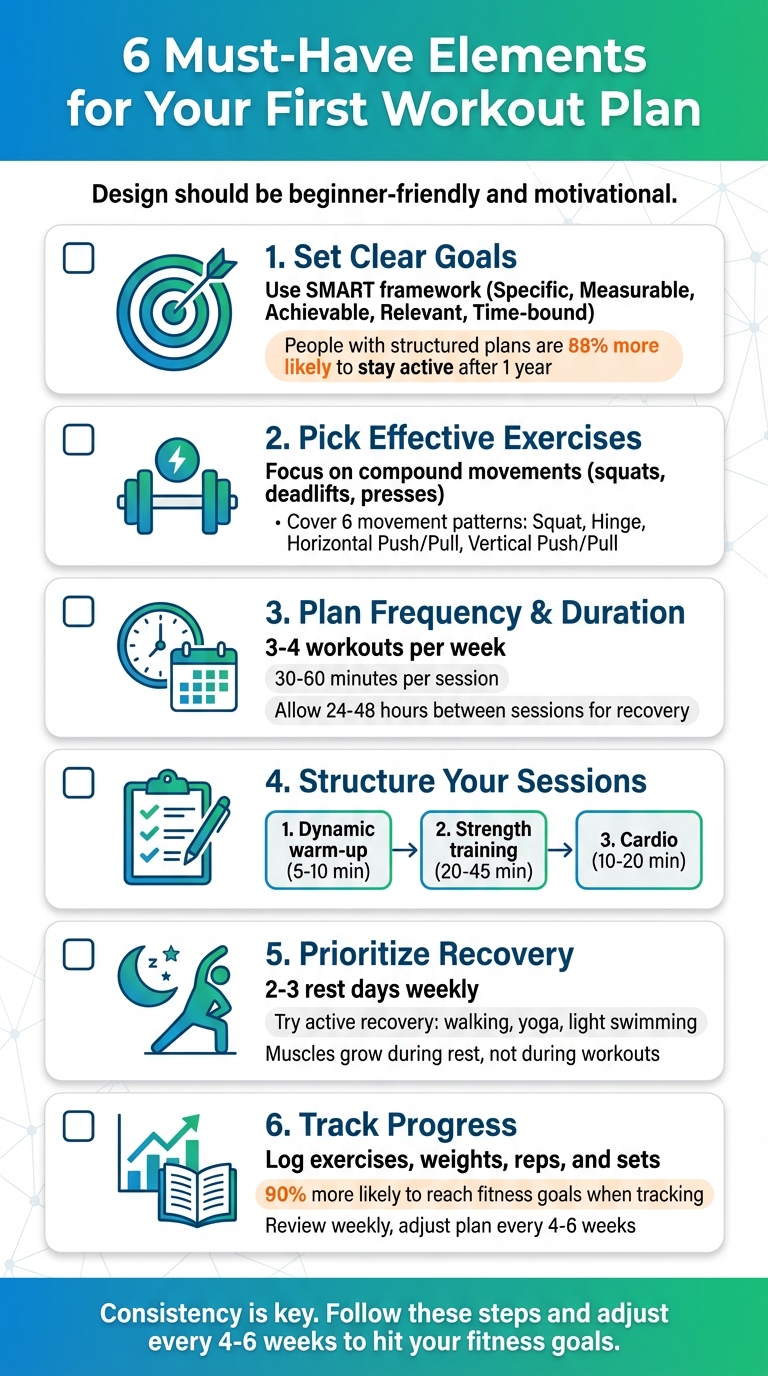
6 Essential Elements of Your First Workout Plan Checklist
The PERFECT Beginner Workout (Sets and Reps Included)
sbb-itb-29cdcd8
1. Set Realistic Fitness Goals
Before diving in, it’s crucial to define a clear and specific target. Vague goals like "get in shape" or "lose weight" are hard to measure and even harder to stick with when motivation wanes.
Start by figuring out your current fitness level. You can do this in just 15 minutes: time yourself walking a mile, see how many push-ups and squats you can do with proper form, and test your flexibility with a sit-and-reach stretch. These simple tests give you a clear starting point, so you can set goals that are realistic for you – not based on someone else’s social media posts.
Use the SMART Framework
The SMART method transforms vague ambitions into clear, achievable steps. Here’s how it works:
- Specific: Define exactly what you want to achieve (e.g., "lose 10 pounds" instead of "lose weight").
- Measurable: Track progress with numbers or milestones.
- Achievable: Make sure your goals fit your current fitness level and schedule.
- Relevant: Tie your goals to something meaningful, like improving your health or keeping up with your kids.
- Time-bound: Set a deadline, like "by June 1st".
"SMART goals are necessary because they help individuals focus their desires and intentions and create a standard by which success can be measured." – Healthline
For example, instead of saying, "I want to get stronger", aim for something like, "Increase my deadlift by 20 pounds in 10 weeks by training twice a week". Studies show that beginners who combine goal setting with small, consistent habits – like packing a gym bag the night before – are twice as likely to stick with their fitness routines.
Match Goals to Your Fitness Needs
Your goals should align with what you genuinely want to improve, whether that’s losing weight, building muscle, or boosting endurance. For weight loss, aim for a steady rate of 1–2 pounds per week. If your goal is to lose 15 pounds, plan for at least 8–10 weeks. Strength goals? Focus on measurable progress, such as increasing the weight on specific lifts each week. For endurance, set targets like running a 5k in under 30 minutes within four weeks.
Be realistic about your schedule. If you can only work out three mornings a week, don’t set a goal that requires five gym sessions. A 30–45 minute workout, treated like a non-negotiable appointment, is often enough to make steady progress. Structured plans make a big difference – people with a set routine are 88% more likely to stay active after a year. Sharing your goals with someone else, like a friend or trainer, can also keep you accountable.
As Alena Luciani, Founder of Training2xl, puts it, "Goals are written in pencil, not set in stone". Check your progress weekly and adjust your plan every 4–6 weeks as needed.
2. Select Exercises for Each Muscle Group
Once you’ve outlined your goals, the next step is choosing exercises that target multiple muscle groups. Picking the right exercises is just as important as setting clear, measurable goals.
"Compound exercises require more than one muscle group working together to complete the movement. This replicates the way your body naturally moves." – Steve Kamb, Founder, Nerd Fitness
Start with Compound Movements
To make the most of your workout, focus on compound exercises. These movements engage multiple muscles at once, making them efficient and effective. Examples include squats, deadlifts, bench presses, and rows.
If you’re new to these exercises, start with bodyweight variations to master proper form. Once you’re confident in your technique, begin adding weight gradually – 2.5 to 5 pounds for upper body exercises is a manageable increase. Perform these energy-intensive moves early in your workout when you’re at your freshest.
"Generally, you’ll want to plan your workout so the most energy-demanding exercises are performed first… to ensure you’ve got enough gas in the tank to perform the compound exercises with proper technique." – Jen Weir, Certified Strength and Conditioning Specialist
Include Upper and Lower Body Exercises
An effective workout plan should address six fundamental movement patterns: Squat, Hinge, Horizontal Push, Horizontal Pull, Vertical Push, and Vertical Pull. Covering all six ensures balanced strength development across your entire body – not just the muscles you see in the mirror.
For instance, you could pair a squat (lower body) with a bench press (upper body), then follow with a deadlift (lower body) and a row (upper body). Aim for 4 to 6 exercises per session – enough to target all major muscle groups without overloading your workout. Balance is key: match pushing exercises (like presses) with pulling movements (like rows) to avoid muscle imbalances and reduce the risk of injury.
| Movement Pattern | Primary Muscles | Alternatives for Beginners |
|---|---|---|
| Squat | Quads, Glutes, Core | Bodyweight Squat, Goblet Squat, Leg Press |
| Hinge | Hamstrings, Glutes, Lower Back | Kettlebell Deadlift, Romanian Deadlift |
| Horizontal Push | Chest, Shoulders, Triceps | Push-up, Dumbbell Bench Press |
| Horizontal Pull | Back, Biceps | Inverted Row, Dumbbell Row |
| Vertical Push | Shoulders, Triceps | Overhead Press, Landmine Press |
| Vertical Pull | Lats, Biceps | Lat Pulldown, Assisted Pull-up |
This structured approach ensures you’re building strength evenly across your body while laying the groundwork for long-term progress.
3. Plan Your Workout Frequency and Duration
Once you’ve chosen your exercises, the next step is figuring out how often to train and how long each session should last. This step is key to making steady progress without overdoing it.
Start with 3-4 Sessions Per Week
For beginners, three to four workouts a week is a sweet spot. This schedule gives your muscles enough stimulation to grow while ensuring they have adequate time to recover. Research indicates muscles need 24 to 48 hours to repair and adapt after intense exercise.
"Three to four workouts a week is the Goldilocks zone for most training goals, maximizing performance and gains by striking a balance between exercise and recovery." – Trevor Thieme, C.S.C.S., Strength Coach
To make recovery easier, plan your sessions on non-consecutive days, like Monday, Wednesday, and Friday. Aim for 30 to 60 minutes per workout, including warm-up and cool-down. Keeping workouts under an hour not only helps with scheduling but also reduces mental fatigue. If you’re tight on time, even 30-minute sessions can be effective when done regularly.
Avoid jumping into five or more days of training per week right away. Without proper recovery, this can lead to injuries or burnout, especially for beginners. Consistency matters more than intensity – showing up three times a week consistently beats sporadic, overly intense sessions.
Next, you’ll want to choose a workout structure that matches your experience and goals.
Full-Body vs. Split Routines
For the first 6–12 months, stick with full-body workouts. These sessions target all the major muscle groups – legs, back, chest, arms, and core – in one go, usually done 2 to 3 times per week. This approach helps beginners practice essential movement patterns more often, which speeds up strength development through neural adaptations.
Split routines, which divide muscle groups across different days (like Upper/Lower or Push/Pull/Legs), are better suited for advanced lifters. These require 4 to 6 training days per week and demand more recovery capacity than most beginners have. A 2024 meta-analysis found that when weekly training volume is the same, both split and full-body routines lead to similar muscle growth.
"Your first year isn’t about accumulating massive volume; it’s about mastering movement patterns through frequent, quality practice." – FitnessRec
Stick with full-body workouts until you’ve built a strong foundation. Once these sessions start leaving you overly fatigued, it might be time to explore split routines. Until then, keep things straightforward and focus on staying consistent.
4. Structure Your Warm-Up, Strength, and Cardio
The way you organize your workout matters. Experts suggest starting with a dynamic warm-up, moving into strength training, and wrapping up with cardio. This sequence ensures your muscles and nervous system are at their best for the most demanding parts of your workout.
Begin with Dynamic Warm-Ups
Kick off your session with 5–10 minutes of dynamic movements. These help raise your core temperature, loosen up your joints, and activate your nervous system without wearing you out. Save static stretches – those long-held poses – for the cool-down phase after your workout.
"Warming up helps your body adjust slowly from rest to exercise." – Ben Kuharik, Exercise Specialist
Some great warm-up moves include arm circles, leg swings, walking knee hugs, and glute bridges for lower body days. For upper body sessions, try scapula push-ups, cat/cow stretches, or band pull-aparts. Full-body options like air squats and high knees work well too.
Once you’re warmed up, dive straight into your strength exercises.
Focus on Strength Training
Strength training should come next, while your energy levels are still high. Plan for 4 to 6 exercises per session, with 3–4 sets of 8–12 reps each. Start with compound lifts like squats, deadlifts, or presses, and finish with isolation moves like bicep curls or lateral raises.
"You want to do strength when your system hasn’t been compromised or fatigued by anything else." – Lee Boyce, CPT
Take 2–4 minutes of rest between heavy compound lifts and about 60–90 seconds between isolation exercises. A solid strength session typically lasts 20–45 minutes.
After finishing your strength work, shift gears to cardio for a well-rounded workout.
Add Cardio for Heart Health
Wrap up your workout with 10–20 minutes of cardio. Whether you choose moderate-paced exercise or high-intensity intervals, doing cardio at the end helps maintain the quality of your strength training while supporting heart health. If your main focus is building muscle or strength, consider scheduling longer cardio sessions on separate days.
5. Plan Rest and Recovery Time
Once you’ve structured your warm-up, strength training, and cardio, it’s time to focus on recovery. This step is essential for a well-rounded workout plan.
Here’s the thing: muscles don’t actually grow during your workout – they grow during rest. When you exercise, tiny tears form in your muscle fibers. The real progress happens in the 24 to 72 hours afterward, as your body repairs these tears through a process called Muscle Protein Synthesis [48,51]. Skipping rest disrupts this repair process, which can stall your progress.
"Rest days aren’t ‘extra’… You don’t only rest when you’re injured; you don’t only rest when you’re tired. Instead, rest should be a nonnegotiable part of your routine." – DeAnne Davis Brooks, Ed.D, Associate Professor of Kinesiology
Recovery is about more than just muscles. Your central nervous system (CNS) also takes a hit during heavy lifting. If you skip rest days, you might notice irritability, lack of motivation, or feeling flat during workouts. On top of that, your stress hormone cortisol needs time to normalize – overtraining can keep it elevated, which slows muscle growth and weakens your immune system [48,50].
Take 2–3 Rest Days Weekly
Most beginners need at least 2 to 3 rest days per week to avoid overtraining [50,51]. For instance, if you train your legs on Monday, give them until at least Wednesday or Thursday to recover fully.
Pay attention to your body’s signals. Persistent soreness lasting longer than three days, a resting heart rate that’s noticeably higher than usual, or sudden drops in performance (like weights feeling much heavier than normal) are all signs you might need an extra rest day [48,49,59]. Your body knows when it needs a break – trust it.
If completely resting feels too slow-paced, you can opt for light recovery activities instead.
Try Active Recovery Activities
Active recovery involves low-intensity movement that promotes blood flow and helps deliver nutrients to your muscles. It’s a great way to aid healing without overloading your body [48,52].
"Active recovery involves gentle movements that aid muscle healing." – Steve Kamb, Founder, Nerd Fitness
Some great options include:
- A 20- to 30-minute walk at an easy pace
- Gentle yoga or tai chi
- Light swimming with relaxed strokes
- Low-resistance cycling
To gauge your effort, use the "talk test." If you can hold a steady conversation, you’re at the right intensity. Keep these sessions shorter than your usual workouts and prioritize smooth, controlled movements over exertion.
Stretch After Each Workout
Save static stretching – those longer-held poses – for after your workout as part of your recovery routine. Spend 5–10 minutes stretching the muscles you trained and foam rolling to ease tightness and reduce delayed onset muscle soreness (DOMS). Hold each stretch for 30 seconds to 2 minutes, breathing deeply throughout.
Foam rolling is another excellent tool. Roll slowly over tight or sore areas for 30 seconds to 2 minutes, avoiding bones and joints. This technique, known as myofascial release, helps relax muscle tension and supports recovery. While stretching and foam rolling are great additions, they’re not substitutes for proper rest days – make sure to prioritize both.
6. Track Your Progress
You’ve created your workout plan – now it’s time to make sure it’s actually delivering results. With your training and recovery routines in place, tracking your progress becomes essential. Why? Because tracking takes the guesswork out of fitness. Studies show that people who track their workouts are 90% more likely to reach their fitness goals, and those who document their progress are 42% more likely to stick to their routines.
"What gets measured gets managed. You can’t improve what you don’t track." – Peter Drucker
The key is knowing what to track, how to record it, and when to adjust your approach.
Keep a Workout Log
Start by logging the basics: exercises, weights, reps, and sets. Do this during your rest periods while the details are still fresh. You can use a notebook, a spreadsheet like Google Sheets, or apps like Strive Workout Log, GymLogger, or Hevy. For a more hands-on approach, paper logs provide a distraction-free way to stay focused.
Don’t stop at the numbers. Add your Rate of Perceived Exertion (RPE) on a scale of 1 to 10 to gauge how hard you’re working. Also, note factors like sleep quality, stress levels, and how the session felt overall. If your performance dips, these notes can help identify whether the issue lies in your training or outside influences.
Measure Strength and Endurance Gains
With your log in place, use it to track progress over time. For strength training, monitor your weights, reps, and sets to ensure you’re applying progressive overload. The "2-for-2 rule" is a great guideline: if you can perform two extra reps beyond your target for two consecutive workouts, it’s time to increase the weight.
For a bigger picture of muscle development, calculate your total training volume (sets x reps x weight). If this number is climbing over the weeks, you’re on track. For endurance, keep tabs on metrics like duration, distance, pace, and heart rate to see improvements in your cardiovascular fitness.
Review Your Plan Weekly
Reviewing your data regularly turns raw numbers into actionable insights. A weekly check-in helps you identify trends: Are your lifts improving? Are you meeting your rep goals? When tracking body weight, use weekly averages instead of daily numbers to avoid being misled by small fluctuations. If progress stalls for 2–3 weeks, tweak your plan – add a rep, increase the weight, or adjust your rest days.
Every 4–6 weeks, take a deeper dive into your progress. If your lifts have plateaued or you’re feeling fatigued, consider a deload week. This involves reducing your training volume by 30–50% while maintaining the same weight, giving your body a chance to recover.
Stick with your routine for at least 6–12 weeks before making major changes. This timeframe allows your body to adapt and show measurable results.
"A workout log isn’t just a record of what you’ve done. It’s a prescription for what you need to do next." – Strive Workout Log
Tracking your workouts not only validates your progress but also helps you refine your plan for even better results.
Conclusion
You’re now equipped with the key elements to create a workout plan that fits your goals and lifestyle.
These six elements – setting realistic goals using the SMART framework, incorporating compound movements for all major muscle groups, scheduling 3–4 workouts per week for 30–45 minutes, including warm-ups and structured training, planning 2–3 rest days for recovery, and tracking your progress – are the foundation of a solid fitness routine.
Tailor your plan to match your current fitness level, schedule, and resources. Be realistic about what you can commit to and choose exercises you’ll enjoy sticking with. For most beginners, this frequency and duration can lead to noticeable improvements over time. Revisit and tweak your plan every 4–6 weeks to keep progressing.
"It’s much better to set the bar a little bit lower and consistently hit all your planned workouts than to set the bar too high and constantly fall short." – Wesley Showalter, CSCS
If you’re feeling overwhelmed or want a more personalized approach, N The Mix Nutrition offers coaching programs to simplify the process. Their personal training service ($99/month) provides custom workout plans, one-on-one coaching, and weekly check-ins. Or, for $179/month, you can bundle training with nutrition coaching for a comprehensive approach.
Start today, track your results, and adjust as you grow stronger!
FAQs
How do I choose a goal if I’m not sure what I want yet?
If you’re not sure about your goal, take a moment to dig into your motivations and define your personal “why.” Understanding this can bring clarity and help steer you in the right direction. Start with broad, adaptable goals and incorporate a mix of strength training, cardio, and flexibility exercises into your routine. Try different activities to see what you enjoy most, and tweak your goals as you learn what feels best for your body and fits your preferences.
What can I do if I don’t have access to a full gym?
Creating an effective workout routine at home is easier than you might think. Start with bodyweight exercises like squats, push-ups, and planks. These moves are simple yet powerful for building strength and endurance. Aim for 20-minute sessions two to three times a week to get started.
Want to mix things up? Add some variety by incorporating resistance bands, dumbbells, or even everyday household items like water bottles or backpacks. The most important part is to set a schedule that works for you, define clear goals, and choose exercises that target different muscle groups. Even with limited space, you can create a balanced and effective routine.
How do I know when it’s time to change my workout plan?
If your workout feels too easy or isn’t pushing your muscles and endurance anymore, it might be time to shake things up. This could mean your body has adjusted to your current routine, and making some tweaks can help you keep moving forward. Consider increasing the intensity, changing up your exercises, or modifying your sets and reps to keep building strength and hitting your goals. Small adjustments can make a big difference.