
Coaching is about finding the right mix between support and accountability to help clients achieve meaningful growth. Too much support can feel unstructured, while excessive accountability may come across as overly critical. The best coaches use empathy to build trust and structure to maintain progress. Here’s how they do it:
- Understand Client Needs: Tailor strategies through personalized nutrition coaching based on individual motivations, challenges, and goals.
- Set Clear Goals: Collaborate with clients to create realistic, measurable objectives.
- Use Accountability Frameworks: Combine data tracking with regular check-ins for consistent progress.
- Provide Balanced Feedback: Acknowledge strengths and address challenges constructively.
- Encourage Long-Term Habits: Shift accountability from the coach to the client for lasting results.
Coaches help clients thrive by blending clarity and compassion, ensuring progress while building independence.
How To Hold Coaching Clients Accountable (5 Biggest Mistakes)
sbb-itb-29cdcd8
Understanding Client Needs and Goals
Coaches need to understand each client’s individual circumstances before introducing accountability measures. Every person comes with their own mix of motivations, challenges, and life situations that shape what they can realistically achieve. Without this understanding, accountability risks becoming a generic checklist that rarely works.
The best coaches go beyond surface-level goals. They dig into factors like work schedules, family responsibilities, cooking skills, and budget limitations – elements that directly impact progress. They also consider internal barriers, such as a client who feels asking for help shows weakness or someone hesitant to share progress until reaching a milestone. This deeper understanding lays the groundwork for creating tailored accountability plans.
"Empathy seemed to be the clearest and most consistent predictor of successful helping."
- Richard Boyatzis, Professor, Case Western Reserve University
This insight underscores the importance of building accountability strategies that adapt to the individual. For example, a coach working with a client who travels often wouldn’t recommend a complex meal prep plan requiring refrigeration. Similarly, for a client who dislikes routine, the plan might include variety instead of rigid schedules. The key is to adapt the framework to fit the client, not force the client to fit the framework.
Identifying What Motivates Clients and What Holds Them Back
The discovery process starts with asking the right questions. Instead of assuming what drives someone, skilled coaches encourage clients to reflect on their own motivations. Questions like "What values are behind this choice?" or "Who do you want to become?" uncover deeper reasons beyond surface-level goals like losing 20 lbs.
But motivation alone isn’t enough. Coaches also need to identify obstacles. Tracking factors like energy, sleep, hunger, and stress often reveals hidden challenges. For instance, a client who skips workouts might not lack discipline – they could be exhausted from poor sleep or overwhelmed by work.
Asking "What got in the way?" is far more productive than "Why didn’t you do it?" The former identifies specific, solvable issues (like not having time to grocery shop or being unsure about what to buy), while the latter often leads to vague excuses or defensive responses.
Understanding both motivations and barriers helps coaches and clients work together to set realistic goals.
Setting Clear, Achievable Goals
Once a coach understands a client’s motivations and challenges, they can collaborate to set meaningful goals. This process is a partnership – goals are created with the client, not dictated to them.
Effective coaches avoid phrases like "I want you to…" or "You should…" Instead, they ask questions like, "What feels like a realistic frequency for a successful week?" This approach gives clients ownership of their goals while still providing structure. It also highlights potential issues early – if a client hesitates to commit to five workouts a week, that’s an important red flag.
"One of the best questions in coaching is: ‘How will you know when you are being successful?’"
- Dr. Michael Arloski, CEO and Founder, Real Balance Global Wellness Services
Goals should follow the SMART framework – specific, measurable, attainable, realistic, and timely – to help clients stay on track. However, they also need to be flexible enough to adapt to real life. For instance, sticking to a meal plan 80% of the time is far more effective than aiming for perfection and only achieving 20% adherence. Flexibility might include building in quick, no-cook meal options for high-stress periods.
Coaches also establish non-negotiables upfront. They consider factors like work schedules, family routines, dietary preferences, and cultural practices to create practical goals. Take Marcus, a traveling sales rep who struggled with meal prep while eating out frequently. His coach adjusted his plan to include portable, protein-rich options like Greek yogurt, beef jerky, and protein bars. This shift boosted his adherence to 90%. The goal – better nutrition – remained the same, but the strategy finally aligned with his lifestyle.
Creating a Framework for Accountability
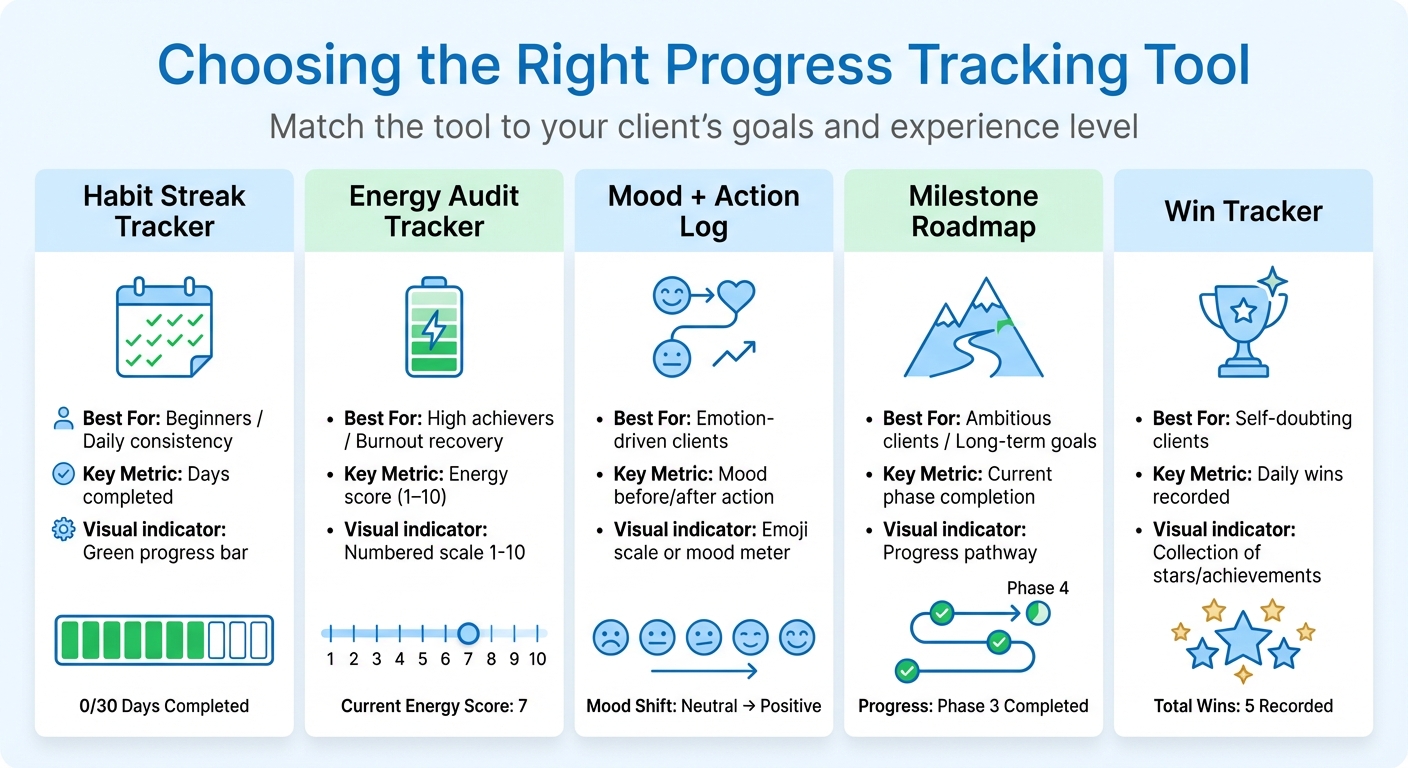
Progress Tracking Tools Comparison for Coaching Clients
When it comes to accountability, structure is key. Without it, accountability can feel like constant nagging. But if it’s too rigid, it won’t adapt to the client’s changing needs. Coaches can strike the right balance by creating a thoughtful framework that encourages both consistency and flexibility.
The process starts from day one. During onboarding, coaches should make expectations crystal clear. A simple statement like, "The check-in is your responsibility; the adjustment is mine", shifts the responsibility to the client while making it clear that the coach’s role is to analyze the data – not to act as a reminder service. This sets the tone for a productive partnership.
Accountability should combine both objective metrics (like weight, step counts, or workouts completed) and subjective measures (such as stress levels, sleep quality, or hunger rated on a 1–10 scale). While hard data shows progress, subjective feedback provides the context behind the numbers. For example, if a client’s weight hasn’t changed in two weeks but their stress levels have spiked and sleep quality has dropped, it’s a sign something needs to be adjusted.
Interestingly, clients often improve their habits simply because they know someone is monitoring their progress. Over time, as clients show consistency – typically over six months or more – coaches can scale back the level of detail required in check-ins. This gradual shift prevents burnout and encourages clients to take ownership of their progress. Ultimately, the framework evolves into regular, efficient check-ins that help maintain momentum.
Using Regular Check-Ins and Feedback
Consistent check-ins are the backbone of accountability. Weekly check-ins – ideally scheduled for Fridays to plan ahead and Mondays for reflecting on the weekend – help track trends and fine-tune goals. In fact, 75% of clients report feeling more engaged when these check-ins are a regular part of their coaching experience.
To keep things efficient, check-ins should take less than two minutes. Instead of overwhelming clients with lengthy forms, coaches can focus on three key questions: What were your recent wins? What challenges did you face? What’s coming up next? This approach is both effective and manageable. For example, N The Mix Nutrition integrates these quick check-ins into its coaching programs, combining progress tracking with tailored adjustments.
Timeliness is also important. Coaches should aim to respond to check-ins within 24 hours to keep the momentum going and provide a premium experience. If a client misses a check-in, a supportive follow-up message after 24 hours can help re-engage them without seeming punitive. Feedback should encourage reflection rather than dictate changes. By using an "observation plus question" format, coaches can foster a collaborative dialogue. For instance, instead of saying, "You need to work on your sleep", they might ask, "I noticed your sleep quality dropped this week – what do you think might be affecting it?"
Technology can further streamline this process, making it easier to track progress and maintain accountability.
Using Progress Tracking Tools
Integrated tools make tracking simpler and more effective by consolidating everything – messaging, data, and even progress photos – into one platform. This eliminates scattered information and gives both coaches and clients a clear view of progress.
Different tools work best for different needs. For example:
- Habit streak trackers are great for beginners focused on daily routines.
- Energy audit trackers help high achievers recovering from burnout by scoring their energy levels on a 1–10 scale.
- Mood and action logs can reveal patterns between emotions and behaviors.
The key is matching the tool to the client’s goals and experience level. To ensure clients actually use these tools, coaches might create a short instructional video (around two minutes) explaining how each one works and why the data matters. When clients understand the purpose behind tracking, they’re more likely to stay engaged.
Visual progress is also powerful. Progress photos, taken every two to four weeks, can highlight changes that the scale might miss. Research shows that people who monitor their own efforts are more likely to succeed. Tracking increases awareness, and awareness leads to better decision-making. However, the system must remain simple – overly complicated forms can lead to frustration or disengagement (sometimes referred to as "quiet quitting").
| Tool Type | Best For | Key Metric |
|---|---|---|
| Habit Streak Tracker | Beginners / Daily consistency | Days completed |
| Energy Audit Tracker | High achievers / Burnout recovery | Energy score (1–10) |
| Mood + Action Log | Emotion-driven clients | Mood before/after action |
| Milestone Roadmap | Ambitious clients / Long-term goals | Current phase completion |
| Win Tracker | Self-doubting clients | Daily wins recorded |
Balancing Feedback: Encouragement and Constructive Criticism
Balanced feedback plays a key role in turning data into meaningful behavioral shifts. It bridges accountability with support, ensuring that constructive criticism encourages growth rather than triggering defensiveness. Neuroscience research reveals that criticism often activates a fight-or-flight response, which can block effective learning. This means that coaches need to carefully frame their feedback to promote progress.
The best feedback comes from someone who acknowledges and appreciates what the client is already doing well. Interestingly, studies show that over half of a performance rating reflects the evaluator’s own biases rather than the subject’s actual performance. To counteract this, coaches should focus on specific, observable actions rather than subjective opinions. Avoiding phrases like "I like" or "I don’t like" can help ensure the feedback stays neutral and objective, reducing the chances of the client feeling judged.
When discussing areas for improvement, the way feedback is presented matters. Rather than highlighting what’s wrong, coaches should offer clear, actionable suggestions and explain the benefits of making those changes. For instance, instead of saying, "You’re not tracking your macros consistently", a coach might ask, "I noticed your food logs were incomplete this week – what made it challenging to complete them?" This type of question invites reflection and problem-solving without making the client feel attacked. Below are some structured methods for delivering feedback that balances support with challenge.
The Empathy Sandwich Technique
The Empathy Sandwich is a three-step approach that combines encouragement with constructive feedback. Here’s how it works: first, acknowledge the client’s experience; next, introduce a respectful challenge or suggest a mindset shift; and finally, reinforce the client’s strengths and capabilities.
For example, a coach might start by validating the client’s situation: "I understand this week was overwhelming with work deadlines." Then, they could introduce a challenge: "At the same time, I’m curious – what would it look like to set aside just 10 minutes for meal prep, even on your busiest days?" Finally, the coach could highlight a strength: "You’ve shown you can prioritize what matters, like when you kept up your workouts during that project launch last month".
"Compassionate coaching is not about fixing or rescuing someone. It is about walking beside them as they learn to meet themselves with courage." – Co-Active Training Institute
Another effective tool is the SBI (Situation, Behavior, Impact) model, which keeps feedback grounded in facts. This method involves describing a specific event (Situation), pointing out the observed actions (Behavior), and explaining the outcome (Impact) without making assumptions about the client’s character. For example: "During last week’s check-in (Situation), you mentioned feeling too tired to track your meals (Behavior), which resulted in insufficient data for adjusting your plan (Impact)." This keeps the conversation focused on actions and their outcomes, steering clear of personal criticism.
If a client becomes defensive or distressed – signs might include crossed arms, avoiding eye contact, or brief responses – it’s crucial for the coach to pause and acknowledge these emotions. A simple statement like "I can see this is frustrating" can help defuse tension, while a moment of silence gives the client space to process. This thoughtful approach naturally transitions into recognizing achievements.
Recognizing Wins and Efforts
Celebrating small victories is just as important as addressing challenges. Acknowledging effort and milestones – not just end results – helps sustain motivation and builds emotional resilience. When clients feel that their progress is noticed, they’re more likely to stay engaged, even during periods of slower progress.
Specific praise, such as "You hit your protein target six out of seven days", demonstrates that the coach is paying attention to the details and values the client’s efforts. This kind of recognition strengthens trust and reinforces positive behaviors.
"People only excel when they receive suggestions for improvement from someone who knows them, cares and recognizes the things they already do well." – Krasimir Kashinov, PCC
Tracking progress through measurable markers like habit streaks, energy levels, or workout consistency makes growth visible. This encourages clients to see that even small steps add up over time. At N The Mix Nutrition, for example, coaches highlight these micro-wins during weekly check-ins, helping clients understand how their daily actions contribute to long-term success.
Supporting Long-Term Habits and Mindset Changes
Real, lasting change happens when people develop habits they can sustain long after their weekly coaching sessions end. Studies reveal that consistent behavior is a stronger predictor of long-term weight loss than any single intervention. The key? Shifting from relying on external accountability to fostering internal commitment. Dr. Michael Arloski, CEO and Founder of Real Balance Global Wellness Services, explains it perfectly:
"Ultimately a client is accountable to themselves. Their coach is not their supervisor, manager, teacher or parent".
Developing new habits doesn’t happen overnight. Research shows it takes an average of 66 days to form a habit, though the timeline can vary widely – from as short as 18 days to as long as 254 days. This means both coaches and clients need patience and a long-term outlook. As a rule of thumb, a simple plan followed consistently for six months will always outperform a "perfect" plan abandoned after two weeks. At N The Mix Nutrition, coaches focus on this principle during weekly check-ins, helping clients see that small, steady actions carry more weight than sporadic, intense efforts. By encouraging this mindset, coaches ensure their support continues to resonate well beyond the formal coaching period. This approach lays the groundwork for resilience and a sense of ownership.
Building Resilience Through Coaching
Setbacks are inevitable – it’s just part of the process. The key is how you handle them. One effective strategy is a 24-Hour Reset Protocol, which encourages clients to address setbacks immediately instead of waiting for the next "perfect" starting point, like Monday. Coaches can also help clients build resilience by asking reflective questions such as, "What did you learn from this experience?" or "What will you do differently next time?".
Another powerful tool is the Dichotomy of Control, a concept from Stoic philosophy. This encourages clients to focus on what they can control – like their effort, food choices, and attitude – while letting go of what they can’t, such as genetics, the number on the scale, or others’ opinions. As Marcus Aurelius once wrote:
"You have power over your mind, not outside events. Realise this, and you will find strength".
To counter perfectionist tendencies, coaches can introduce Floor and Ceiling goals. For example, instead of aiming for exactly 150 grams of protein daily, set a range: a floor of 120 grams and a ceiling of 150 grams. This offers flexibility while maintaining accountability. Research shows that perfectionism often leads to worse health outcomes and unhealthy patterns, while a more balanced approach – like the 80/20 rule – supports better adherence over time. By helping clients navigate setbacks and encouraging self-reflection, coaches can deepen their clients’ resilience and long-term commitment.
Encouraging Self-Reflection and Ownership
The best coaches aim to empower their clients, not make them dependent. One way to do this is by encouraging self-monitoring. When clients take the initiative to track their progress, they develop a stronger sense of self-awareness and accountability, which helps them avoid self-deception. In fact, research shows that self-monitoring is one of the most effective strategies for achieving wellness goals.
At the end of each session, coaches can reinforce ownership by having clients restate their commitments – what’s often called the "Take-Away." Questions like "What are you committing to this week?" or "How will you measure your success?" put clients in control of their own progress.
Another key step is helping clients build a support network outside the coaching relationship. Asking questions like "Who or what else can support you in this effort?" encourages them to identify positive influences in their lives. This also helps address internal barriers, such as the belief that asking for help is a sign of weakness. According to Self-Determination Theory, people need to feel both autonomous (having a choice) and capable (making progress) to stay motivated.
The coaching relationship should feel like a partnership, not a hierarchy. As Michael Arloski puts it:
"Coaching is not a helping profession. It is an assisting profession".
This perspective shifts the focus to the client’s abilities, reinforcing a mindset of gradual, self-directed improvement.
Conclusion
Balancing support with accountability is all about finding the right mix. Dan Steele puts it perfectly: "If you’re only ever supportive, you’re a cheerleader. If you’re only ever challenging, you’re a critic. Growth needs both". This highlights that effective coaching requires encouragement paired with constructive challenges.
It starts with understanding what motivates each client and setting goals that are both achievable and meaningful. Weekly check-ins play a crucial role in keeping clients on course. These sessions blend objective data (like weight or measurements) with subjective insights (such as energy levels or stress), allowing coaches to fine-tune strategies based on real progress.
When it comes to giving feedback, the "Empathy Sandwich" technique is a game-changer. By first recognizing the client’s experience, then introducing a respectful challenge, and finishing with encouragement, coaches can keep the conversation productive and positive. This approach creates a balance between accountability and support, what Dr. Michael Arloski calls the "iron fist in the velvet glove".
The ultimate aim is to help clients shift accountability from external sources to within themselves. Research shows that self-monitoring is key to long-term success. At N The Mix Nutrition, weekly check-ins are designed to nurture this independence, gradually moving clients from relying on their coach to relying on themselves. As Dr. Arloski wisely notes:
"Coaching is not a helping profession. It is an assisting profession".
This underscores the idea that while the coach provides guidance, the client remains in control of their journey.
FAQs
How do I know if my coach is too supportive or too strict?
A coach who strikes the right balance between support and accountability can make all the difference. They should help you feel both motivated and understood – without leaving you feeling judged or overwhelmed. If a coach leans too heavily on support, they might shy away from pushing you toward meaningful growth. On the flip side, being overly strict can leave you feeling pressured or even discouraged. Pay attention to how you feel during your sessions and make it a point to communicate openly. This ensures their approach aligns with your needs and builds a foundation of trust.
What should I do if I keep missing check-ins or tracking?
If keeping up with check-ins or tracking feels like a challenge, consider streamlining the process to make it more manageable. Start by setting clear, specific times for check-ins and using tools designed to simplify tracking. Also, ensure expectations are well-defined so everyone involved knows what to do.
Building accountability is key. Turn check-ins into a regular habit and tweak the process to match your routine or preferences. To stay motivated, keep reminding yourself of the positive outcomes that come with staying consistent. Small changes can make a big difference.
How can I stay accountable without relying on my coach forever?
To maintain accountability over the long haul, it’s essential to develop self-management skills that encourage independence. Start by setting clear and achievable goals, then track your progress regularly. Reflect on both your wins and challenges to identify areas for improvement and make adjustments when needed.
Helpful tools like journals or apps can make it easier to monitor your progress. Establishing consistent routines and celebrating milestones along the way can keep you motivated and committed. Building resilience and staying self-aware ensures you can continue making progress, even without the constant guidance of a coach.