
Balancing fitness with a packed schedule is easier than you might think. Here’s the key takeaway: short, efficient workouts and small, consistent habits can make a big difference. Whether it’s a 10-minute HIIT session, planning workouts like appointments, or adding movement to daily tasks, staying active is manageable with the right strategies.
Key Points:
- Plan Ahead: Schedule workouts like meetings and prepare your gear the night before to save time.
- Set Realistic Goals: Focus on specific, achievable targets like three 20-minute sessions a week.
- Use Short Workouts: High-Intensity Interval Training (HIIT) and compound exercises deliver results in less time.
- Stay Active Daily: Take stairs, walk during calls, or do quick stretches at your desk.
- Eat Smart: Prep balanced meals in advance or work with nutrition coaching to fuel your workouts and recovery.
- Track Progress: Use apps, journals, or fitness communities to stay motivated and accountable.
Consistency beats perfection. Start small, stay flexible, and prioritize your health even on busy days.
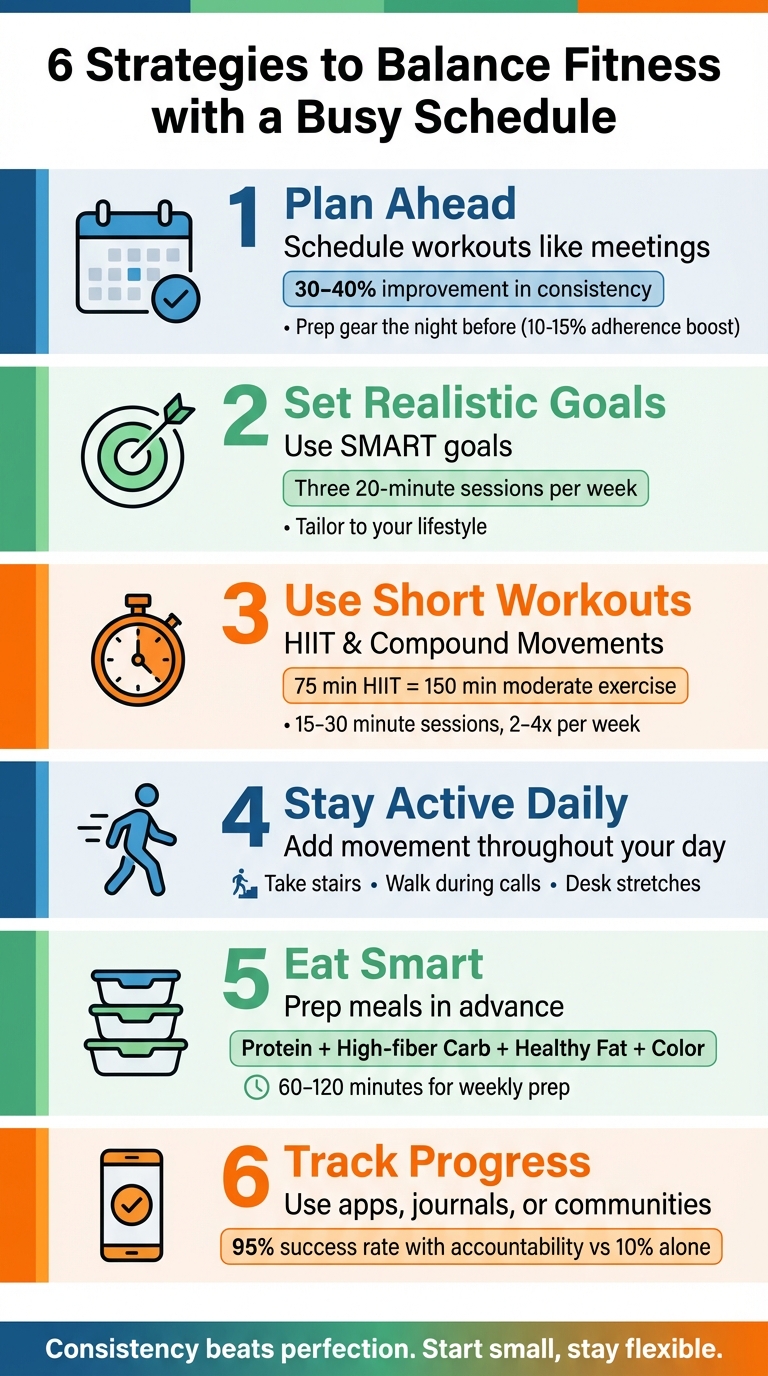
6 Strategies to Balance Fitness with a Busy Schedule
Fitting fitness into a busy schedule (REALISTIC tips that WORK.)
sbb-itb-29cdcd8
Plan Your Workouts in Advance
Turning intentions into actions often requires a solid plan. Scheduling your workouts transforms "if I have time" into "this is when I’m doing it", cutting through the all-too-common excuse of not having enough time.
Studies suggest that treating workouts like non-negotiable appointments can improve consistency by 30% to 40%. By blocking out specific times in your calendar – like "7:00 AM – 7:30 AM, Spin Class" – you’re making a firm commitment to yourself. As Team Trainero puts it:
Treat your workout appointments like any other important meeting. Block them out on your calendar, set reminders… and treat that time as non-negotiable.
Planning also lets you align workouts with your natural energy levels. For example, morning sessions often lead to better consistency. Kenny, an editor, explains his strategy:
If I don’t exercise in the morning, there’s a very good chance I won’t in the afternoon or evening for various reasons: [too tired, too lazy, happy hour, and so on.]
Even small steps like preparing your gear the night before can make a difference, boosting adherence by 10% to 15%. This habit reduces decision fatigue and removes small obstacles that might otherwise derail your plans.
By laying this groundwork, you’re setting yourself up to establish clear goals and stick to your fitness routine.
Set Achievable Fitness Goals
Once your schedule is mapped out, it’s time to define your goals. Vague aspirations like "get in shape" rarely lead to results. Instead, aim for SMART goals – those that are Specific, Measurable, Achievable, Relevant, and Time-bound. For instance, "Complete three 20-minute HIIT sessions per week for the next month" is far more actionable than simply deciding to "exercise more."
Tailor your goals to fit your lifestyle. If your Mondays and Wednesdays are packed with back-to-back meetings, plan shorter 15-minute sessions on those days, saving longer workouts for weekends when you have more flexibility. This flexible approach helps you stay consistent without feeling overwhelmed.
Schedule Workouts Like Appointments
Blocking out time in your calendar for exercise turns it into a firm commitment. Be specific – don’t just write "workout." Instead, jot down the details, like "Tuesday, 6:30 PM – 7:00 PM, Strength Training at Home."
Use multiple reminders to reinforce the habit. Set one the night before, another an hour before, and a final alert 15 minutes prior. These notifications can improve workout consistency by 15% to 20%.
For added accountability, consider signing up for classes with cancellation fees. Rose, a manager, describes her perspective:
Exercise is a date with your future self.
When you honor these appointments with yourself, you’re investing in both your immediate well-being and your long-term health. These strategies make it easier to integrate workouts into even the busiest of schedules.
Use Short, Efficient Workouts
When your schedule is packed, spending an hour at the gym can feel like a luxury you just don’t have. But here’s the good news: you don’t need long workouts to see results. Short, focused sessions can be just as effective – if not more – when you emphasize intensity over duration.
The key is to choose exercises that make every minute count. By targeting movements that work multiple muscle groups at once and ramping up the intensity, you can achieve impressive fitness results in just 15 to 30 minutes. This approach not only saves time but also supports fat loss, builds muscle, and boosts cardiovascular health – all without derailing your busy day.
Try High-Intensity Interval Training (HIIT)
High-Intensity Interval Training (HIIT) is a game-changer for time-crunched fitness enthusiasts. It alternates short bursts of all-out effort – where you hit 80% or more of your maximum heart rate – with brief recovery periods. This method activates Excess Post-Exercise Oxygen Consumption (EPOC), meaning your body keeps burning calories long after the workout ends as it repairs and refuels.
Dr. Russell Camhi, a Sports Medicine Physician at Northwell Health, explains the efficiency of HIIT:
You can get the same (or better) benefits of cardio in half the time with HIIT.
To put it in perspective, 75 minutes of HIIT delivers the same benefits as 150 minutes of moderate exercise. Plus, you can complete a full HIIT session – including warm-up and cool-down – in under 30 minutes.
If you’re new to HIIT, start with a 1:2 work-to-rest ratio. For example, do 20 seconds of high-intensity effort, followed by 40 seconds of rest. As you build endurance, you can extend the work intervals and shorten the rest periods. Exercises like mountain climbers, jump squats, and burpees are excellent choices because they engage your whole body and quickly elevate your heart rate.
Pete McCall, an ACE Certified Personal Trainer, highlights what makes HIIT so effective:
With HIIT, intensity is more important than time; performing a workout at the highest intensity possible allows you to get results in a relatively short amount of time.
Combine HIIT with compound exercises to maximize the benefits of your workout.
Focus on Compound Movements
For efficient, full-body workouts, compound exercises are your secret weapon. These movements involve multiple muscle groups and joints at once, making them perfect for short sessions. Think dumbbell thrusters, deadlifts, and burpees – each of these works at least three major muscle groups in one motion.
Compound exercises not only save time but also build strength and burn more calories compared to isolated movements. For example:
- Dumbbell thrusters: Target your quads, glutes, shoulders, and triceps all at once.
- Devil’s presses: Work your chest, shoulders, legs, and core in a single fluid motion.
- Burpees: Provide a full-body workout using just your body weight.
Andrew Tracey, Fitness Director at Men’s Health, explains the metabolic boost these exercises offer:
Moving from total body movements into an alternating upper/lower pattern means you’ll be able to keep your working muscles reasonably fresh, while your heart and lungs are still doing overtime, giving your metabolism a huge punch.
To stay consistent without overloading your schedule, aim for 2 to 4 short sessions per week, each lasting 15 to 30 minutes. Use a work-to-rest ratio like 40 seconds of effort followed by 20 seconds of rest to maintain intensity. This balance ensures you get the most out of your workouts while avoiding burnout, making fitness manageable even on the busiest days.
Add Movement Throughout Your Day
Adding movement to your daily routine doesn’t have to mean an hour at the gym. Everyday activities, like carrying groceries or tidying up, can contribute to your overall fitness. Your body doesn’t differentiate between structured workouts and functional movement – it all adds up.
Maggie Michalak, Exercise and Sport Scientist at Athlete Training + Health, explains:
Even something like cleaning the house or walking the dog counts. It’s about moving and being active however you can.
Think of exercise as something that happens in small bursts throughout your day. These brief moments of activity – like taking the stairs or stretching – can boost your metabolism, improve heart health, and even give you more energy. By weaving movement into your routine, you’re not just complementing your workouts; you’re creating a lifestyle that keeps you active all the time.
Take Active Breaks
A great way to sneak in movement is by setting a timer every 30 to 60 minutes to remind yourself to get up and move. You could do a quick set of push-ups, a few squats, or stretch at your desk.
Ashley Kenny, Co-Founder of Heirloom Video Books, shares:
The key is being intentional about maximizing movement opportunities that already exist in your day-to-day life.
Pair movement with your daily habits. For example, do calf raises while cooking, wall push-ups while waiting for your coffee, or squats while your lunch heats up. When you’re on a phone call, pace around instead of sitting. If you’re meeting with colleagues, suggest a walking meeting. These small changes turn everyday moments into opportunities to stay active.
Choose Active Transportation
How you get from place to place matters, too. Opt for stairs instead of elevators, park farther from your destination, or walk or bike for short trips instead of driving. If you use public transportation, consider getting off one stop early and walking the rest of the way. Even a quick lap around the office during lunch can help refresh your mind and energize your body. Small choices like these can make a big difference in your daily movement.
Use Nutrition to Support Your Fitness
Pairing the right nutrition with your fitness routine is key to keeping your energy steady and aiding recovery. A well-thought-out meal plan ensures your workouts are effective and your body gets the nutrients it needs to repair and grow.
When life gets busy, proper nutrition becomes even more important. Short workouts won’t deliver results if your diet lacks the essentials. Balanced meals rich in muscle-repairing amino acids and energy-boosting complex carbs are crucial.
Andre Adams, Master Trainer at NASM, puts it perfectly:
The battle is won in the preparation! … Hope is not a strategy, and you can’t outwork a bad diet!
Prep Meals in Advance
Meal prepping saves time and keeps you on track, especially when your schedule is packed. In as little as 60–120 minutes, you can prepare enough lunches and dinners for the week. This minimizes the temptation to grab unhealthy fast food when you’re short on time.
Instead of prepping full meals, focus on versatile ingredients. Cook large batches of grilled chicken, roasted sweet potatoes, and quinoa, then mix and match them throughout the week. Use multiple appliances at once – air fry veggies, pressure cook proteins, and boil grains on the stovetop – to make the process efficient. Most cooked dishes stay fresh in the fridge for 3–4 days or can be frozen for 1–6 months at 0°F.
Diana Dewan, a Nutrition Coach at Katelyn Mann Nutrition, shares this tip:
Preparing food for the week doesn’t have to be painful or take up your whole weekend in order to qualify as ‘meal prep.’
A simple formula can guide your meal prep: Protein + High-fiber Carbohydrate + Healthy Fat + Color (vegetables or fruit). To save even more time, wash and chop veggies as soon as you get home from the store. Keep sauces and dressings separate to avoid soggy meals.
Consider Personalized Nutrition Plans
If meal planning feels daunting or you’re not achieving your fitness goals, personalized nutrition coaching can make things easier. A tailored plan aligns your eating habits with your objectives – whether that’s building muscle, losing fat, or maintaining energy during a hectic week.
For example, N The Mix Nutrition offers macro-based nutrition plans for $129 per month. These plans include 1:1 coaching, weekly check-ins, and app access for tracking your progress (https://nthemixnutrition.com). Certified coaches create plans suited to your lifestyle, fitness level, and schedule – perfectly complementing a personalized workout routine. The added accountability and support make sticking to the plan much easier, especially during busy times.
Personalized plans also consider factors like hormonal cycles, life stages, and activity levels – elements often ignored by generic meal plans. For muscle gain, you might need a calorie surplus of 360–480 calories per day, while fat loss typically requires a deficit of 500–1,000 calories. A good coach will adjust these targets as your body adapts, helping you avoid plateaus.
When your nutrition fits your lifestyle and preferences, it becomes a sustainable habit that consistently supports your fitness goals.
Build Lasting Habits with Support and Accountability
Sticking to a fitness routine can feel like an uphill battle, especially when life is packed with responsibilities. The key to making habits stick lies in tracking your progress and leaning on accountability. Research highlights this: having a fitness idea gives you a 10% chance of success, but when you commit to your goals with someone else – like a coach – your odds skyrocket to 95%.
Track Your Progress
Keeping track of your workouts is more than just jotting down numbers. It’s a way to visually reinforce your dedication and cut down on skipped sessions. By monitoring metrics like resting heart rate, strength gains, or even sleep quality, you can notice progress that a scale might not reveal. After all, body weight can fluctuate due to factors like water retention, hormonal shifts, or muscle growth.
Tools like apps and journals that use activity streaks tap into our natural desire to maintain momentum. Once you hit a 30-day streak, the urge to keep the streak alive becomes a powerful motivator. For those low-energy days, the "Two-Minute Rule" can be a lifesaver, helping you ease into movement and keep the habit alive.
As Zing Coach puts it:
The most effective workout plan is the one you can stick to, even on your worst day. It’s about progress, not perfection.
While tracking your own progress is crucial, external support can solidify your commitment even further.
Join a Supportive Community
Working out solo can sometimes feel isolating, especially when life gets busy. That’s where a supportive community comes in – it not only keeps you accountable but also inspires consistency. Maggie Michalak, an Exercise and Sport Scientist at Athlete Training + Health, explains it well:
When you have a community that is dedicated to health and wellness, it serves as motivation. Seeing people take fitness seriously can, in turn, influence us to make better choices and develop a sustainable habit.
Programs like N The Mix Nutrition offer this kind of support. For $179 a month, their bundle includes personalized nutrition plans, custom workout programs, unlimited messaging with certified coaches, and weekly check-ins (https://nthemixnutrition.com). You’ll also join a community where members share their progress and challenges. Their multi-coach system ensures you always have someone available to guide you – a game-changer when balancing fitness with work, which is the top barrier to exercise for over two-thirds of athletes worldwide.
With regular check-ins and a network of support, exercise becomes a habit you can sustain. Knowing someone is expecting an update from you each week makes it much easier to stay on track, even when your schedule feels overwhelming.
Conclusion
Fitting fitness into a packed schedule is all about using smart strategies: setting aside time for workouts, opting for efficient sessions, incorporating movement into daily life, eating well, and staying accountable.
Even quick actions, like a 10-minute HIIT workout, taking the stairs, or prepping meals briefly, can make a difference. Research suggests that getting 150–299 minutes of vigorous activity per week can reduce the risk of all-cause mortality by 21%–23%. Combine this with a focus on proper nutrition, and you’re setting yourself up for success.
As Josh York, Founder and CEO of GYMGUYZ, wisely says:
Small, consistent actions lead to big changes over time.
You don’t have to aim for perfection – just consistency. Start with one step, like scheduling workouts or squeezing in a 15-minute HIIT session, and build from there.
Balanced nutrition plays a crucial role in amplifying these efforts. If you’re looking for tailored advice on aligning your diet with your fitness goals, check out N The Mix Nutrition at https://nthemixnutrition.com.
Every little effort counts, and your future self will be grateful for the steps you take today.
FAQs
What’s the minimum workout that still gets results?
Short, intense workouts that emphasize compound movements and full-body exercises can be highly effective. Think of routines like a quick 7-minute HIIT session or a 15-20 minute workout with planned progressions and minimal rest. These approaches have been proven to boost fitness levels. The secret lies in maintaining both consistency and intensity, even when time is tight, to achieve noticeable results.
How do I stay consistent when my schedule changes daily?
Consistency with a changing schedule takes some planning and a willingness to adjust. Start by reviewing your weekly routine to pinpoint potential workout windows, then treat those times like firm appointments. Instead of thinking you need to do it all or nothing at all, try adopting an "always something" mindset. Even shorter or different types of workouts can keep you moving forward, especially when your schedule feels unpredictable.
How do I eat well when I don’t have time to cook?
Staying on top of your nutrition doesn’t have to be a challenge, even when life feels chaotic. A little planning can go a long way. One smart approach is to cook larger portions of healthy meals ahead of time, so you have leftovers ready to go. Think soups, stir-fries, or casseroles that reheat well.
Another tip? Keep your kitchen stocked with convenient, wholesome options. Pre-cut vegetables, fresh fruit, nuts, and yogurt are all great choices that require little to no prep. And when time is tight, quick meals like smoothies or salads can save the day without sacrificing nutrition.
By having easy, nutrient-packed foods within reach, you can stick to a balanced diet no matter how packed your schedule gets.