
Stress eating is a common response to emotions like anxiety, boredom, or loneliness. It’s not about physical hunger but rather a craving for comfort, often triggered by stress hormones like cortisol. While it may provide temporary relief, it can lead to long-term health issues like weight gain, high blood pressure, and emotional guilt.
Key Steps to Stop Stress Eating:
- Identify Triggers: Track patterns with a journal to understand what causes emotional eating – stressful workdays, lack of sleep, or specific situations.
- Build Healthy Alternatives: Replace eating with activities like walking, deep breathing, or writing down feelings. Use the S.T.O.P. technique: Stop, Take a breath, Observe your feelings, and Proceed with a non-food activity.
- Practice Mindful Eating: Slow down, eat without distractions, and listen to your body’s hunger cues. Differentiate between physical and emotional hunger.
- Plan Balanced Meals: Eat nutrient-rich foods regularly to stabilize blood sugar and reduce cravings.
- Seek Support: Work with a nutrition coach or therapist to address underlying causes and stay accountable.
Stress eating is about managing emotions, not food. Small changes, like pausing before eating or choosing healthier outlets for stress, can help you regain control and improve both physical and emotional well-being.
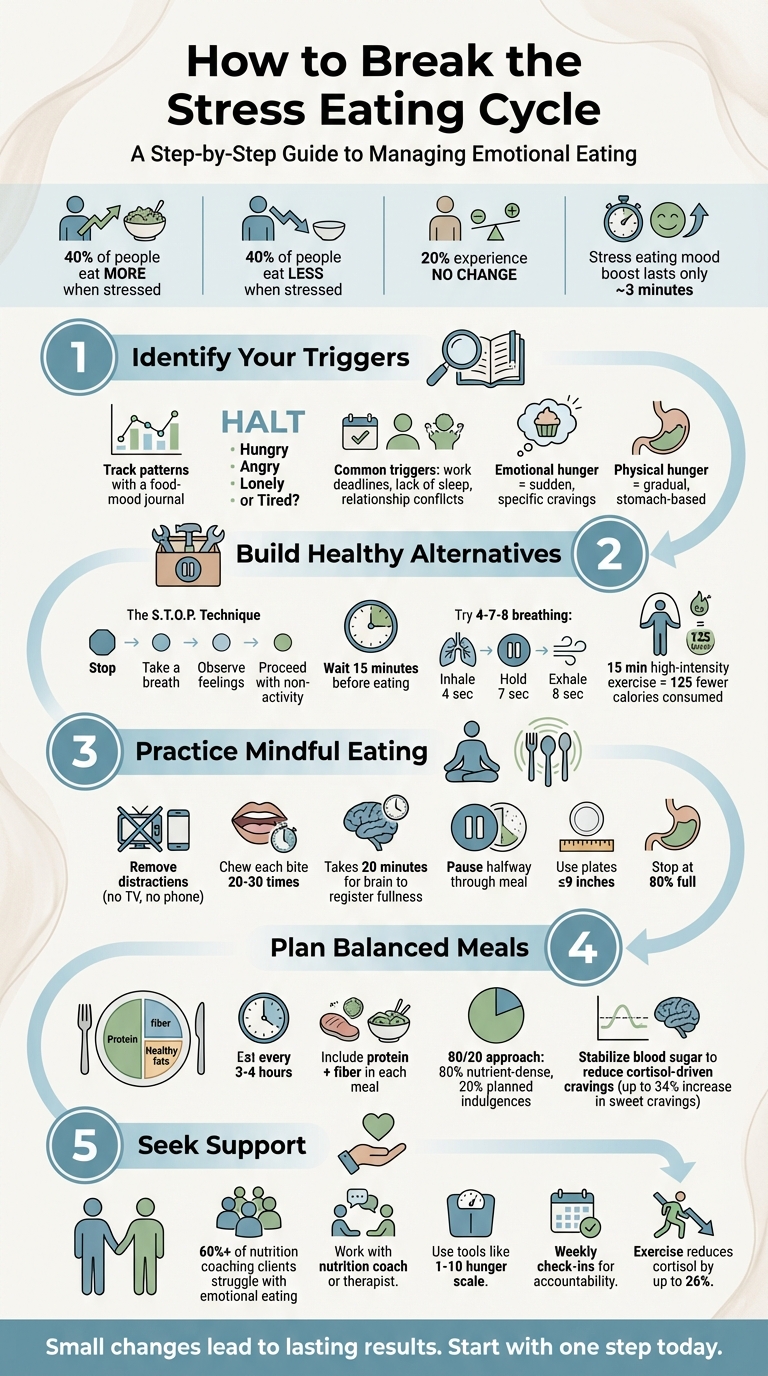
5 Steps to Break the Stress Eating Cycle
How to Manage "Stress Eating" & Compulsive Eating | Dr. Elissa Epel & Dr. Andrew Huberman
sbb-itb-29cdcd8
Step 1: Identify Your Triggers
Pinpointing what sets off your stress eating is the first step toward breaking the cycle. Once you know what triggers you, it’s easier to develop healthier ways to respond through personalized coaching.
Common Stress Eating Triggers
Stress eating can be triggered by psychological, environmental, physiological, and social factors. These might include work deadlines, relationship conflicts, or financial challenges. Sometimes, even environmental cues like the smell of freshly baked cookies or the sight of snacks can spark the urge to eat, even if you’re not physically hungry.
Your physical state plays a role too. Lack of sleep or feeling exhausted often intensifies cravings, especially for sugary or high-fat foods. Chronic stress can keep your cortisol levels high, which ramps up your appetite. For many, stress eating habits begin early in life – think back to moments when treats were used as a way to cheer you up after a tough day.
It’s also helpful to differentiate between emotional and physical hunger. Emotional hunger tends to come on suddenly and is tied to cravings for specific comfort foods, while physical hunger builds gradually. Warning signs of stress eating include distracted eating – like snacking while scrolling on your phone – or realizing you’ve eaten without even remembering the meal. Afternoons and evenings are particularly vulnerable times for stress-related overeating.
Track Patterns with a Journal
Once you understand common triggers, keeping a journal can help you spot patterns in your own habits.
Start a food–mood journal to track your eating behaviors and emotions. For one week, jot down the "Five Ws": what you ate, when you ate it, where you were, who you were with, what you were doing, and how you felt before, during, and after eating.
Before grabbing a snack, try the HALT method: ask yourself if you’re Hungry, Angry, Lonely, or Tired. If hunger isn’t the reason, take a moment to name the exact emotion you’re feeling. Research suggests that identifying a specific emotion – like saying, “I feel rejected” instead of just “I feel bad” – can cut the urge to eat in half. You might notice patterns like craving cookies after every phone call with your mother or reaching for chips after a stressful Monday meeting. Recognizing these triggers gives you the power to make better choices as you move forward.
Step 2: Build Healthy Coping Mechanisms
After identifying your triggers, the next step is to replace stress eating with habits that actually address your emotions. The goal here is to train yourself to pause before reacting and fill that space with activities that genuinely help you feel better.
"When you stress eat, you’re using food to solve a problem. Only it’s a problem that food can’t solve." – Julia Malacoff, PN1, CPT, Precision Nutrition
This shift from using food as a crutch to adopting proactive coping strategies opens the door to techniques like pausing before eating.
The Pause Technique
Before grabbing food, give yourself a 15-minute window. This short delay can help the intensity of your craving naturally subside. Use this time to engage in a quick activity – go for a short walk, practice deep breathing, or write down your feelings in a journal.
A helpful method is the S.T.O.P. Technique: Stop, Take a breath, Observe your feelings (ask yourself if you’re hungry or just stressed), and Proceed with a non-food activity. Another option is the 4-7-8 breathing exercise: inhale for 4 seconds, hold your breath for 7, and exhale forcefully over 8 seconds. This simple technique can activate your body’s relaxation response.
Create a Non-Food Coping Toolkit
In addition to pausing, prepare a set of go-to alternatives for when stress hits. Create a list of non-food activities, like the 5-5-5-5-5 Exercise: jot down 5 people you can call, 5 ways to relax, 5 calming places to visit, 5 positive self-talk phrases, and 5 distraction activities. Keep this list in an easy-to-see spot – on your fridge, desk, or phone – so you can access it quickly.
Physical movement is another powerful stress reliever. Research shows that students who did 15 minutes of high-intensity interval training after mental work consumed 125 fewer calories than those who rested. Even short bursts of activity – walking, stretching, or dancing – can release endorphins. Pair movement with tactile activities like knitting, coloring, or origami, or sensory experiences such as a hot shower, soothing music, or a foot massage to further reduce stress. Studies also suggest that drinking black tea for six weeks may help lower cortisol levels.
Step 3: Practice Mindful Eating
Now it’s time to focus on how you eat. Mindful eating isn’t about following strict rules or adopting a new diet. Instead, it’s about slowing down and tuning in to your body’s cues, rather than letting external triggers dictate your eating habits.
"Mindful eating is simply paying attention. It’s not a diet, not a rulebook, just slowing down and noticing your food." – Nasir Akindele, Author, The Little Wellness Project
This practice helps you differentiate between two types of hunger. Physical hunger builds gradually, often showing up as a growling stomach or low energy. Emotional hunger, on the other hand, strikes suddenly and tends to crave specific comfort foods like pizza or ice cream. Interestingly, stress affects eating behaviors differently: about 40% of people eat more when stressed, another 40% eat less, and 20% don’t experience any change.
The Basics of Mindful Eating
Start by removing distractions. Turn off the TV, leave your phone in another room, and sit down at a table with your food plated properly instead of eating directly from the package. Before you take your first bite, take three deep breaths to help shift into a calmer, more focused state.
As you eat, engage all five senses. Notice the colors, smells, textures, and flavors of your food. Chew each bite 20–30 times – not only does this aid digestion, but it also allows you to truly savor your meal. Eating slowly is key because it takes about 20 minutes for your brain to register fullness. If you eat too quickly, you might overeat before realizing you’re full.
Halfway through your meal, pause and ask yourself, "Am I still hungry, or am I just eating because the food is here?". This small check-in can help you stop eating when you’re about 80% full, avoiding that uncomfortable, stuffed feeling. If portion sizes are a challenge, try using a plate no larger than 9 inches across to naturally limit how much you serve yourself.
Once mindful eating becomes a habit, you can take it a step further by planning balanced meals to prevent stress-driven food choices.
Plan Balanced Meals
Mindful eating lays the groundwork for steady, balanced eating habits. To avoid stress-induced snacking or overeating, aim to eat nutrient-rich meals every 3–4 hours. Focus on including protein and fiber in each meal. These nutrients help you stay full longer and keep your blood sugar stable, which can reduce cravings triggered by cortisol spikes.
Consider an 80/20 approach: aim for nutrient-dense foods 80% of the time while allowing yourself planned indulgences for the remaining 20%. This method helps avoid the extremes of an all-or-nothing mindset. You can also think of foods in two categories: "always" foods (those that fuel your energy and align with your goals) and "sometimes" foods (those to enjoy occasionally). This framework offers guidance without guilt.
"Mindful eating focuses on the why and the how of eating, versus what’s promoted by many diets, which are more about what to eat, how much to eat, maybe even when to eat." – Maxine Smith, RD, LD, Cleveland Clinic
Creating a daily food plan can act like a roadmap for your meals, helping you make intentional choices during stressful times rather than falling into impulsive habits.
Step 4: Get Professional Support
You don’t have to tackle this challenge on your own. While self-awareness and mindful eating are important, sometimes breaking free from the cycle of stress eating requires professional guidance – especially when old habits persist despite your best efforts.
The Role of Personalized Nutrition Coaching
Personalized nutrition coaching goes beyond generic diet plans, which often focus only on what to eat. Instead, it dives into the deeper question of why you turn to food for comfort. In fact, over 60% of people seeking nutrition coaching report struggling with emotional or stress eating specifically. A skilled coach helps uncover the underlying causes – what experts call "primary food", such as relationships, career pressures, or other life stressors that drive emotional eating.
Using tools like "Food and Mood" journals, you can track patterns to pinpoint whether your triggers stem from work, finances, or social dynamics.
"When you stress eat, you’re using food to solve a problem. Only it’s a problem that food can’t solve."
– Julia Malacoff, PN1, CPT, Precision Nutrition
Coaching also provides practical strategies, like the 1–10 hunger scale, to help you distinguish between physical hunger (which builds gradually and is stomach-based) and emotional hunger (which is sudden and craving-driven). Techniques like the previously mentioned Pause Technique can be reinforced to help you manage cravings. A good coach doesn’t just guide you through successes – they also help you view setbacks as opportunities to learn and grow.
N The Mix Nutrition offers this kind of support through custom macro-based nutrition plans and personalized coaching. Their certified coaches provide weekly check-ins, unlimited messaging, and accountability to help you address the root causes of stress eating. Instead of focusing on willpower or restrictive diets, the emphasis is on understanding your body’s signals, stabilizing blood sugar with balanced meals, and developing healthier coping mechanisms.
From here, consider which program might best align with your needs – whether it’s nutrition-focused, fitness-focused, or a combination of both.
Program Options for Your Goals
N The Mix Nutrition provides tailored programs to help you break the stress eating cycle. Depending on your priorities, you can choose from nutrition coaching, personal training, or a bundled approach that combines both. Here’s how each option works:
| Program | Monthly Price | What’s Included | Stress Eating Benefits |
|---|---|---|---|
| Nutrition Coaching | $129 | Custom macro-based plan, 1:1 coaching, app access, weekly check-ins, support & accountability | Helps stabilize blood sugar, reducing cravings and providing structure to counter impulsive eating. |
| Personal Training | $99 | Custom workout plan, 1:1 coaching, developmental advice, plan adjustments, progress tracking | Reduces cortisol levels by up to 26% and offers a healthy, mood-boosting alternative to stress eating. |
| Bundle Package | $179 | Combined nutrition and fitness coaching, unlimited messaging, custom training programs, comprehensive check-ins | Tackles both biological triggers (like hormones and hunger) and psychological patterns (such as habit loops and emotional regulation) for a complete solution. |
If your main challenge is managing cravings and understanding what and when to eat, the Nutrition Coaching program is a great fit. It provides a personalized macro plan designed to keep your blood sugar steady – a key factor since cortisol spikes can increase cravings for sweets by up to 34%.
For those who find relief through physical activity, the Personal Training program offers structured workouts tailored to your needs. Exercise is a powerful tool for managing stress, as it lowers cortisol levels and provides a quick, non-food coping mechanism. A short walk or stretching session can often shift your mood without the need for comfort food.
The Bundle Package combines both services for a more comprehensive approach. While nutrition coaching focuses on the "what" and "when" of eating, fitness training addresses the "why" by helping you process stress through movement. Together, they create a system that doesn’t rely solely on willpower.
"Conquering emotional eating extends beyond the goal of weight loss; it’s fundamentally about mastering control over your life."
– Abby Aikens, OnPoint Nutrition
No matter which program you choose, you’ll also benefit from a supportive community and a multi-coach system. This ensures you’ll always have guidance, even if your primary coach isn’t available. That kind of accountability can make all the difference when it comes to building long-lasting, healthier habits.
Conclusion
Breaking free from the stress eating cycle doesn’t mean striving for perfection – it’s about making small, manageable changes. Start by identifying your triggers and asking yourself, “Am I eating because I’m hungry, or because I’m stressed?”
Create a set of non-food coping strategies that genuinely help you relax. Techniques like the S.T.O.P. method can be a game-changer when cravings strike. It’s worth noting that research suggests stress eating only boosts your mood for about three minutes. On the other hand, healthier habits can provide relief that lasts much longer.
Practice mindful eating by paying attention to your body’s hunger signals and enjoying your meals without distractions. Keep tempting trigger foods out of sight, and instead, stock your kitchen with balanced options that support stable blood sugar levels. Most importantly, let go of guilt and shame – those emotions only keep the cycle going.
"Stress eating is about escaping your feelings, pushing them away, so the key to getting a handle on it is understanding your stress better."
– Susan Albers, PsyD, Psychologist
FAQs
How do I tell emotional hunger from real hunger?
Physical hunger tends to come on slowly, starting with a feeling in your stomach. It can be satisfied with a range of foods, and you might notice signs like feeling tired, getting a headache, or even experiencing shifts in your mood. On the other hand, emotional hunger hits fast and is often linked to emotions like stress or boredom. It usually drives cravings for specific comfort foods rather than just any meal. Understanding these differences is key to managing stress-related eating and finding healthier ways to cope.
What should I do during the 15-minute pause when cravings hit?
During the 15-minute pause, try using mindful distractions to handle cravings effectively. Simple actions like taking deep breaths, sipping water, or physically stepping away from the situation can make a big difference. You could also go for a quick walk, practice mindfulness techniques, or shift your attention to another activity. These approaches give you a moment to reset, regain control, and prevent stress or emotions from leading to impulsive eating.
When is it time to get professional help for stress eating?
If stress eating starts to feel unmanageable, persists over time, or begins to impact your health and daily life, it might be time to reach out for professional help. Some signs to watch for include constant feelings of distress, trouble controlling the behavior, or health problems tied to stress eating. When it begins to disrupt your well-being or feels too overwhelming to handle alone, a professional can offer the guidance and support you need.