
Macros – protein, carbs, and fats – are the key to shaping your body and improving performance. While calories control your weight, macros determine whether you lose fat, build muscle, or maintain your current state. Here’s what you need to know:
- Protein (4 kcal/g): Builds and repairs tissues. High thermic effect (20–30%), keeps you fuller, and preserves muscle during fat loss.
- Carbs (4 kcal/g): Main energy source, especially for the brain and workouts. Essential for glycogen storage.
- Fats (9 kcal/g): Supports hormones, protects organs, and aids nutrient absorption. Energy-dense, so portion control is important.
To calculate your ideal macro ratio:
- Find your TDEE (Total Daily Energy Expenditure): Use the Mifflin-St Jeor equation and adjust for activity level.
- Set your goal: Fat loss (reduce calories 10–25%), muscle gain (increase 5–20%), or maintenance.
- Choose a macro split: Common splits include 40/30/30 (protein/carbs/fats) for fat loss or 30/50/20 for muscle gain.
Example: For a 2,000-calorie diet with a 40/30/30 split:
- Protein: 200g (40%)
- Carbs: 150g (30%)
- Fats: ~67g (30%)
Adjust your macros based on energy levels, hunger, and performance. Tracking macros ensures better diet adherence (40% improvement) and helps retain up to 30% more lean muscle during weight loss. Start by calculating your TDEE, set your goals, or work with a coach for personalized macro plans to get optimal results.
How to Calculate Macronutrients (Carbohydrate, Protein, Fat) || Determine the Amount of Macro
sbb-itb-29cdcd8
What Are Macronutrients and How Many Calories Do They Provide?
Macronutrients – or macros – are the primary sources of fuel for your body. They provide energy, support physical structure, and keep your body functioning smoothly. Unlike vitamins and minerals, which are needed in smaller amounts, macronutrients make up the majority of your diet and significantly influence your daily calorie intake.
"Macronutrients are basically what your body runs on. You want your diet to have a balance of carbs, fat and protein."
- Albert Abayev, Registered Dietitian, Cedars-Sinai
Let’s break down the three main macronutrients, their individual purposes, and how they contribute to your calorie count.
The 3 Macronutrients Explained
Protein serves as the building block for your body. When consumed, it breaks down into amino acids, which are essential for repairing and building muscles, skin, nails, and organs. There are 20 amino acids your body uses, and 9 of them are considered "essential", meaning you need to get them through your diet.
Carbohydrates are the go-to energy source for your body. They convert into glucose, which powers your brain, central nervous system, and red blood cells. To function at its best, your brain alone needs about 130 grams of carbohydrates daily. Any excess carbs are stored as glycogen in your liver and muscles. Carbs come in two types: simple carbs (like sugar and white bread) that digest quickly and can spike blood sugar levels, and complex carbs (like whole grains and fiber-rich vegetables) that digest more slowly and provide steady energy.
Fats play critical roles in your body, from producing hormones to protecting organs and maintaining cell membranes. They also help absorb essential vitamins like A, D, E, and K. Some fats, such as Omega-3 and Omega-6 fatty acids, are "essential", meaning your body can’t produce them on its own.
Each macronutrient also has a unique "thermic effect", which is the energy your body uses to digest it. Protein has the highest thermic effect, burning 20–30% of its calories during digestion. Carbohydrates burn 5–10%, while fats use only 0–3%. Because of this, high-protein diets often lead to better fat retention during weight loss – up to 25% more compared to low-carb diets.
Calories Per Gram for Each Macronutrient
The calorie content of macronutrients is based on the 4-4-9 rule, a standard in nutritional science:
| Macronutrient | Calories per Gram | Primary Function | Thermic Effect (TEF) |
|---|---|---|---|
| Protein | 4 kcal | Builds and repairs tissues | 20–30% |
| Carbohydrates | 4 kcal | Provides energy, especially for the brain | 5–10% |
| Fats | 9 kcal | Supports hormones and stores energy | 0–3% |
| Alcohol* | 7 kcal | Non-essential energy source | N/A |
*Although alcohol contains 7 calories per gram, it isn’t a required nutrient.
Fats pack more than twice the calories per gram compared to protein or carbohydrates, which is why portion control is so important when managing calorie intake.
"The one macro rule worth memorizing: Hit your protein target consistently, keep fat above a sensible minimum, then let carbs flex to your energy needs and preferences."
- Stephen M. Walker II, Fuel Nutrition
Protein doesn’t just have the highest thermic effect – it also helps you feel fuller for longer, making it a key player in controlling hunger during weight loss. At the same time, maintaining a healthy fat intake is crucial for hormone health and nutrient absorption, while carbs can adjust based on your energy demands.
With a solid understanding of what macronutrients do and how they provide energy, the next step is figuring out the right balance for your personal goals.
How to Calculate Your Macro Ratios
Understanding macronutrients is just the start. Once you know what they do, you’ll need to figure out your calorie needs and then divide those calories among protein, carbs, and fats. This process begins with calculating your Total Daily Energy Expenditure (TDEE) – the total number of calories your body burns in a day. From there, you adjust your calorie intake based on your fitness goals and allocate those calories into specific macro ratios.
Here’s the general process: Calculate BMR → Multiply by your activity factor → Adjust for fitness goals → Break down calories into macro ratios. Let’s take a closer look at how to calculate your TDEE.
Step 1: Calculate Your Total Daily Energy Expenditure (TDEE)
Your TDEE is made up of four parts:
- Basal Metabolic Rate (BMR): Calories burned at rest.
- Exercise Activity (EA): Calories burned during workouts.
- Non-Exercise Activity Thermogenesis (NEAT): Calories burned from daily movements like walking or fidgeting.
- Thermic Effect of Food (TEF): Energy used to digest and process food.
The Mifflin-St Jeor equation is a reliable way to estimate your BMR:
- Men: (10 × weight in kg) + (6.25 × height in cm) – (5 × age in years) + 5
- Women: (10 × weight in kg) + (6.25 × height in cm) – (5 × age in years) – 161
Once you know your BMR, multiply it by an activity factor that reflects your lifestyle and exercise habits. Be honest when assessing your activity level – overestimating leads to inaccurate results. For example, if you have a desk job but exercise 3–4 times a week, you’re "Moderately Active", not "Very Active".
| Activity Level | Description | Multiplier |
|---|---|---|
| Sedentary | Little to no exercise, desk job | 1.2 |
| Lightly Active | Light exercise/sports 1–3 days/week | 1.375 |
| Moderately Active | Moderate exercise/sports 3–5 days/week | 1.55 |
| Very Active | Hard exercise/sports 6–7 days/week | 1.725 |
| Extra Active | Physical job or training twice a day | 1.9 |
For example, in October 2025, Alex, a 30-year-old male, 5’10" tall, and weighing 185 lbs, calculated his BMR at 1,807.5 calories. With a "Moderately Active" multiplier of 1.55, his TDEE came out to about 2,800 calories.
Once you have your TDEE, adjust your calorie intake to match your fitness goals.
Step 2: Adjust Ratios for Your Fitness Goals
Your TDEE represents the number of calories needed to maintain your current weight. From here, you can tweak your intake depending on your goal.
- For fat loss: Reduce calories by 10–25% (or 300–500 calories).
- For muscle gain: Increase calories by 5–20% (or 200–300 calories).
After adjusting your calories, divide them into macro ratios that suit your goal:
- Fat loss: 30–40% protein, 30–40% carbs, 20–30% fats.
- Muscle gain: 30–35% protein, 40–55% carbs, 15–25% fats.
"Calories determine weight change… Macros determine body composition – the right macro split helps you lose fat instead of muscle."
In Alex’s case, he applied a 20% calorie deficit for fat loss, bringing his daily intake down to 2,240 calories. He chose a macro split of 40% protein, 30% carbs, and 30% fats.
Example Calculation: The 40/30/30 Split
The 40/30/30 split is a popular choice for many goals. When protein takes up 40%, it’s great for fat loss. When carbs are 40%, it works well for maintenance.
Using Alex’s target of 2,240 calories and a 40/30/30 split:
- Protein: 2,240 × 0.40 = 896 calories ÷ 4 = 224g
- Carbs: 2,240 × 0.30 = 672 calories ÷ 4 = 168g
- Fats: 2,240 × 0.30 = 672 calories ÷ 9 = ~75g
For a standard 2,000-calorie maintenance plan with a 40% carbs, 30% protein, and 30% fats split:
| Macronutrient | Percentage | Calories | Grams |
|---|---|---|---|
| Carbohydrates | 40% | 800 kcal | 200g |
| Protein | 30% | 600 kcal | 150g |
| Fats | 30% | 600 kcal | ~67g |
"Calculating your macros lets you know what to shoot for – what your target is."
- Molly Kimball, R.D., C.S.S.D., Ochsner Fitness Center
Consistency is key here. Focus on hitting your weekly macro averages and aim to stay within ±5–10 grams of your protein and fat targets. A digital food scale can help with accuracy since guessing portion sizes often leads to mistakes. If you notice low energy during workouts, consider increasing carbs. If hunger is an issue, add more protein or fats.
Next, we’ll look at how macro ratios can change based on different fitness goals.
Macro Ratios for Different Fitness Goals
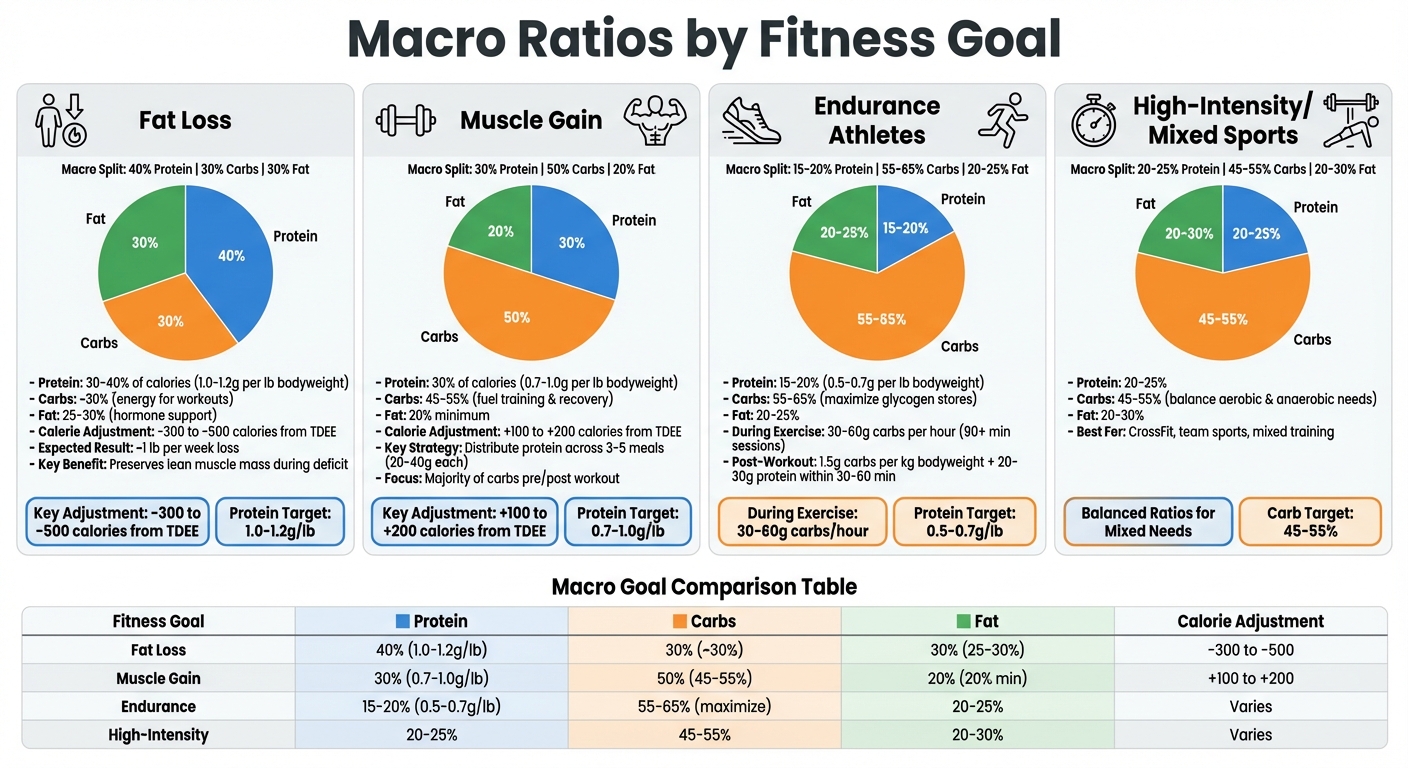
Macro Ratios Guide for Fat Loss, Muscle Gain, and Athletic Performance
Your fitness goals directly influence how you should tweak your macro ratios. The right balance can make a big difference – whether you’re aiming to lose fat while keeping muscle or building strength without unnecessary fat gain.
Macro Ratios for Fat Loss
If fat loss is your goal, a common macro split is 40% protein, 30% carbohydrates, and 30% fat. Protein takes center stage here (30–40% of your calories) because it helps maintain lean muscle during a calorie deficit. Plus, protein has a high thermic effect, meaning your body burns more calories digesting it.
"High-protein diets during caloric restriction preserve significantly more lean muscle mass compared to standard protein diets, even without resistance training."
Carbs, on the other hand, should stay at around 30%. This ensures you have enough energy for workouts and mental focus. Meanwhile, fats should make up 25–30% of your calories to support hormones and nutrient absorption. Avoid dropping fats below 20%.
To figure out your protein intake, aim for 1.0–1.2 grams per pound of body weight. For steady fat loss (about 1 pound per week), reduce your total daily energy expenditure (TDEE) by 300–500 calories. If your weight loss plateaus for more than two or three weeks, it might be time to weigh your food. Studies show manual logging can lead to underestimations of up to 30–50%.
| Deficit Size | Daily Calorie Reduction | Weekly Weight Loss | Best For |
|---|---|---|---|
| Small | 250 calories | ~0.5 lb | Those already lean |
| Moderate | 500 calories | ~1.0 lb | Most people; sustainable approach |
| Aggressive | 750 calories | ~1.5 lb | Individuals with higher body fat |
Next, let’s explore how to adjust macros if muscle gain is your primary goal.
Macro Ratios for Muscle Gain
Building muscle requires a different approach. A calorie surplus is essential, along with a higher carbohydrate intake to fuel training and recovery. For muscle gain, a typical macro split is 30% protein, 50% carbohydrates, and 20% fat.
Carbs take the spotlight here, accounting for 45–55% of your calories. They’re vital for replenishing glycogen and supporting high training volumes. Protein remains important for muscle repair and growth, so aim for 0.7–1.0 grams of protein per pound of body weight. To minimize fat gain, keep your calorie surplus modest – around 100–200 extra calories daily.
"When you’re cutting weight and you’re in a hypocaloric situation, you really have to try and work as much carbohydrate in as you can… it’ll help fuel whatever training you’re able to do."
- Dr. Eric Trexler, PhD in Sports Nutrition
Distribute your protein intake evenly across 3–5 meals, with each meal containing 20–40 grams. This helps optimize muscle protein synthesis throughout the day. For better performance and recovery, consume the majority of your carbs before and after workouts.
Macro Ratios for Endurance and High-Intensity Training
Endurance athletes – like runners and cyclists – require a macro balance tailored to long aerobic efforts. Their diets should include 55–65% carbohydrates, which are critical for maximizing glycogen stores. Protein, at 0.5–0.7 grams per pound of body weight, should make up 15–25% of total calories to support recovery without weighing down digestion. Fats generally stay between 20–25%.
For high-intensity or mixed-sport athletes (think CrossFit or team sports), a balanced split works best: 45–55% carbohydrates, 20–25% protein, and 20–30% fat. Carbs are key for both anaerobic bursts and sustained energy. If your workouts last over 90 minutes, aim to consume 30–60 grams of carbs per hour to keep energy levels steady. After training, refuel with 1.5 grams of carbs per kilogram of body weight and 20–30 grams of protein within 30–60 minutes to support recovery.
| Sport Category | Carbs (%) | Protein (%) | Fat (%) | Primary Nutritional Priority |
|---|---|---|---|---|
| Endurance | 55–65% | 15–20% | 20–25% | Maximize glycogen stores |
| Mixed/High-Intensity | 45–55% | 20–25% | 20–30% | Balance aerobic and anaerobic needs |
| Strength/Power | 40–50% | 25–35% | 20–30% | Support muscle repair and growth |
Personalized Macro Plans with N The Mix Nutrition

Once you’ve figured out how to calculate and tweak your macro ratios, personalized coaching takes things a step further by tailoring these numbers to fit your specific lifestyle. Generic macro calculators might give you a starting point, but they often overlook crucial factors like sleep quality, stress levels, and how your body reacts to different foods. That’s where personalized coaching shines. Combining app-based tracking with human guidance has been shown to improve success rates by 50%.
Benefits of a Personalized Macro Plan
At N The Mix Nutrition, certified coaches rely on biofeedback – such as energy levels, mood, strength, and even menstrual regularity – to fine-tune your macro plan each week. Feeling tired? Stalled weight loss for two weeks? Your coach can adjust your macros in real-time, eliminating the guesswork.
This approach emphasizes long-term, sustainable changes by linking nutrition to movement, mindset, and sleep habits. Instead of rigid meal plans, you’ll get a flexible strategy that prepares you for real-life situations, like dining out, traveling, or attending social events. This flexibility is key: adopting an 80/20 balance (80% healthy choices, 20% indulgences) can cut diet dropout rates by 60%.
"Macro counting remains the gold standard for achieving sustainable fat loss without the pitfalls of fad diets."
- Jodi Yerta, Owner & Lead Coach at N The Mix Nutrition & Coaching
For those recovering from years of yo-yo dieting, the program also incorporates metabolic repair techniques like reverse dieting. This process gradually increases your calorie intake while maintaining high protein levels, helping to rebalance hormones. Many clients see their maintenance calorie levels rise by 200–500 calories within 8–16 weeks. By integrating wearable tech, the program ensures your plan adapts to your daily lifestyle, bridging the gap between calculations and real-world living.
Up next, let’s take a closer look at the services that make this personalized coaching experience possible.
Services Offered by N The Mix Nutrition
N The Mix Nutrition offers three clear service levels, making it easy to choose an option that fits your needs. With a team of 16 certified coaches across the U.S., they provide tailored support for every client. Here’s what’s available:
- Nutrition Coaching ($129/month): Includes a custom macro plan, one-on-one coaching, weekly check-ins, and app access.
- Personal Training ($99/month): Features personalized workout plans and progress tracking.
- Bundle Package ($179/month): Combines both nutrition and fitness coaching, plus unlimited messaging for maximum accountability.
Every plan starts with a detailed assessment of your body composition, lifestyle habits (like sleep and stress), and personal goals. Weekly check-ins allow your coach to analyze your progress and make adjustments based on how your body is responding – not just the number on the scale. The service also syncs with advanced wearables like Oura and Whoop for real-time data tracking.
New clients can test the waters with a 14-day trial to explore the coaching and app features before committing. Additionally, many clients use HSA or FSA accounts to cover the cost, as nutrition coaching often qualifies as a reimbursable expense.
| Service Level | Monthly Price | Key Features |
|---|---|---|
| Nutrition Coaching | $129 | Custom macro plan, 1:1 coaching, weekly check-ins, app access |
| Personal Training | $99 | Personalized workout plan, 1:1 guidance, progress tracking |
| Bundle Package | $179 | Nutrition + fitness coaching, custom macros, unlimited messaging |
Conclusion
Figuring out the right macro ratios isn’t about sticking to a rigid formula – it’s about tweaking the balance of protein, carbs, and fats to match your personal goals. While calories determine whether you gain or lose weight, macros decide if that change comes from fat or muscle and how it impacts your overall performance. Protein helps preserve muscle, carbs fuel your workouts and mental focus, and fats play a key role in hormone regulation and nutrient absorption.
Success comes from both precise numbers and sustainable habits. Research shows that macro-balanced diets can help retain 25% more fat loss compared to low-carb trends, and tracking macros can preserve 20–30% more lean muscle during a calorie deficit. This is the difference between simply dropping pounds and transforming your body composition. Whether your goal is fat loss with a 40/30/30 split or muscle gain with a higher-carb approach (around 50%), the secret lies in adjusting your ratios as your body and goals evolve – not sticking to a cookie-cutter percentage.
"Macro counting remains the gold standard for achieving sustainable fat loss without the pitfalls of fad diets."
- Jodi Yerta, Owner & Lead Coach at N The Mix Nutrition
Accurate macro calculations are the foundation of real results. Start by reviewing your TDEE, then set protein intake based on your weight (0.8–1.2g per pound), and adjust carbs and fats based on your activity level and goals. Pay attention to biofeedback like energy, hunger, and workout performance to make weekly tweaks. If you find yourself stuck or overwhelmed, working with a coach can save you from trial-and-error by providing tailored adjustments to fit your lifestyle.
When done right, macro tracking shifts from being a restrictive diet to a flexible, sustainable approach that supports fat loss, muscle building, and overall metabolic health.
FAQs
How do I know my TDEE is accurate?
To get an accurate Total Daily Energy Expenditure (TDEE), start by calculating your Basal Metabolic Rate (BMR) and factoring in your activity level. It’s important to revisit this calculation regularly, especially if your weight, activity level, or body composition changes over time. These shifts can influence your TDEE, so make adjustments as necessary to stay on track with your goals.
What if my macro split makes me tired or hungry?
Feeling drained or constantly hungry? It might be a sign that your current macro balance isn’t working for your body. Meals lacking balance or not enough protein and healthy fats can leave you feeling fatigued and unsatisfied – especially if you’re in a calorie deficit. Tweaking your macro ratios, such as adding more protein or fats, can help boost energy levels and keep hunger in check. Since everyone’s needs are different, pay attention to how your body reacts and make adjustments to find what works best for you.
How often should I change my macros?
How often you should adjust your macros depends on your specific goals, how your body is responding, and the progress you’re making. A good rule of thumb is to reevaluate every 2 to 4 weeks, especially if you hit a plateau, notice changes in your energy levels, or see shifts in your body composition. Regular check-ins and adjustments can help keep your nutrition plan on track – whether you’re aiming for fat loss, building muscle, or maintaining your current progress.