
Macro tracking is a straightforward way to lose fat while maintaining muscle and energy. Instead of restricting food groups or following fad diets, you focus on balancing protein, carbs, and fats with personalized macro plans to hit daily targets. This method helps you create a calorie deficit while fueling your body properly, preserving muscle, and supporting hormone health (like testosterone). Here’s how it works:
- Protein: Builds and repairs muscle, keeps you full, and burns more calories during digestion.
- Carbs: Provide energy for workouts and daily activities.
- Fats: Support hormones and vitamin absorption.
Steps to Start:
- Calculate Calories: Use the Mifflin-St Jeor formula to find your daily energy needs (TDEE).
- Set a Deficit: Reduce calories by 10–20% for steady fat loss.
- Divide Macros: Common ratio is 40% carbs, 30% protein, 30% fat.
- Track Daily: Use a food scale and apps like MyFitnessPal or MacrosFirst for accuracy.
Key tip: Aim for 0.7–1.0g of protein per pound of body weight to protect muscle during fat loss. Track progress with weekly weigh-ins, measurements, and photos. Adjust macros only after 2–4 weeks of consistent tracking.
Start small – log one meal a day or focus on hitting your protein goal first. Over time, this habit can help you lose fat and maintain results without feeling deprived.
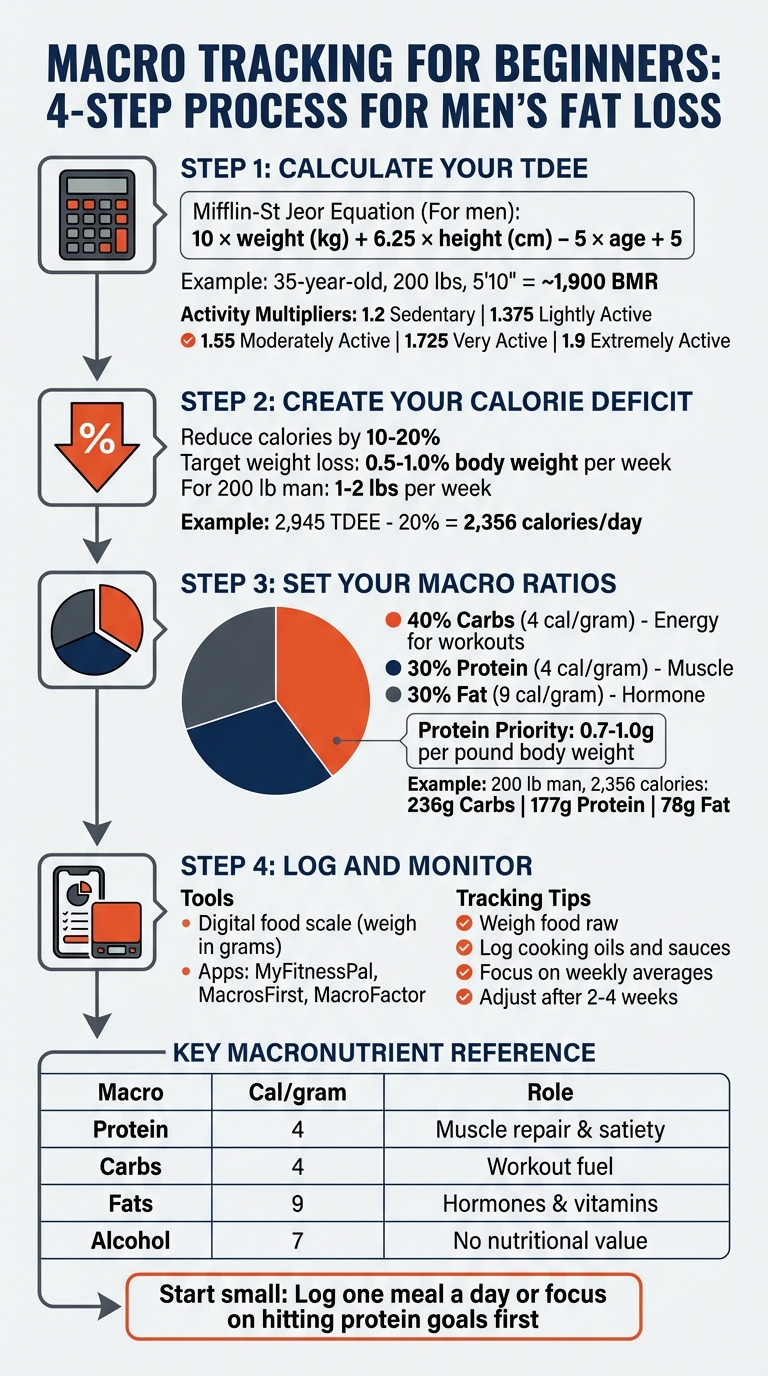
4-Step Macro Tracking Guide for Men’s Fat Loss
What Macronutrients Are and How They Support Fat Loss
Defining Macronutrients
Your body relies on three essential macronutrients, each serving a unique purpose. Protein provides 4 calories per gram and acts as the body’s builder, supplying amino acids crucial for repairing tissues and building muscle. Carbohydrates, also at 4 calories per gram, are the body’s primary energy source, fueling intense workouts and supporting brain function. Fats, offering 9 calories per gram, play a protective role by supporting hormone production (like testosterone), aiding in the absorption of vitamins A, D, E, and K, and safeguarding vital organs.
"The advantage of focusing on macronutrients over calories is that it tells you a bit more about the quality of your food, and how it affects your body."
- Brian St. Pierre, MS, RD, Precision Nutrition
Alcohol, while providing 7 calories per gram, lacks any nutritional value for fat loss or muscle building. Understanding these caloric differences can help explain why a small portion of nuts (high in fat) contains far more calories than a larger serving of rice (high in carbs), even if both align with your macro goals.
Now, let’s break down how these macronutrients work together to maximize fat loss.
How Macros Affect Fat Loss
Once you understand macronutrients, the next step is seeing how they shape your fat loss results. While calorie intake determines weight loss, macronutrient balance impacts the quality of that weight loss. A 2025 study revealed that tracking macros can help preserve 20% to 30% more lean muscle mass during fat loss compared to focusing solely on calorie counting. This is especially important for men, as maintaining muscle mass is key to keeping metabolism strong and achieving a lean, defined look.
Each macronutrient plays a specific role in supporting fat loss. Protein stands out as the most filling macronutrient, helping you manage hunger while in a calorie deficit. Additionally, digesting protein burns 20–30% of its calories, far more than carbs (5–10%) or fats (0–3%). Carbohydrates are essential for replenishing muscle glycogen, which keeps you energized and prevents that drained, flat feeling during workouts. Fats, on the other hand, are vital for maintaining healthy testosterone levels, which directly influences your ability to retain muscle and burn fat. For men targeting fat loss while staying strong, a good protein intake is 0.7–1.0 g per pound of body weight.
| Macronutrient | Calories per Gram | Primary Role in Fat Loss |
|---|---|---|
| Protein | 4 | Muscle repair, satiety, and preventing muscle tissue breakdown |
| Carbohydrates | 4 | Fueling workouts and replenishing muscle glycogen |
| Fats | 9 | Hormone regulation (e.g., testosterone) and vitamin absorption |
sbb-itb-29cdcd8
How to Calculate Your Calorie and Macro Targets
Step 1: Calculate Your Daily Calorie Needs
Start by figuring out your Basal Metabolic Rate (BMR) – the number of calories your body burns at rest. The Mifflin-St Jeor equation is a trusted method for this calculation. Here’s the formula for men:
10 × weight (kg) + 6.25 × height (cm) − 5 × age + 5
If you’re using pounds and inches, you’ll need to convert your measurements first: divide your weight by 2.2 to get kilograms and multiply your height in inches by 2.54 to get centimeters. For example, a 35-year-old man weighing 200 lbs (about 90.9 kg) and standing 5’10" (approximately 178 cm) would have a BMR of roughly 1,900 calories.
Once you have your BMR, multiply it by an activity multiplier to estimate your Total Daily Energy Expenditure (TDEE) – the total calories you burn in a day. For example, a sedentary person might use a multiplier of 1.2, while someone with moderate activity (exercising 3–5 days a week) might use 1.55. For the 200-lb man with moderate activity, the TDEE would be about 2,945 calories. Accurately gauging your activity level is key to setting realistic calorie goals.
| Activity Level | Multiplier | Description |
|---|---|---|
| Sedentary | 1.2 | Minimal movement, desk job |
| Lightly Active | 1.375 | Light exercise 1–3 days/week or 6,000–8,000 steps/day |
| Moderately Active | 1.55 | Moderate exercise 3–5 days/week or 8,000–12,000 steps/day |
| Very Active | 1.725 | Hard exercise 6–7 days/week or physically demanding job |
| Extremely Active | 1.9 | Intense daily training or professional athlete |
Once you’ve calculated your TDEE, you’ll use it to set a calorie deficit for fat loss.
Step 2: Create a Calorie Deficit
To lose fat, you need to eat fewer calories than you burn. A 10–20% calorie reduction is often recommended for steady, sustainable fat loss without extreme hunger or energy dips. Using the earlier example, a 20% deficit from 2,945 calories would result in a daily target of around 2,356 calories.
Aim to lose weight at a rate of 0.5–1.0% of your total body weight per week. For a 200-lb man, this means losing about 1–2 lbs weekly. This pace helps protect muscle mass while keeping your metabolism healthy.
Step 3: Set Your Macro Ratios
After calculating your calorie target, divide those calories among macronutrients (macros) to support fat loss and muscle maintenance. A common ratio is 40% carbohydrates, 30% protein, and 30% fat. This balance provides enough protein to protect muscle, carbohydrates for energy, and fats to support hormones.
Protein should be a priority – aim for 0.7–1.0 grams per pound of body weight. For the 200-lb man, that’s about 140–200 grams of protein daily. Protein not only helps maintain muscle during a calorie deficit but also has a higher thermic effect, meaning it burns 20–30% of its calories during digestion.
Fats should make up at least 20–25% of your total calories to maintain healthy hormone levels. The rest of your calories can come from carbohydrates, which fuel both workouts and daily activities.
"Your ability to accurately calculate and adjust your macros will determine whether you reach your fitness goals and how fast you get there."
- James, Healthy Eater
How to Track and Log Your Macros Daily
Converting Calories to Grams
To convert your macro percentages into grams, you’ll need to know how many calories each macronutrient provides: protein and carbohydrates each have 4 calories per gram, while fat contains 9 calories per gram. For instance, if a 200-pound man consumes 2,356 calories daily with a 40/30/30 macro split, his targets would be approximately 236g of carbohydrates, 177g of protein, and 78g of fat. If alcohol is part of the equation, remember it provides 7 calories per gram. Adjust your carbohydrate or fat intake accordingly on those days to stay within your calorie limits.
Tools and Methods for Tracking
Accurate tracking starts with a digital food scale. Weighing your food in grams or ounces ensures precision. Use the "tare" function to zero out the weight of your container before adding food. This method also lets you measure multiple ingredients in one bowl – just reset the scale to zero after each addition.
For tracking convenience, apps can be a game-changer. If you’re new to this, MacrosFirst is a great starting point, offering specific macro goal settings for free. MyFitnessPal boasts an extensive food database, though its gram-based tracking requires a subscription. MacroFactor goes a step further by dynamically adjusting your targets based on weight changes and past intake, with access to over 1.36 million verified food entries. Many of these apps also let you scan barcodes to quickly log packaged foods.
"Use a food scale for the best results. Measuring by weight will always be more accurate than measuring by volume."
- Brian St. Pierre, MS, RD, Precision Nutrition
With these tools and techniques, you’ll have a solid foundation for meeting your macro goals consistently.
Planning Meals Around Your Macros
Planning your meals ahead of time can turn your tracking app into a personalized menu, helping you avoid the stress of last-minute adjustments. When weighing food, always log it in the same state you measured it – for example, raw chicken weighs more than cooked chicken, and dry rice weighs less than cooked rice after it absorbs water. Stick to verified or commonly used entries in your app for better accuracy. Don’t forget to log cooking oils, butter, sauces, and dressings, as these are calorie-dense and can throw off your macros if overlooked.
To make things even easier, save meals that perfectly fit your macro targets as favorites in your app. This way, you can quickly repeat meals that work for you, making it simpler to stay on track with your goals. By planning and tracking consistently, you’ll be better equipped to maintain fat loss and support muscle retention over time.
Tracking Progress and Adjusting Your Plan
How to Monitor Your Results
To track fat loss effectively, use a combination of tools: the scale, body measurements, and progress photos. These methods give a clearer picture of your progress beyond the usual day-to-day fluctuations. For the scale, weigh yourself at the same time each day – ideally, first thing in the morning after using the bathroom. Focus on weekly averages rather than daily numbers to get a more accurate idea of trends.
Body measurements are another reliable tool. Measure areas like your waist, chest, hips, and arms every two weeks. Even a small reduction, such as a quarter-inch off your waist per week, is a good sign that fat loss is happening, even if the scale doesn’t reflect it right away. Progress photos, taken consistently in the same lighting and clothing, can also reveal changes that numbers might not capture yet.
Beyond physical metrics, pay attention to internal signals like energy levels, sleep quality, workout performance, and hunger. These factors provide valuable feedback on how your body is responding to your macro plan and whether your calorie deficit is manageable.
If progress slows down despite accurate tracking, it may be time to adjust your macros.
Adjusting Macros When Progress Stalls
Before making any changes, review your tracking for consistency over 2–4 weeks. A true plateau – where there’s no change in weight, measurements, or photos for three or more weeks – requires some adjustments. But first, ensure your tracking is accurate: Are you staying within 5 grams of your macro targets? Are you logging every meal, including those small, untracked snacks that could add 200–400 extra calories per day?
"The goal of macros is to eat as MUCH as possible, not as little. If you tighten up your adherence to your current macros before you cut them down, you might just start to see results – all while eating more food!"
- Tami Smith, NASM Certified Personal Trainer and Macro Coach
Once you’ve confirmed a true plateau, lower your daily calorie intake by 100–200. Focus on reducing carbs or fats while keeping protein steady to maintain muscle mass. Additionally, recalculate your macro targets after every 10–15 pounds lost, as your body will require fewer calories to sustain itself as you lose weight.
Getting Professional Coaching Support
If you’ve hit a wall with self-adjustments, professional coaching can provide tailored solutions. Certified coaches at N The Mix Nutrition take the guesswork out of macro adjustments by creating personalized plans based on your metabolic history, biofeedback, and even bloodwork, rather than relying on one-size-fits-all formulas. Weekly one-on-one check-ins can help identify tracking errors, like underestimating portion sizes or missing hidden calories from things like cooking oils.
Combining app-based tracking with professional coaching can improve fat loss success rates by 50%. Coaches can also introduce advanced strategies like macro cycling – using higher carbs on workout days – to break through plateaus and enhance fat loss by 10–15%. If restrictive diets have been an issue in the past, they can guide you through metabolic repair protocols, gradually increasing your maintenance calories by 200–500 over 8–16 weeks. This approach helps you eat more while still losing fat.
For those interested, N The Mix Nutrition offers a 14-day free trial of their program, with personalized plans starting at $129 per month. Their coaches provide the accountability and customized tweaks that turn macro tracking into a long-term, manageable system for achieving your goals. By combining consistent tracking, strategic adjustments, and expert guidance, you can develop a sustainable fat-loss strategy that works for you.
Tracking Macros for Fat Loss (10 Tips That Make it EASY)
Conclusion
Macro tracking doesn’t have to be complicated. The process boils down to four main steps: figure out your daily calorie needs, create a manageable 300–500 calorie deficit, set your macro ratios (with protein intake at 0.7–1 gram per pound of body weight), and track what you eat. Then, monitor your progress for 2–4 weeks and adjust as needed. This straightforward approach sets you up for steady, lasting fat loss.
The secret to success? Consistency. As Malia Frey, M.A., ACE-CPT, CHC, explains:
"Consistency matters far more than perfection".
By committing to habits like logging meals, weighing portions, and meeting protein goals, you’ll develop a deeper understanding of nutrition that sticks with you – even after you stop tracking every detail.
One of the biggest perks of macro tracking is flexibility. No food is off-limits, which helps avoid the restrictive mindset that often leads to diet burnout. Following an 80/20 approach – where 80% of your intake comes from whole, nutrient-dense foods and 20% allows for indulgences – has been shown to lower dropout rates by 60%. This balance makes it easier to maintain progress over the long term, turning a diet into a sustainable lifestyle.
If you’re just starting, ease into the process. Begin by tracking one meal a day or focusing on your protein target until it becomes second nature. Pre-log meals the night before and weigh food raw for the most accurate tracking. These small, consistent habits not only build awareness but also lead to noticeable changes in body composition after 4–6 weeks of steady effort.
Your journey starts with one logged meal. Build the habit, trust the process, and allow yourself room to learn and adapt. With consistency and patience, you’ll bridge the gap between your nutrition and fat loss goals, setting yourself up for long-term success.
FAQs
Do I need to track macros every day?
Tracking your macros every single day isn’t a must for everyone, but keeping an eye on them regularly can go a long way in helping you stick to your goals. It’s okay to allow some flexibility – it all depends on your personal needs and how you’re progressing. The main thing? Consistency. Find a routine that fits your lifestyle while leaving space for balance and long-term success.
How do I handle eating out while tracking?
Eating out while keeping track of your macros doesn’t have to derail your progress – it just takes a bit of planning. Start by checking restaurant menus ahead of time to get an idea of the options available. Since restaurant meals often have higher fat content, it’s smart to save some of your daily fat macros for that meal.
When you’re at the restaurant, tools like the plate method or macro-tracking apps can help you estimate your intake. If your goals are more rigid, you can adjust your macros earlier in the day to allow for a little more flexibility during your meal out. With some preparation and a flexible mindset, you can enjoy dining out while staying on track.
What should I do if my weight stops dropping?
If your weight loss or fitness progress plateaus, the first step is to double-check that you’re tracking your macros consistently and accurately. Often, stalls happen because of inconsistent logging or failing to tweak your macros as needed over time. Make sure you’re hitting your daily targets without fail.
If the stall continues for a few weeks despite consistent tracking, try making small adjustments to your protein, carb, or fat intake. Keep in mind, patience is crucial – real progress often takes 2-4 weeks of steady effort before you notice changes.