
When it comes to nutrition, mindful eating and macro tracking are two popular approaches, each with distinct goals and methods. Here’s the gist:
- Mindful Eating: Focuses on your body’s natural hunger and fullness cues, the sensory experience of eating, and building a healthier relationship with food. It’s about slowing down, eating without distractions, and tuning into how food makes you feel.
- Macro Tracking: Involves logging grams of protein, carbs, and fats to meet specific daily targets. This method is data-driven and ideal for achieving measurable goals like fat loss, muscle gain, or improved performance.
Quick Overview
- Mindful Eating Benefits: Supports emotional eating recovery, promotes long-term habits, and improves overall food awareness.
- Macro Tracking Benefits: Offers precise control, helps meet specific fitness goals, and ensures proper nutrient intake.
These methods aren’t mutually exclusive. You can combine them: use macro tracking for structure and mindful eating to stay connected to your body’s signals. This mix can help balance measurable results with sustainable habits.
Macro Tracking vs. Intuitive Eating – The Pros, Cons, and Where They Coexist
sbb-itb-29cdcd8
What Is Mindful Eating?
Mindful eating shifts attention away from external guidelines – like calorie tracking or hitting specific macros – and instead focuses on the internal experience of eating. Inspired by Buddhist mindfulness practices, it encourages being fully present with your physical sensations, cravings, and emotions during meals. It’s less about asking, "Am I getting enough protein?" and more about understanding whether you’re eating because you’re hungry or simply reacting to stress or boredom.
The purpose isn’t to control your plate with numbers but to reconnect with your body’s natural cues and build a healthier relationship with food. As Maxine Smith, RD, LD from Cleveland Clinic explains:
"Mindful eating focuses on the why and the how of eating, versus what’s promoted by many diets, which are more what to eat, how much to eat, maybe even when to eat."
This approach prioritizes awareness over restriction and curiosity over judgment. It avoids categorizing foods as "good" or "bad" and instead focuses on how the food makes you feel, both during and after eating.
Core Principles of Mindful Eating
A few simple practices form the foundation of mindful eating, helping you tune into your body’s natural signals. One key principle is slowing down. Your brain needs time to register fullness, and eating too quickly can lead to overeating before those signals kick in. To slow down, you can put your fork down between bites, chew thoroughly, and aim for meals to last at least 10–20 minutes.
Another important practice is removing distractions. Turn off the TV, put your phone away, and avoid multitasking during meals. This allows you to fully engage your senses – taking in the taste, texture, and aroma of your food. By focusing on these sensory details, you’re more likely to recognize when you’re satisfied, often with smaller portions than you might typically eat.
Mindful eating also means listening to your body’s cues rather than following external rules or schedules. Before eating, ask yourself, "Am I physically hungry, or am I eating out of habit, stress, or convenience?" During the meal, check in with your hunger levels and aim to stop eating when you feel comfortably satisfied – about 80% full – rather than overstuffed. These small, deliberate changes can transform your eating experience and lead to meaningful results.
Benefits of Mindful Eating
The benefits of mindful eating go far beyond the dinner table. Studies have shown it can improve both physical and mental health. For example, a study published in the journal Appetite in August 2024 linked mindful eating to a lower body mass index (BMI), better diet quality, and increased physical activity. In a 12-week mindful eating program, participants lost an average of 4 pounds (1.9 kg) and reported greater self-acceptance.
Mindful eating can also help break the frustrating cycle of yo-yo dieting. While traditional dieters often regain 50% of lost weight within 2 years and 80% within 5 years, mindful eating focuses on lasting behavioral changes rather than temporary restrictions. It’s also been effective in reducing binge eating by creating a pause between triggers and your response.
Taking the time to savor your food can improve digestion, reduce bloating, and leave you more satisfied with smaller portions. By distinguishing between physical hunger and emotional triggers, you’re more likely to make healthier food choices and feel more connected to how food impacts your body. As Maxine Smith puts it:
"It’s a very empowering approach versus a deprivation approach. You’re regaining control over food rather than letting it take control of you."
What Is Macro Tracking?
Macro tracking, sometimes called flexible dieting or IIFYM (If It Fits Your Macros), is a nutrition strategy where you log the daily grams of the three main macronutrients: protein, carbohydrates, and fats. Unlike basic calorie counting, which only tracks total energy intake, macro tracking digs deeper into what makes up your food. This approach ensures your body gets the right fuel for goals like fat loss, muscle maintenance, or even hormonal balance.
Here’s a quick breakdown: protein and carbohydrates each provide 4 calories per gram, while fats deliver 9 calories per gram. That means two meals with the same calorie count can affect your body very differently depending on how those calories are divided among these macronutrients.
Jodi Yerta, Owner & Lead Coach at N The Mix Nutrition & Coaching, sums it up perfectly:
"Macro counting – tracking proteins, carbs, and fats – allows precise control over your calorie intake while fueling your body optimally."
Think of macro tracking as "nutritional training wheels." It teaches portion control and helps you understand food density. This is especially useful because studies show people often underestimate how much they eat – sometimes by as much as 30% to 50%.
How Macro Tracking Works
Putting macro tracking into action involves a structured four-step process: calculating energy needs, setting macro ratios, tracking your intake, and adjusting as needed.
- Calculate Your Energy Needs: Start by figuring out your Total Daily Energy Expenditure (TDEE). This involves using the Harris-Benedict equation to estimate your Basal Metabolic Rate (BMR) and multiplying it by an activity factor.
- Set Your Macro Ratios: Your macro breakdown depends on your goals. A common starting point is 40% carbohydrates, 30% protein, and 30% fat. But these ratios can shift. For example, if you’re working on muscle gain, you might bump carbs up to 50% or more. On the other hand, a ketogenic approach might reduce carbs to just 5–10%.
- Track Your Intake: Use tools like MyFitnessPal, Cronometer, or MacroFactor to log your food. Measuring portions with a digital scale in grams or ounces is the most accurate method. To make things easier, many experts suggest planning meals the night before or in the morning to avoid making rushed choices when you’re already hungry.
- Adjust Based on Progress: As your body responds, tweak your targets. One of the great things about macro tracking is its flexibility – you can enjoy your favorite foods as long as you hit your daily goals. Many follow the 80/20 rule: aim for 80% whole, minimally processed foods and leave 20% for indulgences.
Benefits of Macro Tracking
Macro tracking does more than just help with weight management. By focusing on food quality and composition, it ensures weight loss primarily comes from fat rather than muscle or bone. In fact, studies show that people following macro-based diets retain 20% to 30% more muscle during fat-loss phases compared to those who only count calories.
This method also improves diet adherence by giving you clear, measurable goals instead of vague guidelines. It’s particularly helpful for those with specific fitness objectives, like prepping for competitions or maintaining muscle mass while using GLP-1 weight-loss medications – a growing trend in 2026.
Brian St. Pierre, MS, RD, from Precision Nutrition, explains:
"The advantage of focusing on macronutrients over calories is that it tells you a bit more about the quality of your food, and how it affects your body."
Beyond body composition, macro tracking helps you understand how different foods influence your energy, workout performance, and hunger levels throughout the day. For beginners, many experts recommend starting with protein – aiming for 1.6–2.2 grams per kilogram of body weight – before fine-tuning carbs and fats. This step-by-step approach prevents overwhelm and builds confidence.
Looking ahead, macro tracking in 2026 is becoming even more personalized. AI tools and wearables like Oura and Whoop now integrate real-time biomarker data, making it easier than ever to tailor your nutrition plan. Combined with mindful eating practices, this approach creates a balanced, modern strategy for achieving your health goals.
Main Differences Between Mindful Eating and Macro Tracking
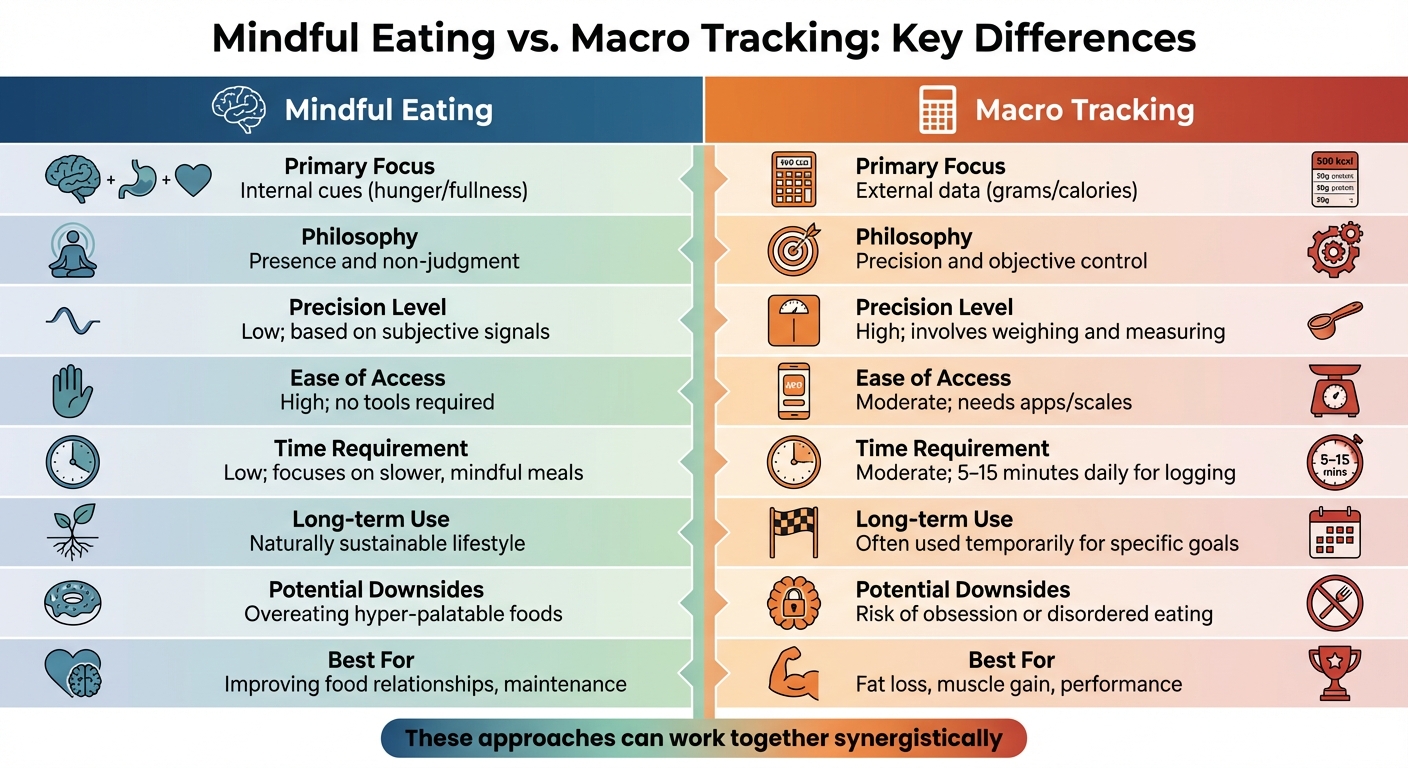
Mindful Eating vs Macro Tracking: Key Differences and Benefits Comparison
Mindful eating and macro tracking take completely different paths when it comes to managing food and nutrition. Mindful eating leans on your body’s natural cues – like hunger, fullness, and how food impacts your mood and energy levels – to guide your choices. On the other hand, macro tracking relies on hard numbers, specifically grams of protein, carbs, and fats, to hit pre-set nutritional targets.
The approaches also differ in how they view food. Mindful eating is all about the experience: savoring flavors, tuning into emotions, and noticing how food makes you feel. Macro tracking, meanwhile, is about precision, focusing on the exact breakdown of macronutrients to achieve specific goals like losing fat or maintaining muscle. As researcher Joseph B. Nelson explains, mindful eating involves "paying attention on purpose, in the present moment, and nonjudgmentally".
The outcomes they prioritize are also distinct. Mindful eating aims to nurture a healthier relationship with food, while macro tracking zeroes in on measurable results, like changes in body composition. Eric Trexler, PhD, highlights this difference:
Mindful eating is an evidence-based strategy that may have beneficial effects pertaining to behavioral and psychological elements of eating… Macro tracking is an evidence-based strategy that appears to effectively facilitate weight management.
These contrasting foundations set the stage for a closer comparison.
Comparison Table
| Feature | Mindful Eating | Macro Tracking |
|---|---|---|
| Primary Focus | Internal cues (hunger/fullness) | External data (grams/calories) |
| Philosophy | Presence and non-judgment | Precision and objective control |
| Precision | Low; based on subjective signals | High; involves weighing and measuring |
| Ease of Access | High; no tools required | Moderate; needs apps/scales |
| Time Requirement | Low; focuses on slower, mindful meals | Moderate; 5–15 minutes daily for logging |
| Long-term Use | Naturally sustainable lifestyle | Often used temporarily for specific goals |
| Potential Downsides | Overeating hyper-palatable foods | Risk of obsession or disordered eating |
| Best For | Improving food relationships, maintenance | Fat loss, muscle gain, performance |
Interestingly, these two methods don’t have to be at odds – they can complement each other. Macro tracking gives you the hard numbers on what you’re eating, while mindful eating provides insight into how those choices make you feel. Together, they blend data with personal awareness, creating a balanced approach to nutrition.
When to Use Mindful Eating, Macro Tracking, or Both
The right approach depends on your health goals. Neither mindful eating nor macro tracking is universally superior – they serve different purposes and can be tailored to individual needs.
Who Should Use Mindful Eating?
Mindful eating is a great fit if you’re focused on creating a sustainable lifestyle rather than chasing specific numbers on a scale. It’s especially helpful for maintaining a healthy weight, addressing emotional or binge eating, and improving your relationship with food.
This method works well if you can eat without distractions and want to move away from strict diet rules. Studies show mindful eating helps foster a healthier connection with food. As researcher Joseph B. Nelson puts it:
The purpose of mindful eating is not to lose weight, although it is highly likely that those who adopt this style of eating will lose weight.
Who Should Use Macro Tracking?
If you have specific body composition goals – like fat loss, muscle growth, or athletic performance – macro tracking is your go-to method. It’s particularly valuable for metabolic recovery after years of yo-yo dieting, which is increasingly relevant as preventive health and metabolic optimization gain traction in 2026. This approach provides precision, and studies suggest it can improve diet adherence by 40%.
Macro tracking works best for those who prefer measurable results, cook regularly, and don’t have a history of disordered eating. It’s a temporary tool designed to help you meet specific goals.
Using Both Approaches Together
As your goals shift, combining mindful eating with macro tracking can offer the best of both worlds. Macro tracking provides structure, while mindful eating helps you tune into your body’s natural hunger signals.
For example, you might start with macro tracking for 4 to 16 weeks to build awareness of portion sizes and how macronutrient ratios affect your body. During this time, pay attention to how your energy, mood, and hunger levels fluctuate before and after meals. This blend of subjective and objective data can guide adjustments. Once you’ve achieved your goals, you can gradually transition to untracked meals, using the skills you’ve developed to estimate portions confidently.
A hybrid strategy like the 80/20 rule – tracking 80% of your intake while leaving 20% for mindful, untracked choices – can make the process more sustainable. This approach has been shown to cut program dropout rates by 60%, and combining app-based tracking with professional coaching can increase success rates by 50%.
How N The Mix Nutrition Supports Both Approaches
N The Mix Nutrition bridges the gap between mindful eating and macro tracking through personalized coaching. Their team of 16 certified coaches uses macro tracking as an educational tool to help clients understand portion sizes and food composition. Over time, clients transition to a more intuitive, sustainable approach. This method combines the structure of macro tracking with the self-awareness that comes from mindful eating.
Their philosophy is simple: focus on "habits, not hacks." As they put it:
We focus on habits, not hacks. Nutrition, movement, mindset, sleep – all connected. We help you master the fundamentals so results actually last.
The coaching process prioritizes practical, actionable guidance over raw data. Weekly check-ins allow coaches to assess biofeedback like energy, sleep, mood, and hunger, adjusting plans based on how your body responds – not just the number on the scale. The goal? To empower you to make confident food choices in any situation, whether dining out, traveling, or attending social events.
Personalized Macro-Based Nutrition Plans
For $129 per month, the Nutrition Coaching program delivers personalized macro targets tailored to your goals – whether you’re aiming for fat loss, muscle gain, or recovering from years of yo-yo dieting. The package includes one-on-one coaching, app-based tracking, and weekly progress reviews.
Coaches encourage an 80/20 approach: 80% whole foods and 20% flexibility for treats. Research shows that combining app tracking with professional coaching boosts success rates by 50%.
For example, in early 2026, a Kansas City client started with a custom plan of 2,200 calories (180g carbs, 140g protein, 73g fat). By aligning their macros with their workout routine, they shed 15 pounds in 12 weeks – without excessive hunger.
Mindset and Habit Coaching
Beyond macro tracking, N The Mix Nutrition offers "Beyond Macros" coaching, which focuses on mindset, education, and building sustainable habits. This program helps clients shift from detailed tracking to intuitive eating. You’ll learn to identify hunger cues, eat without distractions, and make decisions based on how your body feels – not just what fits your macros. These skills help you develop a healthier, more balanced relationship with food.
Brian L., a program graduate, shared his experience:
I won’t be able to go back to the overweight me again. I genuinely thought my diet was good before I joined. I learned a ton during the challenge, gained some confidence, and had fun doing it.
Bundle Packages
For $179 per month, the Bundle Package combines personalized macro plans, workout programs, and unlimited coach messaging for a complete nutrition and fitness solution. This option is ideal for clients focused on body composition goals that require both precise nutrition and strength training. A 14-day free trial lets you explore the coaching style risk-free before committing. Plus, HSA/FSA payments are accepted, making the program more accessible.
| Service Tier | Monthly Price | Key Features |
|---|---|---|
| Nutrition Coaching | $129 | Personalized plan, one-on-one coaching, app access, weekly check-ins |
| Personal Training | $99 | Custom workout plan, one-on-one guidance, progress tracking |
| Bundle Package | $179 | Nutrition + Fitness coaching, unlimited messaging, custom macros |
These programs combine detailed strategies with mindful eating principles, offering a balanced path to long-term success.
Conclusion
Mindful eating and macro tracking work hand in hand to create a balanced approach to nutrition. Macro tracking provides clear, measurable data, while mindful eating adds a personal touch by helping you tune into how food impacts your hunger, energy, and overall well-being. As Eric Trexler, PhD, puts it:
Macro tracking and mindful eating are not merely compatible, but can even be synergistic in nature.
Combining these methods often leads to the best results. Start with macro tracking to get a handle on portion sizes and the nutritional makeup of your meals. Studies suggest that pairing tracking apps with coaching can further enhance success. Once you’ve built a solid foundation, incorporate mindful eating habits: eat without distractions, pay attention to your hunger signals, and notice how certain foods influence your mood and energy levels. This combination allows you to make thoughtful food choices in any situation, whether you’re closely tracking or leaning on your intuition. Over time, this adaptable approach evolves to fit your changing needs.
Your strategy will naturally shift based on your goals and life circumstances. For instance, if you’re aiming for specific body composition changes or recovering from a history of restrictive dieting, macro tracking offers structure and accountability. On the other hand, if you’re focused on maintaining results or improving your relationship with food, mindful eating provides the flexibility and self-awareness necessary for long-term success. Many people find themselves alternating between these approaches throughout their journey – and that’s completely normal. The key is to align your methods with your current goals.
For those seeking expert guidance, N The Mix Nutrition offers personalized coaching designed to integrate both approaches. Their certified coaches use macro tracking as a teaching tool while also helping clients develop mindset skills for sustainable habits. With plans starting at $129 per month and a 14-day free trial, you can explore how these methods can work together to create lasting results.
The takeaway? You don’t have to choose between data and intuition. A blended approach, supported by expert coaching, can help you achieve and sustain your goals.
FAQs
How do I know if macro tracking is right for me?
Macro tracking works well if you like a structured way to manage your food intake, particularly for goals like losing fat or building muscle. It allows you to better understand your eating habits and gives you precise control over your macronutrient intake.
On the other hand, if tracking feels stressful or leads to unhealthy patterns, mindful eating could be a better fit. The key is to choose an approach that supports both your goals and your mental health.
Can I combine mindful eating with macro tracking without feeling obsessed?
Yes, you can combine mindful eating with macro tracking without it becoming overwhelming, as long as you approach it with balance and self-awareness. Mindful eating emphasizes tuning into your body’s hunger and fullness signals, while macro tracking acts as a flexible guide. By slowly shifting from strict tracking to mindful habits and focusing on staying aware of your body’s needs, you can maintain a positive relationship with food without feeling overly consumed by the process.
What’s a simple way to start mindful eating if I’m used to tracking?
To begin practicing mindful eating, try shifting your attention away from external tracking tools and toward your body’s natural signals, such as hunger and fullness. Notice how different foods influence your energy levels and mood. Take a moment to check in with yourself before, during, and after meals. This approach helps you better understand your body’s needs, making it easier to enjoy food while staying aligned with your health goals.