
You’ve been dieting and exercising, but the scale won’t budge. Here’s why: small, often unnoticed habits might be the issue. From inaccurate calorie tracking to hidden calories in food, low protein intake, and unrealistic goals, these factors can quietly derail progress. This guide breaks down eight common reasons weight loss stalls and offers practical solutions:
- Inaccurate calorie tracking: Hidden calories from oils, condiments, or fitness tracker errors add up.
- Low protein intake: Protein controls hunger, preserves muscle, and boosts metabolism.
- Oversized portions: Even healthy foods like nuts or avocados can push you over your calorie limit.
- Hidden calories in processed foods: Sneaky sugars and fats in "healthy" options can sabotage your deficit.
- Imbalanced macronutrients: Too many simple carbs or not enough protein can hinder fat loss.
- Dehydration: Thirst can feel like hunger, and low water intake slows metabolism.
- Inconsistency: Weekend overeating or skipping workouts undoes weekday efforts.
- Unrealistic goals: Overly strict diets or focusing only on the scale can lead to frustration.
To overcome these challenges, focus on accurate food tracking, balanced macros, portion control, staying hydrated, and setting realistic targets. Small, consistent changes can make a big difference.
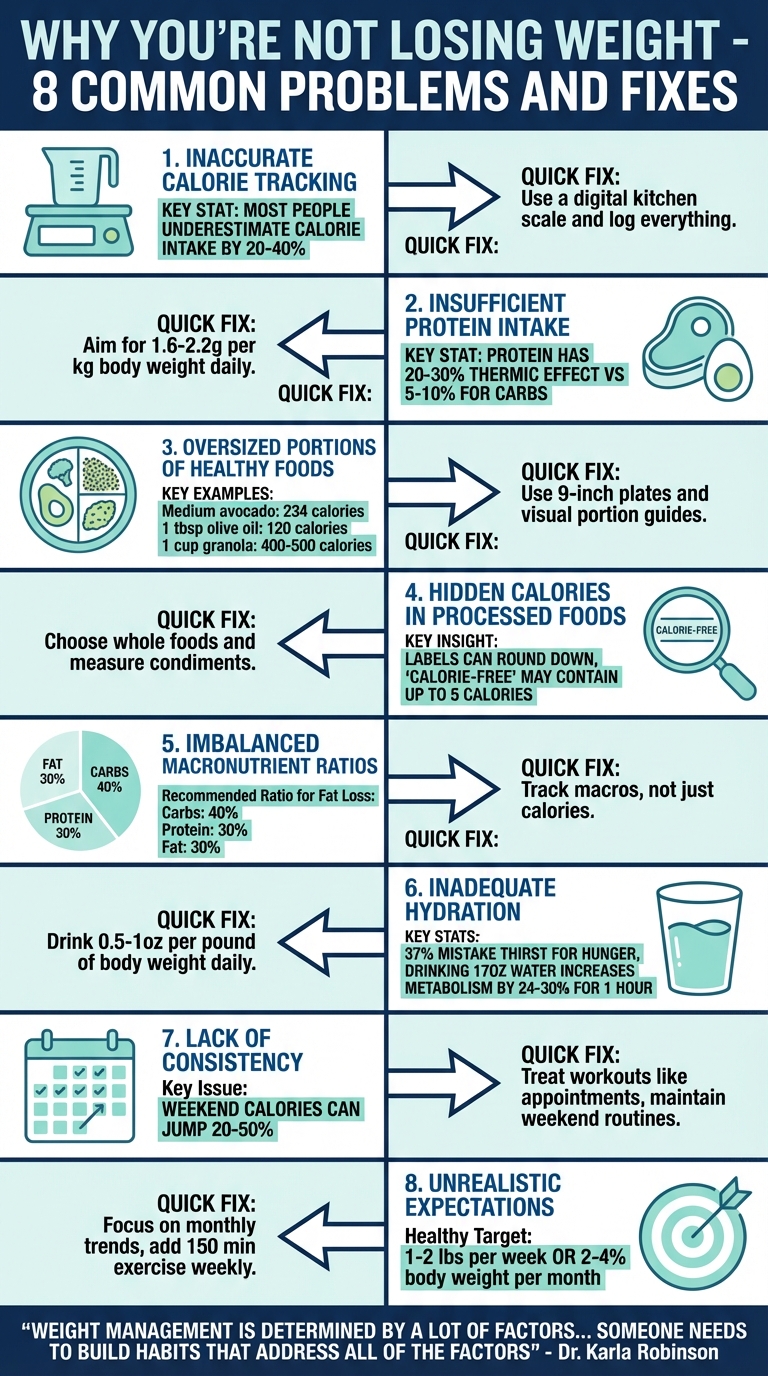
8 Common Weight Loss Problems and Solutions Infographic
1. Inaccurate Calorie Tracking
Why Tracking Matters
Did you know most people underestimate their calorie intake by 20–40%? That gap alone can derail your progress. While big meals might get tracked correctly, it’s the hidden calories – like a tablespoon of olive oil (around 120 calories), a handful of almonds, or those extra bites while cooking – that often slip through the cracks.
These small mistakes add up fast. For example, a heaping tablespoon of peanut butter might pack 180–200 calories, while a level spoonful contains closer to 90–100. And calorie-dense foods like nuts, oils, and cheese are often underestimated when eyeballed. Even logging cooked food incorrectly can throw things off – 100 grams of raw rice cooks into about 300 grams, so recording cooked weight as raw can drastically overstate calorie counts.
"Small errors repeated daily can mean hundreds of extra calories per week."
– Brad Newton, Fitness Coach
Another common trap? Eating back calories from fitness trackers. These devices often overestimate workout burns by 20–50%. Treating those numbers as a green light to eat more can erase your calorie deficit. And let’s not forget the weekend effect – skipping food logs on Saturdays and Sundays can wipe out the careful tracking done during the week.
The good news? You can fix these pitfalls with better tracking habits.
Solution: Use Food Tracking Tools
To tighten up your tracking, start with the basics: a digital kitchen scale. Weigh calorie-dense foods like nuts, oils, and cheese in grams before cooking. And follow this golden rule: If it passes your lips, log it. This includes everything – cooking spray, coffee creamer, condiments, and even those "just one bite" moments.
Food tracking apps like MyFitnessPal, Cronometer, or MyNetDiary can make this process easier. Look for verified entries (usually marked with a green check) to avoid errors, and log your meals before you eat so you can adjust portions as needed.
Accurate tracking is your first step toward breaking through weight loss plateaus. If you’re struggling to refine your habits, N The Mix Nutrition offers one-on-one coaching to help pinpoint blind spots, integrate precision into your routine, and keep you accountable with weekly check-ins.
sbb-itb-29cdcd8
2. Insufficient Protein Intake
The Role of Protein in Weight Loss
Not eating enough protein can leave you feeling hungry and make weight loss harder. Why? Protein helps regulate hunger hormones. Without it, your body produces more ghrelin (the hunger hormone) and less of the hormones that help you feel full, like GLP-1, PYY, and CCK. This imbalance can lead to constant cravings and unplanned snacking, which can derail your calorie deficit .
Another issue is muscle loss. When your protein intake is too low, your body may break down muscle for energy – up to 20–30% of the weight you lose could come from muscle. This is a problem because muscle burns more calories at rest, so losing it slows your metabolism. On top of that, protein has a thermic effect of 20–30%, meaning your body burns about a third of its protein calories just digesting it. Compare that to carbs (5–10%) and fats (0–3%), and it’s clear that protein is a metabolism-boosting powerhouse .
"If you don’t get enough protein, your body can’t function properly – nearly all reactions in our body require protein."
– Maddie Pasquariello, MS, RDN
When your metabolism slows, maintaining a calorie deficit becomes tougher, and the chances of regaining weight go up. Studies show that increasing protein intake from 15% to 18% of your daily calories can cut the risk of weight regain in half.
Solution: Adjust Protein Intake
To protect your muscle mass and keep hunger in check, aim for 1.6–2.2 grams of protein per kilogram of body weight daily. For someone weighing 165 pounds (75 kilograms), that’s about 120–165 grams of protein per day. Spread this intake across your meals – around 30–40 grams each at breakfast, lunch, and dinner – for better muscle protein synthesis and steady energy levels .
Starting your day with a high-protein breakfast (about 30 grams) can reduce hunger by 20–30% for the rest of the day. Focus on lean protein sources like chicken breast (31 grams per 100 grams cooked), Greek yogurt (18–20 grams per 200 grams), or eggs (12–14 grams for two large eggs) to get the most protein with fewer calories .
If hitting your protein goals feels overwhelming, N The Mix Nutrition offers custom macro plans to make things easier. These plans ensure your protein intake supports fat loss while maintaining muscle and metabolic health. Once your protein intake is on track, portion control can help fine-tune your diet even further.
3. Oversized Portions of Healthy Foods
The Portion Pitfall
You could be filling your plate with all the “right” foods – like avocados, nuts, olive oil, or granola – and still not see the scale budge. Why? Even healthy foods can derail your calorie deficit when portions get out of hand. This is often linked to the "health halo effect", where foods perceived as healthy lead to overeating without realizing it.
Take avocados, for instance. A medium avocado packs about 234 calories, yet many people consume half or even a whole one at once, while the recommended portion is just 1/3 to 1/5 of the fruit. Olive oil is another sneaky culprit – each tablespoon contains 120 calories, but a quick, unmeasured pour can triple that amount. And granola? A single cup can contain 400–500 calories, far exceeding the suggested serving of 1/4 to 1/3 cup.
"Nuts are a great example of a healthy, nutrient-rich food that should be consumed in small portions. It’s easy to eat a lot of them at a time without realizing how high in calories they are."
– Julia Zumpano, RD, LD, Cleveland Clinic
Adding to the challenge, most people underestimate their calorie intake by 20–30% [8,35]. This often includes forgetting to count cooking oils, sauces, or healthy snacks. These "hidden" calories can quietly turn a calorie deficit into weight maintenance – or even weight gain. Tightening up portion sizes is an effective way to stay on track, alongside accurate tracking and balanced macronutrient choices.
Solution: Portion Control Strategies
The goal isn’t to cut out your favorite healthy foods – it’s to measure them more carefully. Start by using the 9-inch plate rule. Swap your standard 11-inch dinner plates for 9-inch ones to naturally limit portions. Fill half the plate with low-calorie vegetables, one-quarter with lean protein (about the size of your palm), and one-quarter with complex carbs (roughly the size of your fist).
For calorie-dense foods, visual cues can be a game-changer when you don’t have a scale handy. Here are a few examples:
- A serving of nuts should be about the size of a golf ball (1 ounce).
- Cheese? Think the size of a 9-volt battery (1 ounce).
- Nut butter or oil? Match it to the size of your fingertip (1 teaspoon).
Pre-portioning snacks into small containers instead of eating straight from the bag can also help curb mindless overeating.
| Food Item | Common Serving | Recommended Serving |
|---|---|---|
| Avocado | ½ to 1 whole fruit | 1/3 to 1/5 of a medium fruit |
| Olive Oil | "Quick drizzle" (~3 tbsp) | 1 tablespoon |
| Granola | Full cereal bowl | 1/4 to 1/3 cup |
| Nuts | Large handfuls | 1 ounce (size of a golf ball) |
| Pasta | 2+ cups | 1 cup cooked (size of a baseball) |
Measuring portions accurately can help you avoid hidden calories that might be sabotaging your progress.
For those seeking extra guidance, N The Mix Nutrition coaching provides tailored serving recommendations based on your specific weight loss goals. This personalized approach takes the guesswork out of portion control, helping you stay in a calorie deficit without feeling deprived or second-guessing your choices.
4. Hidden Calories in Processed Foods
Identifying Hidden Calories
Processed foods can quietly derail your weight loss efforts. That seemingly "healthy" granola bar, low-fat salad dressing, or organic snack? They often pack hidden sugars and fats to enhance flavor. Labels like "organic", "natural", or "gluten-free" can lull you into a false sense of security, but many of these items are calorie-dense.
The issue often lies in the fine print. Ingredients like high-fructose corn syrup, cane sugar, honey, dextrose, nectar, or fruit juice concentrate sneak in extra sugars. Similarly, unhealthy fats such as partially hydrogenated oils and shortening are common culprits. Even calorie counts can be misleading – labeling laws allow rounding, so a "calorie-free" Splenda packet may still contain up to 5 calories. Use four in your coffee, and you’ve unknowingly added 20 calories.
Portion sizes also play tricks on us. A tablespoon of mayonnaise has around 94 calories, but many people use two or three on a sandwich. That "splash" of olive oil you pour? It might be closer to 2 tablespoons (240 calories) instead of the 120 calories you thought. These small additions – whether it’s cooking oils, condiments, or even milk in coffee – can easily cancel out a 300–500 calorie deficit.
"Most people drastically underestimate the amount of calories they consume each day. They forget to count cooking oils, sauces, dressings, and alcohol." – Brittany Werner, M.S., R.D.N., Director of Nutrition Coaching at Working Against Gravity
To combat this, check total carbohydrate counts on labels to spot hidden sugars. Use a digital scale to measure calorie-dense items like peanut butter and dressings instead of relying on guesswork. When eating out, ask for sauces and dressings on the side so you can control portions. Keeping detailed food logs helps track even the smallest calorie sources, making smarter choices easier.
Solution: Swap for Whole Foods
Now that you’re aware of hidden calories, focus on whole foods to regain control. Fresh fruits, vegetables, lean proteins, and whole grains naturally lack the additives that sneak in extra calories. Accurate tracking and portion control are key, but choosing whole foods can also significantly reduce unintended calorie intake.
Swapping refined carbs for whole-food options can make a big difference. For instance, replace white rice (210 calories per cup) with cauliflower rice (75 calories per cup) or trade semolina pasta (220 calories per cup) for zucchini noodles (35 calories per cup). Other smart swaps include using applesauce instead of vegetable oil in baking, cutting out 1,925 calories and 218 grams of fat per cup. Replace mayonnaise with hummus to slash fat from 20 grams to just 2.7 grams per 2 tablespoons while adding protein and fiber. Switching from whole milk to fat-free milk saves nearly 70 calories per cup. Even swapping sugary sodas for water infused with fresh fruit can eliminate about 140 calories per 12-ounce serving.
How you cook matters, too. Instead of frying with oil, try steaming, baking, poaching, or air-frying. Use herbs, spices, and lemon juice for flavor instead of calorie-heavy condiments. These small adjustments add up quickly, helping you cut calories without feeling deprived.
For a tailored approach, N The Mix Nutrition coaches can help you pinpoint hidden calorie sources in your diet and recommend personalized swaps to support your weight loss goals. Their evidence-based guidance takes the guesswork out of label reading and ensures your choices align with a sustainable calorie deficit.
5. Imbalanced Macronutrient Ratios
The Impact of Macro Ratios
Hitting your calorie goals is important, but ignoring the balance of macronutrients – protein, carbohydrates, and fats – can still hold back your weight loss efforts. Each macronutrient has a unique role in energy use, hunger control, and fat storage. For example, eating too many simple carbs compared to protein can lead to blood sugar spikes and higher insulin levels, which encourage fat storage. Foods like white bread, sugary treats, and processed snacks digest quickly, often leaving you with energy crashes and cravings.
Protein stands out as the most filling macronutrient and burns the most calories during digestion (20–30% of its calories). If your diet lacks enough protein while losing weight, you risk losing muscle mass, which can lower your resting metabolic rate. Research from 2025 showed that diets with balanced macros helped people lose 25% more fat and retain 20–30% more muscle compared to low-carb diets.
Signs that your macronutrient ratios are off include constant hunger, feeling tired during workouts, frequent sugar crashes, or hitting a weight loss plateau despite eating fewer calories. Additionally, not getting enough fat (less than 20% of your daily intake) can disrupt hormone production, especially for women.
Solution: Balance Your Macros
Start with a balanced approach. A recommended ratio for fat loss is 40% carbohydrates, 30% protein, and 30% fat. If you’re aiming for more aggressive fat loss while preserving muscle, you might consider a higher protein ratio, such as 40% protein, 40% carbohydrates, and 20% fat. To maximize satiety and support your metabolism, aim for 1.6–2.2 grams of protein per kilogram of body weight (or about 0.8–1 gram per pound).
| Goal | Carbs % | Protein % | Fat % | Primary Benefit |
|---|---|---|---|---|
| Fat Loss | 35–40% | 35–40% | 20–25% | Muscle preservation & high satiety |
| Maintenance | 40% | 30% | 30% | Balanced energy & sustainability |
| Insulin Resistance | 25% | 30% | 45% | Improved insulin sensitivity |
Make simple swaps to improve your carb choices. Replace white rice with quinoa, white bread with whole grains, and sugary snacks with fiber-rich vegetables. When buying packaged foods, check the labels: prioritize items where protein grams outweigh sugar grams, and aim for less than 8 grams of sugar per serving.
For example, in 2026, a Kansas City client followed a fat-loss macro plan of 2,200 calories (180 grams of carbohydrates, 140 grams of protein, and 73 grams of fat). Over 12 weeks, they shed 15 pounds without the constant hunger often associated with low-calorie diets.
If you’re looking for expert guidance, N The Mix Nutrition offers personalized coaching and nutrition resources to help fine-tune your macro ratios based on factors like sleep, energy, and stress. Jodi Yerta, Owner and Lead Coach at N The Mix Nutrition & Coaching, explains:
"Macro counting – tracking proteins, carbs, and fats – allows precise control over your calorie intake while fueling your body optimally. Unlike generic calorie counting, it promotes hormonal balance, muscle retention, and energy stability."
Through strategies like macro counting and reverse dieting, you can even boost your maintenance calorie level by 200–500 calories in just 8–16 weeks, helping to correct metabolic slowdowns. Getting your macros right is a key step toward breaking through weight loss barriers, such as hydration and workout consistency.
6. Inadequate Hydration
The Importance of Hydration
Did you know that your brain can confuse thirst with hunger? This mix-up happens when you’re dehydrated, leading to unnecessary snacking. In fact, 37% of people mistake thirst for hunger because the sensations are so similar.
Dehydration doesn’t just affect your appetite – it also hinders weight loss in several ways. Losing as little as 2% of your body weight in fluids can reduce exercise performance by up to 25%, meaning fewer calories burned during workouts. Chronic dehydration can also cause your body to retain water, leading to bloating and masking fat loss on the scale. On top of that, dehydration can leave you feeling fatigued, unfocused, and prone to poor decisions, all of which make sticking to a healthy routine much harder.
Hydration also plays a direct role in boosting your metabolism. Drinking 17 oz (about 500 ml) of water can increase your metabolic rate by 24-30% for about an hour. This process, known as water-induced thermogenesis, burns energy as your body processes and warms the water. One study found that participants who drank two cups of water three times a day lost over 3 pounds in eight weeks – without changing anything else in their diet. Clearly, staying hydrated is a key piece of the weight loss puzzle.
Solution: Drink Adequate Water
To stay hydrated and support your weight loss goals, try these simple tips:
- Drink 0.5–1 oz of water per pound of body weight daily (e.g., 80-160 oz for someone weighing 160 pounds).
- Start your day with 16-32 oz of water to rehydrate after sleeping.
- Drink 16 oz about 20-30 minutes before meals to help you feel fuller and reduce calorie intake by 75-90 calories per meal.
- Use the 15-minute rule when cravings hit: drink a glass of water and wait 15 minutes to see if the feeling subsides.
Monitor your hydration by checking the color of your urine. Aim for a pale yellow shade, similar to light lemonade; darker colors suggest you need more fluids. If you exercise, add an extra 16-32 oz of water for every hour of activity to replace fluids lost through sweat.
Tools like N The Mix Nutrition’s tracking features can help you keep an eye on your water intake alongside your nutrition. This makes it easier to spot connections between dehydration and increased hunger or cravings. Staying hydrated is a simple yet powerful way to overcome weight loss plateaus and maintain your progress.
7. Lack of Consistency in Diet and Exercise
Why Consistency is Key
Picture this: you stick to your calorie goals and crush your workouts Monday through Friday, but by the weekend, things unravel. Calorie intake can jump by 20%–50%, and that "all-or-nothing" mindset often wipes out the progress you made during the week. When you’re too restrictive, it can lead to burnout, where one slip feels like a complete failure. This can trigger binge eating and send you back to square one.
"Consistency is king when it comes to weight loss." – Stephanie Kay, Registered Holistic Nutritionist
Consistency doesn’t just mean tracking calories or balancing macros – it’s about building habits that stick. Here’s another twist: when you’re in a calorie deficit, your brain may unconsciously slow you down. This is called Non-Exercise Activity Thermogenesis (NEAT), where your body reduces movement to conserve energy. It’s not laziness; it’s biology.
Solution: Build Habits That Last
Start small and focus on workouts that fit your lifestyle. Instead of aiming for six gym sessions a week, begin with three solid workouts. This creates momentum without overwhelming you. On days when motivation is low, even 15 minutes of activity can help keep the habit alive.
Try habit stacking to make new routines easier. For example, take a 10-minute walk after your morning coffee or do a quick stretch before brushing your teeth. Treat workouts like appointments – block off time in your calendar to make them non-negotiable. To avoid weekend setbacks, stick to your usual breakfast and snack routine on Saturdays and Sundays.
The Mix Nutrition’s Bundle Package can also help by offering structured meal plans and accountability tools. These features reduce decision fatigue and let you focus on other wins, like better sleep, increased steps, or hitting your protein goals. These tools align perfectly with the consistent habits and structure needed to sustain weight loss over time. Together, they create a framework for steady progress without the mental exhaustion of constant guesswork.
8. Unrealistic Expectations and Low Physical Activity
The Problem with Unrealistic Goals
While tracking progress and maintaining balanced macros are key, unrealistic expectations and low activity levels often stand in the way of success. Setting overly ambitious weight loss goals or chasing an unattainable body image can lead to frustration. When the results don’t match your aggressive timeline, it’s easy to feel disheartened. The truth is, your body doesn’t adhere to deadlines, and extreme calorie restrictions can trigger metabolic adaptation, where your body slows down to conserve energy, thinking it’s in starvation mode.
Here’s another wrinkle: muscle is denser than fat. During body recomposition – where you lose fat and gain muscle – the scale might not budge much. This can be discouraging, even though positive changes are happening beneath the surface. Like tracking errors, inflated expectations can derail progress by clashing with your body’s natural rhythm.
"Happiness equals reality minus expectations." – Stephanie Kay, Registered Holistic Nutritionist
Aggressive dieting also has a dark side. It often leads to binge-restrict cycles that disrupt hormones, making it harder to achieve long-term success. What feels like stalled progress is often just “scale noise” – temporary weight changes caused by water retention, glycogen storage, or hormonal fluctuations, none of which reflect actual fat loss.
Solution: Set Realistic Targets and Stay Active
Aiming for steady progress – like losing 1–2 pounds per week or 2%–4% of your body weight per month – is a better way to protect your metabolism and ensure sustainable results. Instead of obsessing over daily weigh-ins, focus on monthly trends to account for natural fluctuations caused by water retention or glycogen levels.
Physical activity is just as crucial as managing your calorie intake. Strive for at least 150 minutes of moderate-intensity exercise each week – about 30 minutes on five days. Resistance training 2–4 times a week can help preserve muscle mass while losing fat. Even small lifestyle tweaks, like taking the stairs, parking farther away, or pacing during phone calls, can increase your Non-Exercise Activity Thermogenesis (NEAT), which plays a big role in overall calorie burn.
N The Mix Nutrition’s Personal Training and coaching services can help you craft an activity plan that fits your lifestyle and aligns with realistic, sustainable goals. By setting achievable targets and making movement a regular part of your routine, you’ll set yourself up for long-term success while staying in tune with your body’s natural pace.
Why You’re Not Losing Fat (4 HIDDEN Mistakes You Don’t Realize You’re Making)
Conclusion
Weight loss stalls are often a sign that it’s time to make some changes. Throughout this article, we’ve covered eight common hurdles – like inaccurate calorie tracking, not enough protein, hidden calories, portion distortions, imbalanced macros, poor hydration, inconsistency, and unrealistic expectations. Each of these challenges has a clear solution, and identifying them can help you adjust your strategy effectively.
Your Basal Metabolic Rate (BMR), Total Daily Energy Expenditure (TDEE), and lifestyle factors all play a role in overcoming these obstacles. These metrics aren’t fixed – they evolve with changes in muscle mass, hormones, genetics, and how your body adapts to calorie deficits. That’s why finding an approach tailored to your needs is so important.
"Weight management is determined by a lot of factors… To effectively lose weight, someone needs to build habits that address all of the factors that may be contributing to their excess weight." – Dr. Karla Robinson, Medical Editor at GoodRx
The key to lasting results lies in small, consistent adjustments, not drastic measures. For instance, recalibrating portion sizes with a digital food scale, walking 8,000–10,000 steps daily to boost NEAT, or ensuring you consume 0.7 to 1.0 grams of protein per pound of body weight can all add up over time. A healthy pace for weight loss is about 0.5% to 1% of your body weight per week, or 2% to 4% per month.
If you’re ready to ditch the guesswork and follow a plan designed specifically for your body, lifestyle, and goals, N The Mix Nutrition’s coaching services could be the answer. Starting at $129/month, their program includes personalized macro-based nutrition plans, 1:1 coaching, weekly check-ins, and the accountability you need to overcome plateaus and build sustainable habits. The right support can be the difference between staying stuck and achieving the results you’ve been working so hard for.
FAQs
How can I tell if my calorie deficit is real?
To make sure your calorie deficit is legitimate, it’s crucial to track your food intake carefully using trustworthy tools. This helps prevent underestimating how much you’re actually consuming. Keep in mind that factors like water retention, hormonal fluctuations, and how your metabolism adjusts can impact your progress. Stick to your plan, review your food logs often, and pay attention to weight trends over time. Don’t forget – things like sleep quality and stress levels can also play a role in how effective your calorie deficit is.
What should I do if the scale isn’t changing but I’m exercising?
If the number on the scale isn’t changing, several factors could be at play. You might be gaining muscle while losing fat, which can balance out your weight. Inconsistent weighing conditions – like varying hydration levels, sodium intake, or weighing at different times of the day – can also affect the results. Another possibility is that you’re not eating enough to properly fuel your body, which can impact your progress.
To address this, try weighing yourself under the same conditions each time (e.g., first thing in the morning before eating or drinking). Make sure your nutrition aligns with a calorie deficit if weight loss is your goal. Keep in mind that muscle growth can sometimes mask fat loss on the scale. Additionally, hitting a plateau or experiencing metabolic adaptation could temporarily slow things down. Stay patient and consistent!
How long should I stick with a plan before adjusting macros or calories?
Experts suggest following your plan consistently for 2-4 weeks before making any changes. For women, it’s wise to wait through an entire menstrual cycle (around 4 weeks) to account for hormonal shifts. Additionally, giving yourself at least 3 weeks allows you to rule out normal fluctuations in progress before concluding you’ve hit a plateau. This approach ensures a more accurate evaluation of your progress.