
If you’ve ever struggled to maintain weight loss, you’re not alone. Most quick fixes and extreme diets fail because they’re unsustainable. Instead, building small, consistent habits can lead to lasting results. Here are 10 proven strategies to help you lose weight and keep it off:
- Set a Moderate Calorie Deficit: Aim for 300–500 fewer calories daily to lose 0.5–1 pound per week without extreme hunger or muscle loss.
- Increase Protein Intake: Protein keeps you full, boosts metabolism, and preserves muscle. Include 25–30 grams per meal.
- Incorporate Resistance Training: Build muscle to burn more calories at rest and maintain strength.
- Track Progress: Monitor weight, measurements, or habits weekly to stay on track.
- Eat Breakfast Daily: Start your day with a balanced, high-protein meal to manage hunger and reduce cravings.
- Stick to a Consistent Eating Schedule: Regular meal times help regulate hunger hormones and support metabolism.
- Move Daily: Aim for 150–300 minutes of activity weekly, including simple actions like walking or stretching.
- Practice Mindful Eating: Pay attention to hunger cues and avoid distractions during meals to prevent overeating.
- Prioritize Sleep and Manage Stress: Poor sleep and high stress increase hunger hormones and cravings, making weight loss harder.
- Work with a Nutrition Coach: Personalized plans and support can improve success and prevent weight regain.
These habits focus on steady, manageable changes that fit into your daily life. Start small, stay consistent, and give yourself time to see results.
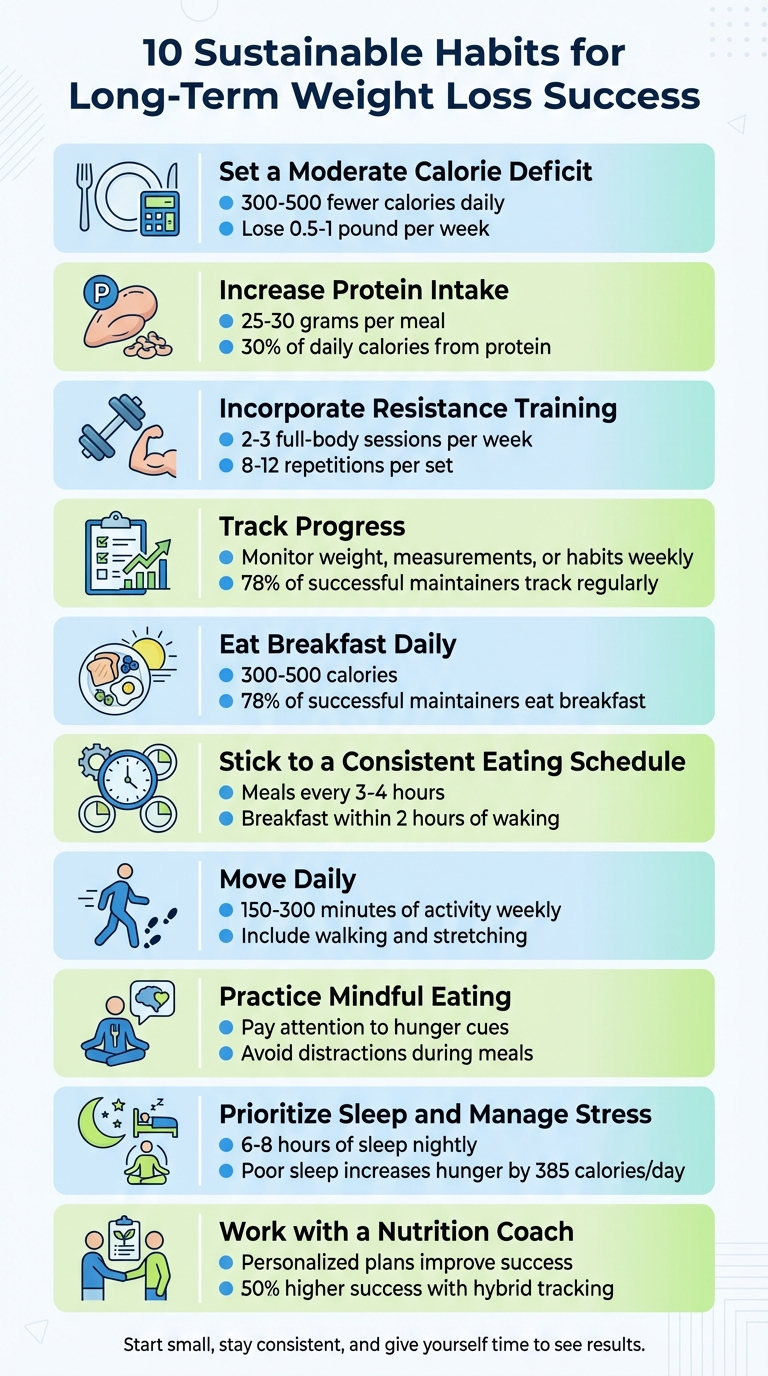
10 Sustainable Habits for Long-Term Weight Loss Success
1. Set a Moderate Calorie Deficit
How It Works
A calorie deficit happens when you eat fewer calories than your body needs to maintain its current weight. This forces your body to use stored fat for energy, leading to fat loss. A moderate deficit – typically 300 to 500 calories below your maintenance level – is ideal. This approach supports steady fat loss of about 0.5 to 1 pound per week while maintaining muscle mass, especially when paired with enough protein and resistance training. In contrast, cutting more than 700 calories can increase hunger and risk muscle loss.
Why Moderation Matters
Certified Coach Zach Anderson emphasizes:
A healthy calorie deficit for fat loss will feel mildly challenging at times, but never chaotic or extreme.
Aiming for a 400 to 500 calorie deficit strikes a balance, delivering noticeable progress while keeping hunger manageable and mood stable. After 6 to 12 weeks of dieting, taking a maintenance break of the same length can help restore hormonal balance and support long-term success.
Making It Work for You
Start by calculating your maintenance calories. A simple way to estimate this is to multiply your weight in pounds by 14 to 16, depending on your activity level. From there, subtract 10 to 20% to find your calorie target. For instance, if your maintenance level is 2,000 calories, aim for 1,600 to 1,800 calories per day.
You can also increase your calorie deficit through movement. Adding 1,500 to 2,000 extra steps a day can burn roughly 100 calories. Track your weight daily and review weekly averages to account for natural fluctuations. If you feel overly tired or lightheaded, increase your intake by 150 to 300 calories to find a more sustainable balance. Adjustments like these ensure your calorie deficit fits your individual needs, setting the stage for long-term success.
2. Eat More Protein
Why Protein Is Key for Weight Loss
When you’re working toward steady weight loss and maintaining muscle, increasing your protein intake can make a big difference. Protein helps in three major ways: it reduces hunger, boosts calorie burn during digestion, and helps preserve muscle mass.
Studies show that getting about 30% of your daily calories from protein can naturally lead to eating fewer calories – up to 441 fewer per day. Plus, protein has a higher thermic effect, meaning your body uses more energy to digest it. Around 20–30% of protein calories are burned during digestion, compared to just 5–10% for carbs and 0–3% for fats. This can translate to burning an extra 142 calories daily, which is roughly the same as walking an additional 1.2 miles.
To maintain muscle while losing weight, aim to eat at least 1.25 grams of protein per kilogram of body weight (or 0.57 grams per pound) each day. Research also suggests that people who get about 18% of their calories from protein are 50% less likely to regain weight they’ve lost. As Weight Loss Researcher Gracie Sinclair puts it:
Protein’s effects on satiety, metabolism, and body composition collectively address the physiological adaptations that typically undermine long-term weight management.
Making Protein Part of Your Routine
Adding more protein to your diet doesn’t have to be complicated. Try to include 25–30 grams of protein in each meal. For example, starting your day with a protein-packed breakfast of around 40 grams can reduce afternoon snacking by 32%. Foods like eggs, canned tuna, Greek yogurt, lentils, and tofu are excellent choices. A 4-ounce chicken breast provides about 32 grams of protein, while a 7-ounce serving of Greek yogurt offers roughly 18–20 grams.
Looking for easy ways to incorporate more protein? Stir Greek yogurt into a chickpea curry or sprinkle hemp seeds on top of your yogurt. Keep quick options like hard-boiled eggs or canned tuna on hand, and consider batch-cooking chicken breasts to simplify meal prep.
Sticking With It for the Long Haul
The beauty of a high-protein diet is that it focuses on keeping you full rather than making you feel deprived. In fact, by 2025, 70% of Americans reported they were actively trying to eat more protein, and the market for protein-rich foods is expected to grow by $50.2 billion between 2023 and 2028.
To make this approach sustainable, aim for 1.2 to 1.6 grams of protein per kilogram of body weight (about 0.54 to 0.73 grams per pound) daily. Spread your intake evenly across meals to help control hunger and maintain muscle. When combined with a moderate calorie deficit, increasing your protein intake can be a powerful tool for achieving lasting weight loss.
10 Everyday Habits That Help You Lose Weight
3. Add Resistance Training to Your Routine
Pairing resistance training with a balanced diet can help protect muscle, boost metabolism, and improve overall health.
Why It Works
Cutting calories alone often leads to a loss of both fat and muscle. Resistance training helps preserve lean muscle mass while promoting fat loss. A meta-analysis of 49 studies found that combining resistance training with dietary adjustments led to greater fat loss, better muscle retention, and a more stable resting metabolic rate compared to dieting alone.
Muscle is more than just strength – it’s a calorie-burning powerhouse. As Kelsey Graham, Assistant Professor and Director of Health and Wellness Coaching at San Diego Mesa College, puts it:
Muscle is metabolically expensive; the more muscle you have, the more calories you burn at rest.
This increased calorie burn can help counteract the slower metabolism that often accompanies calorie restriction.
How to Start Without Overcomplicating It
You don’t need an expensive gym membership or fancy equipment to begin. Start with 2–3 full-body sessions per week, focusing on compound exercises like squats, push-ups, rows, and glute bridges. Modify exercises to suit your current fitness level – for example, use a chair for squats or do push-ups against a wall or counter if regular push-ups feel too difficult.
Aim for 1–3 sets of 8–12 repetitions, selecting weights or body weight that challenge you during the last few reps. As you gain strength, increase the resistance or repetitions every few weeks. Allow 48–72 hours of recovery before targeting the same muscle groups again. This simple approach makes resistance training easy to fit into your routine and maintain over time.
Long-Term Benefits
Resistance training isn’t just about losing weight – it’s about celebrating progress in strength, energy, and how your clothes fit. These non-scale victories can be incredibly motivating. Plus, building muscle and strength is an investment in your long-term health. Research shows that people in the strongest third of the population during midlife are 2.5 times more likely to live to 100. Strength training now can set you up for a healthier, more active future.
4. Track Your Progress Regularly
Evidence-Based Effectiveness
Keeping tabs on your progress can make a big difference when it comes to achieving and maintaining weight loss. Studies back this up – regular tracking has been shown to significantly increase the chances of meeting weight loss goals. For example, a systematic review and meta-analysis highlighted that self-monitoring behaviors play a key role in successful weight management.
The National Weight Control Registry, which follows over 10,000 people who have kept off substantial weight for at least a year, also emphasizes the importance of tracking. Nearly all participants in the registry use some form of regular monitoring.
Tracking isn’t just about numbers; it’s about understanding how your daily habits – like sleep, movement, and nutrition – impact your progress. Alison Heilig, a Certified Personal Trainer, puts it perfectly:
"Tracking how you sleep, move, fuel, and recover can help you connect the dots and adjust more effectively".
This kind of awareness allows you to make informed changes instead of guessing what’s working or what might need tweaking.
Ease of Integration into Daily Life
Incorporating tracking into your routine doesn’t have to be a chore. Even tracking once a week or every other week can provide valuable insights. Be mindful, though, that daily weigh-ins might not always tell the full story because of natural fluctuations in weight.
To get a clearer picture, focus on more than just the number on the scale. Pay attention to how your clothes fit, your energy levels, and your strength. The scale can’t differentiate between losing fat, gaining muscle, or simply retaining water. For a practical approach, consider the plate method – fill half your plate with vegetables, a quarter with protein, and a quarter with carbs – or take monthly progress photos to visually track changes.
Sustainability of the Habit
Think of tracking as gathering data, not as a judgment on your success or failure. This perspective keeps things objective and helps you stay curious rather than critical. For instance, if you’re consistently hitting 5,000 steps when aiming for 10,000, adjust your goal to something more achievable, like 6,500 steps.
Catching small changes early is also key. Spotting a 3–5 pound gain and addressing it right away is much easier than dealing with a larger setback down the road. Regular tracking keeps you informed, allowing you to refine your habits and stay on course.
5. Eat Breakfast Every Day
Why Breakfast Matters
Starting your day with a balanced breakfast does more than just fill your stomach – it sets the tone for your metabolism and helps manage hunger hormones. Research backs this up: skipping breakfast can lead to overeating later in the day, while eating a nutritious morning meal helps regulate your appetite.
Here’s a compelling stat: 78% of people who successfully maintain weight loss for a year report eating breakfast daily. Similarly, the National Weight Control Registry found that 80% of adults who kept off over 30 pounds for at least a year make breakfast part of their routine. High-protein breakfasts, in particular, work wonders. They not only reduce levels of the hunger hormone ghrelin but also help curb evening cravings for high-fat foods.
But there’s a catch – what you eat matters. Julia Zumpano, RD, LD, from the Cleveland Clinic, explains:
If you start your day off with something sweet, you’re more likely to crave sweets all day. Sugar is very addicting and difficult to control.
So, choosing the right foods can make or break your breakfast strategy.
Making Breakfast Fit Your Life
You don’t need to spend hours preparing breakfast to reap the benefits. A meal between 300 and 500 calories is enough to get you going. Use this simple formula: combine one protein (like eggs, Greek yogurt, or tofu), one whole grain, and a fruit or vegetable.
Pressed for time? Plan ahead. Options like overnight oats, chia pudding, or egg muffins can be prepped the night before, saving you precious minutes in the morning. If mornings are chaotic, even waking up 15 minutes earlier can make a difference.
Building a Lasting Habit
Consistency is the secret to making breakfast a daily ritual. Research shows that it takes an average of 66 days to form a new habit, though it can vary from 18 to 254 days depending on the person. Start small – commit to eating breakfast for one week. Over time, it will feel more natural and less like a chore.
And don’t worry if you’re not hungry right after waking up. Listen to your body and eat when your appetite kicks in. The goal is to create a routine that feels sustainable, not forced.
sbb-itb-29cdcd8
6. Keep a Consistent Eating Schedule
Evidence-Based Effectiveness
Your body operates on an internal 24-hour clock, known as the circadian rhythm, and the timing of your meals has a direct impact on hunger hormones and metabolism. Eating late at night can interfere with fullness signals, increase hunger, and slow down your metabolism. For example, a study involving 16 overweight adults found that those who delayed their first meal until noon and ate their last meal at 8:30 p.m. experienced lower leptin levels – a hormone that regulates appetite – throughout the day.
Another study, which included 30 participants with obesity, revealed that consuming 45% of daily calories at breakfast significantly reduced feelings of hunger throughout the day. Similarly, having dinner earlier, between 6:00 and 7:00 p.m., rather than at 10:00 p.m., can increase the calories your body burns while at rest. These structured eating patterns work hand-in-hand with other strategies that support a steady metabolism.
Ease of Integration into Daily Life
Establishing a consistent eating schedule doesn’t have to be complicated. A simple framework can make all the difference. Start by eating breakfast within two hours of waking, aim for lunch around 1:00–2:00 p.m., and finish dinner before 7:00 p.m.. Spacing meals every 3 to 4 hours can help keep your blood sugar levels stable throughout the day.
The key to success is making the habit as effortless as possible. Certified Personal Trainer Alison Heilig advises:
The goal is to reduce friction and give yourself a version of the habit that’s easy to say ‘yes’ to, even on your hardest days.
One way to simplify this is through habit stacking – link your meal times to existing daily routines. For example, eat lunch right after your noon meeting or have dinner immediately following your evening walk. For busier days, keep portable high-protein, high-fiber snacks – like nuts or cheese sticks – readily available.
Sustainability of the Habit
Almost half of your daily actions – about 45% – are already habits you perform without much thought. Once you establish a consistent eating schedule, it becomes just another part of your routine. The goal is to aim for consistency, not perfection. If you miss a meal time, simply pick up the habit again at your next meal.
To build this rhythm, start small. Focus on just 2 or 3 anchor habits, like eating breakfast at the same time every day or sticking to a regular lunch hour. These anchors create a foundation for a dependable routine. Research indicates that it takes an average of 66 days for a new behavior to become automatic, though the time frame can vary from 18 to 254 days depending on the individual and the habit. As Patrick McCarthy, Hoot Contributor, emphasizes:
Consistency drives maintenance.
7. Move Your Body Daily
Incorporating daily movement into your routine is a powerful way to complement consistent meal times and support your overall weight loss strategy.
Why Daily Movement Matters
Daily physical activity plays a critical role in maintaining long-term weight loss. It helps counteract the metabolic slowdown that often follows weight reduction, improves insulin sensitivity, and burns additional calories. Beyond the physical benefits, exercise also reduces stress and lifts your mood, which can help manage triggers for overeating.
For general health, adults should aim for at least 150 minutes of moderate-intensity aerobic activity each week. To prevent weight regain and support long-term success, increasing this to around 300 minutes weekly is recommended. According to the American College of Sports Medicine, 150–250 minutes per week can lead to modest weight loss, but surpassing 250 minutes is often necessary for more noticeable results. The most important factor, however, is sticking to a routine that works for you.
Making Movement a Daily Habit
The key to staying active isn’t about finding the "perfect" workout – it’s about making movement a natural part of your day. Many people struggle not due to a lack of motivation but because their routines rely on ideal circumstances. Instead, focus on creating habits that work even on your busiest or most stressful days.
Start small. Incorporate Non-Exercise Activity Thermogenesis (NEAT) into your life – simple actions like taking the stairs, parking farther from your destination, or stretching during a break. Pair movement with existing habits, such as walking while watching a show or doing stretches while waiting for your coffee to brew.
Treat exercise like any other important appointment by scheduling it on your calendar. On hectic days, even a brisk 20-minute walk can make a difference. The goal is consistency, not perfection.
Building a Sustainable Routine
A consistent movement routine is just as important as your meal schedule or resistance training for reinforcing long-term weight loss. The trick is to choose activities you genuinely enjoy, as this keeps you engaged and committed.
Research shows that roughly 45% of daily behaviors are habitual and require little conscious effort. On average, forming a new habit takes about 66 days, though this can vary between 18 and 254 days depending on the individual. Start with small, manageable goals you can stick to about 80% of the time, even on your most exhausting days. Gradually build from there – introducing one new action at a time ensures you’re setting yourself up for long-term success.
8. Practice Mindful Eating
Adding mindful eating to your daily routine can deepen your connection with food and help you build habits that support lasting weight loss.
Evidence-Based Effectiveness
Mindful eating is all about being fully present during meals – tuning into hunger signals, savoring flavors, and noticing textures without distractions like phones or TV. Studies show that this practice can match the effectiveness of traditional diet programs for weight loss while also addressing binge eating and emotional eating. For example, a 12-week study involving 34 women found that mindful eating training led to an average weight loss of 4 lbs (1.9 kg). A review of 68 studies revealed that mindfulness techniques consistently improved eating habits, helping people eat more slowly and recognize when they were full. Given that 80% of lost weight is often regained within five years, mindful eating helps tackle the behaviors that contribute to this cycle.
"Mindful eating focuses on the why and the how of eating, versus what’s promoted by many diets, which are more what to eat, how much to eat, maybe even when to eat." – Maxine Smith, RD, LD
Sustainability of the Habit
Unlike restrictive diets that often feel limiting, mindful eating allows you to enjoy all foods in moderation. You won’t need to count calories or eliminate entire food groups. Instead, this approach rewires your brain to respond differently to eating triggers, creating habits that are easier to maintain over time. Whether you’re at a family gathering or navigating a busy schedule, mindful eating fits seamlessly into your life.
Ease of Integration into Daily Life
Start small – try practicing mindful eating with just one meal or snack each day. This makes it easier to turn into a routine. Before eating, take a moment to rate your hunger on a scale from 1 to 10; aim to start eating at a 3–4 and stop when you reach a 6–7. Simple strategies like putting your fork down between bites or turning off distractions can help you focus on your meal and recognize when you’re full. These small changes are easy to implement and can make a big difference in your eating habits.
9. Get Enough Sleep and Manage Stress
Getting enough sleep and keeping stress levels in check aren’t just nice-to-haves – they’re essential for long-term weight loss. Sleep and stress directly impact your body’s ability to regulate hunger, metabolism, and overall energy balance. Pair these with healthy eating and exercise, and you’ll create a solid foundation for sustainable progress.
Evidence-Based Effectiveness
Sleep deprivation and chronic stress can sabotage your weight loss efforts. For instance, insufficient sleep reduces leptin (the hormone that signals fullness) and increases ghrelin (the hormone that triggers hunger). This imbalance can lead to consuming an additional 385 calories a day and cutting fat loss by up to 55%.
Research backs this up. A study conducted at the Kaiser Permanente Center for Health Research followed 472 obese adults during a six-month weight loss program. Those who slept 6–8 hours a night and reported lower stress levels were twice as likely to lose at least 10 pounds compared to individuals with poor sleep and high stress. The study also found a significant link between stress reduction and weight loss (p = .048).
Another study, led by Dr. Esra Tasali at the University of Chicago Medicine in 2022, showed that improving sleep alone could reduce calorie intake. By adding just 1.2 hours of sleep per night, participants naturally ate about 270 fewer calories daily – without dieting or calorie counting. Dr. Tasali highlighted:
Sufficient sleep can also make you feel less hungry and help you to eat healthier foods; and sleep is free, has no side effects, and has many other benefits to overall health and well-being.
Stress, on the other hand, raises cortisol levels, which can lead to abdominal fat storage and emotional eating. Chronic stress can also disrupt sleep, creating a vicious cycle. However, mindful eating practices have been shown to cut stress-induced eating by 40% in consistent practitioners.
These findings make it clear: quality sleep and stress management are key players in any successful weight loss plan.
Sustainability of the Habit
The great thing about sleep and stress management? They’re simple, low-cost, and effective. Unlike pricey diets or complex fitness programs, prioritizing sleep is free and has no downsides. According to the Reshape App:
By fixing sleep first, you make fat loss more automatic, sustainable, and less dependent on constant willpower.
When it comes to stress, small habits like breathing exercises or short walks can be seamlessly added to your daily routine. These micro-changes provide long-term benefits without feeling overwhelming.
Ease of Integration into Daily Life
Improving your sleep doesn’t require a complete lifestyle overhaul. Start with small adjustments like sticking to a consistent wake-up time (even on weekends) to help regulate your internal clock. Create a calming sleep environment by keeping your room cool, dark, and quiet, and avoid blue light from screens before bed. Cutting back on caffeine in the afternoon can also make a big difference.
For stress management, try simple strategies like the 22-Minute Rule: dedicate just 22 minutes a day to movement, even during your busiest times. You can also take short breaks every 60–90 minutes or practice calming techniques like box breathing to ease your nervous system and make better food choices.
With these manageable changes, you can improve both your sleep and stress levels, setting yourself up for lasting success.
10. Work with a Nutrition Coach
After incorporating habits like meal timing and mindful eating, working with a nutrition coach can refine your weight loss approach and make it more effective.
Evidence-Based Effectiveness
A nutrition coach creates a plan tailored to your individual needs, aligning with your lifestyle, preferences, and goals. This personalized approach is far more effective than generic advice. Research shows that nearly 90% of people who lose significant weight eventually regain it, but coaching can provide the tools and support to help you stay in the successful 10% who maintain their weight loss over time.
One key strategy often used by coaches is implementing macro-balanced diets. Studies show these diets help retain 25% more fat loss compared to low-carb fad diets. Additionally, combining mobile app tracking with professional feedback – known as hybrid tracking – boosts weight loss success rates by 50%. For those who have experienced the ups and downs of yo-yo dieting, coaches can introduce strategies like reverse dieting and customized plans to repair your metabolism while focusing on sustainable, balanced nutrition.
Sustainability of the Habit
Coaching focuses on building habits gradually, one small step at a time. For instance, a coach might encourage you to drink more water or add protein to your meals, instead of trying to overhaul your entire diet overnight. This approach reduces reliance on sheer willpower and prioritizes lasting change. As AFPA Wellness explains:
Small, repeatable actions shape long-term outcomes far more than occasional bursts of motivation.
Flexibility is another cornerstone of coaching. For example, adopting an 80/20 rule – where 80% of your diet follows the plan and 20% allows for indulgences – has been shown to reduce dropout rates by 60%. Kellie Lunday, MS, RD, LD, highlights how this balance helps lower stress and builds sustainable eating patterns. Coaches also consider factors like family traditions, emotional triggers, and daily routines to design plans that work in your everyday life.
Ease of Integration into Daily Life
Nutrition coaches help you start right where you are, identifying simple, actionable steps that fit seamlessly into your current routine. Certified Personal Trainer Cori Lefkowith compares it to setting a GPS:
It’s like setting a GPS: you start where you are to reach your goal.
Techniques like habit stacking – pairing new habits with existing ones, such as drinking water while waiting for your coffee to brew – make it easier to incorporate changes. Coaches also provide backup plans for challenging days, like suggesting pre-chopped vegetables for quick meals or shorter workouts to maintain consistency. Regular check-ins and feedback ensure you stay on track, even when life throws curveballs.
With a nutrition coach, each small, well-integrated habit builds momentum, helping you progress toward sustainable weight loss over time.
Conclusion
Sustainable weight loss is all about building daily habits that stick. The 10 habits we’ve discussed in this article share a common goal: keeping things realistic, adaptable, and tailored to your lifestyle. Whether it’s creating a manageable calorie deficit, upping your protein intake, or teaming up with a nutrition coach, the focus is on consistency – not perfection.
What sets apart those who maintain their progress from those who struggle often comes down to having systems that work, even on tough days. Certified Personal Trainer Alison Heilig puts it this way:
Most people don’t fail because they lack motivation or discipline. They fail because they’re trying to install a habit that only works on their best, most stress-free days.
Start small. Maybe it’s adding an extra ounce of protein to your lunch or taking a 10-minute walk after dinner. These little changes can snowball into bigger progress over time. Research suggests it takes about 66 days for a behavior to become automatic, so give yourself the grace to build gradually.
Stick to the 80% Rule: aim to follow your healthy habits 80% of the time, leaving room for life’s inevitable ups and downs. This flexible approach helps prevent burnout and the all-or-nothing mindset that can derail progress.
Keep track of your progress objectively, and don’t let setbacks throw you off course. Instead, treat them as opportunities to learn and adjust. Cori Lefkowith, owner of Redefining Strength, offers this reminder:
The more you acknowledge that [setbacks] may happen and it’s okay, that you’re human, the faster you’ll be able to get back to the habits you want.
The key is to create habits that align with your goals, schedule, and preferences. Focus on directional consistency – making choices that move you closer to your goals – rather than striving for flawless execution every day. With patience, self-compassion, and systems that work for you, sustainable weight loss is within reach.
FAQs
How do I figure out my maintenance calories?
You can figure out your maintenance calories by using a calorie calculator or applying formulas like the Mifflin-St Jeor or Harris-Benedict equations. These methods take into account factors like your age, gender, height, weight, and activity level. For a more accurate and personalized approach, it’s a good idea to consult a registered dietitian or healthcare professional who can tailor their advice specifically to your needs.
What if I’m not hungry in the morning?
If you’re not feeling hungry in the morning, it’s perfectly okay to skip breakfast or eat later when hunger kicks in. What really matters is tuning into your body’s signals and making sure you’re getting balanced nutrition throughout the day.
You can start your morning with a glass of water or a small, nutrient-packed snack when you do feel ready to eat. Focus on building habits that align with your lifestyle and promote lasting well-being, rather than sticking to rigid meal schedules.
How can I stay consistent on weekends or holidays?
Staying on track during weekends or holidays doesn’t have to mean rigid rules. Instead, focus on habits that are flexible and easy to maintain. For example, plan your meals and activities ahead of time to avoid last-minute decisions that might derail your progress. Incorporate movement into your day – something as simple as a walk before or after a meal can make a difference.
When it comes to eating, practice mindfulness. Pay attention to your hunger cues, savor each bite, and enjoy your food without rushing. It’s also a good idea to keep healthy snacks within reach to help curb the temptation to overindulge.
Above all, approach these moments with a mindset of flexibility and self-compassion. This way, you can stay consistent with your goals while still enjoying the special occasions that make life meaningful.