
Want to transform your fitness and nutrition game? It starts with understanding macros – protein, carbs, and fats. These nutrients are key to fueling your body, improving metabolism, and reaching goals like fat loss or muscle gain. Unlike restrictive diets, macro-based approaches offer flexibility while delivering better results.
Here’s why macro tracking works:
- Protein builds muscle and keeps you full.
- Carbs fuel your brain and workouts.
- Fats support hormones and absorb vitamins.
Studies show macro-based diets help retain 25% more fat loss and 20-30% more muscle compared to calorie-only plans. With tools like the Mifflin-St Jeor equation, you can calculate your Basal Metabolic Rate (BMR), set your Total Daily Energy Expenditure (TDEE), and create personalized macro plans.
Key tips:
- Use the 80/20 rule: 80% nutrient-dense foods, 20% treats.
- Adjust macros as your weight or goals change.
- Track meals with apps like MacroFactor for precision.
Start with small steps: calculate your macros, prep meals, and track progress weekly. This system turns short-term effort into lasting results.
The Ultimate Guide to Meal Planning // macros, meal prep & more
sbb-itb-29cdcd8
How to Calculate Your Macro Targets
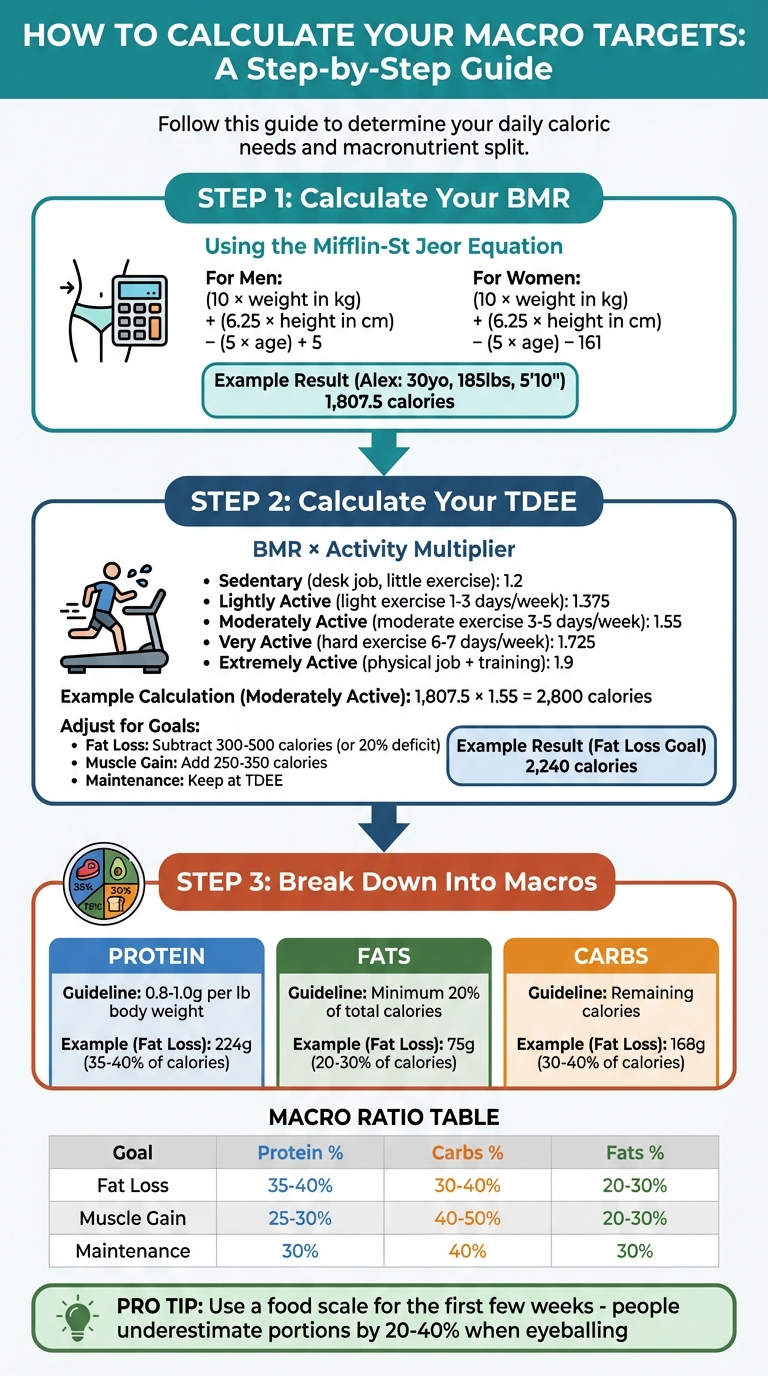
How to Calculate Your Macro Targets: 3-Step Process
Figuring out your macro targets involves three main steps: calculating your Basal Metabolic Rate (BMR), estimating your Total Daily Energy Expenditure (TDEE), and dividing your calories into protein, carbs, and fats based on your specific goals.
Your BMR is the number of calories your body needs to maintain basic functions like breathing and digestion while at rest. The Mifflin-St Jeor equation is a reliable way to calculate it. For men, the formula is:
(10 × weight in kg) + (6.25 × height in cm) − (5 × age) + 5.
For women, the formula is the same, but you subtract 161 instead of adding 5. Once you’ve calculated your BMR, multiply it by an activity factor to estimate your TDEE – the total calories you burn in a day.
Be cautious when choosing your activity level. Overestimating it can lead to inflated calorie targets and slow progress. For example, if you work a desk job and exercise three times a week, you’re likely “moderately active” (activity multiplier: 1.55), not “very active.” After finding your TDEE, adjust it based on your goal:
- For fat loss: Subtract 300–500 calories.
- For muscle gain: Add 250–350 calories .
Now that you know your calorie target, the next step is breaking it down into macros.
Simple Formulas for Macro Calculation
Let’s look at an example from a Gymkee case study published in October 2025. Alex, a 30-year-old man weighing 185 lbs and standing 5’10", works a desk job and trains 3–4 times a week. Using the Mifflin-St Jeor equation, his BMR was calculated at 1,807.5 calories. With an activity multiplier of 1.55, his TDEE came to 2,800 calories. To lose fat, he applied a 20% calorie deficit, setting his daily goal at 2,240 calories. His macros were distributed as follows:
- Protein: 224g
- Carbs: 168g
- Fat: 75g.
Here’s how to calculate your macros:
- Protein: Aim for 0.8–1.0 grams per pound of body weight to maintain muscle during fat loss.
- Fats: Ensure at least 20% of your total calories come from fats to support hormonal health .
- Carbs: Use the remaining calories for carbohydrates, which fuel both your workouts and daily energy needs.
| Goal | Protein % | Carbs % | Fats % |
|---|---|---|---|
| Fat Loss | 35–40% | 30–40% | 20–30% |
| Muscle Gain | 25–30% | 40–50% | 20–30% |
| Maintenance | 30% | 40% | 30% |
Source: IIFYM
One helpful tip: invest in a food scale for the first few weeks. Studies show that people often underestimate portion sizes by 20–40% when eyeballing them.
Once you’ve set your macros, be ready to tweak them as your body and goals change.
Adjusting Macros for Advanced Goals
Your initial macro targets are just a starting point. As your body changes, your calorie and macro needs will shift, too. For instance, losing 11 lbs (5 kg) can reduce your maintenance calorie needs by 100–150 calories per day.
If you’ve been dieting for a long time and feel stuck, reverse dieting might help. This strategy involves gradually increasing your calorie intake by 10–15% over 4–12 weeks while keeping protein intake high. This can restore hormonal balance, improve thyroid function, and boost your maintenance calories by 200–500. During this period, focus on improvements in sleep, energy, and strength.
"Macro counting ensures adequate protein for muscle preservation (critical during deficits to avoid metabolic adaptation), enough carbs for workout performance and thyroid function, and healthy fats for hormones."
- Jodi Yerta, Owner & Lead Coach, N The Mix Nutrition & Coaching
For more advanced strategies, carb cycling can be a game-changer. On training days, increase your carbohydrate intake to fuel performance and recovery. On rest days, lower carbs to maintain a calorie deficit . If progress stalls for 3–4 weeks despite consistent tracking, consider reducing your total calories by 10–15%, primarily from carbs or fats, while keeping protein stable. Pay attention to your energy levels, hunger, and sleep to ensure these adjustments are sustainable .
Incorporate these tweaks into your daily routine to stay consistent and build habits that align with your goals.
Building a Daily Meal Plan Around Macros
Once you’ve figured out your macro targets, it’s time to turn those numbers into meals. Start by prioritizing protein in every meal – aim for 20–40g per serving. Pair it with carbohydrates for energy and fats to keep you full and support hormone regulation.
Distributing protein evenly across your meals can help maintain muscle and manage hunger better. Dr. Gregory Katz, Assistant Professor of Medicine at NYU Grossman School of Medicine, puts it this way:
"Higher protein diets tend to be better at preserving muscle, especially when that’s coupled with some degree of physical activity".
If measuring every ingredient feels overwhelming, the hand-portion method can be a quick and easy guide: use a palm-sized portion for protein, a cupped hand for carbs, and a thumb-sized portion for fats. To get a better sense of portion sizes, you can start by using a food scale [19, 23].
A good rule of thumb is to follow the 80/20 approach: focus on 80% whole, nutrient-rich foods while leaving 20% for flexibility. Research shows that this balance can lower diet dropout rates by 60%. To save time, batch cook proteins like chicken, tofu, or beans at the start of the week, and prep vegetables right after grocery shopping. This makes daily meal prep much easier.
Meal Templates for Breakfast, Lunch, and Dinner
Here are simple meal ideas to help you hit your macro goals:
Breakfast (35g protein / 35g carbs / 10g fat):
Scramble 4 egg whites with 1 whole egg and a handful of spinach. Pair it with ½ cup of dry oatmeal (cooked as directed) and fresh berries. This meal provides a protein-packed start with energy from complex carbs.
Lunch (40g protein / 30g carbs / 12g fat):
Grill 6 oz of chicken breast and serve it with ½ cup of cooked quinoa and a mixed green salad drizzled with 1 tablespoon of olive oil. This combo keeps you full and supports muscle repair.
Dinner (40g protein / 50g carbs / 25g fat):
Make a salmon stir-fry with 6 oz of cooked salmon, 1 cup of mixed vegetables (like bell peppers, broccoli, and snap peas), and ½ cup of brown rice. The salmon provides omega-3 fats, which are great for recovery and hormonal health.
Snack (20g protein / 10g carbs / 10g fat):
Mix 1 cup of plain, non-fat Greek yogurt with a small handful (12–15) of almonds. This snack is perfect for a post-workout boost or a mid-afternoon pick-me-up.
Macro Content in Common Foods
Knowing the macro breakdown of common ingredients can simplify meal planning. Here’s a quick reference:
| Food Item | Serving Size | Protein (g) | Carbs (g) | Fats (g) |
|---|---|---|---|---|
| Chicken Breast (Grilled) | 6 oz | 40 | 0 | 3–5 |
| Salmon (Cooked) | 6 oz | 35–40 | 0 | 15–20 |
| Whole Egg | 1 large | 6 | 0.5 | 5 |
| Greek Yogurt (Non-fat) | 1 cup | 15–20 | 10 | 0 |
| Oatmeal (Dry) | ½ cup | 5 | 35 | 3 |
| Quinoa (Cooked) | ½ cup | 4 | 30 | 2 |
| Brown Rice (Cooked) | ½ cup | 2.5 | 22 | 1 |
| Almonds | 12–15 nuts | 3–5 | 3–5 | 10 |
Chicken breast and salmon are standout protein options, while oatmeal and quinoa deliver carbs with a bit of protein. Whole eggs and almonds are great for adding both protein and healthy fats to your meals, giving you flexibility to balance your macros.
Next, we’ll cover how to track your progress and make adjustments to your macros when needed.
7-Day Macro-Based Routine
Once you’ve established your macro targets and meal planning, the next step is creating a weekly routine that makes macro tracking second nature. The goal here isn’t perfection – it’s consistency. A structured week helps you hit your targets regularly, turning macro counting into a long-term habit.
"Macro counting gives you freedom to eat what you enjoy as long as it fits your personalized targets" – Jodi Yerta, Owner & Lead Coach at N The Mix Nutrition.
One way to structure your week is by syncing your macros with your activity levels. For example, aim for around 250g of carbs on workout days and scale back to 150g on rest days, while keeping protein intake high to maintain muscle. Research shows this approach can lead to 25% better fat loss retention compared to restrictive low-carb diets.
Stick to the 80/20 rule for flexibility – this means 80% of your food comes from whole, nutrient-dense sources, while 20% can include treats. Studies suggest this balance reduces dropout rates by 60%. If you miss a meal or workout, don’t overcompensate by restricting later. Just get back on track with your next meal. As Shape & Joy puts it, "It’s about consistency over time, not perfection in the moment". This steady approach supports smoother meal prep and better workout planning.
Meal Prep and Repeatable Meals
Meal prep doesn’t have to mean cooking for the entire week. Instead, try prepping in 3–4 day cycles – cook on Sunday and midweek to keep things fresh and manageable. Start by batch-cooking your staple proteins, like grilled chicken breast, baked tofu, or lean ground turkey. Pair those with grains such as quinoa or brown rice, making enough for several meals. Store your food in glass containers to avoid concerns about reheating in plastic.
From there, mix and match your prepped ingredients to create variety. For instance, grilled chicken can easily become the star of salads, wraps, stir-fries, or grain bowls. Keep some convenient backup options on hand, like protein bars, beef jerky, whey protein powder, or even frozen meals that fit your macros.
Once your meals are prepped, plan them around your workouts to maximize recovery and performance.
Timing Workouts with Your Meals
Timing your meals around your training schedule can make a big difference in both performance and recovery. After a workout, aim to eat carbs within 1–2 hours, along with 20–40g of protein, to replenish glycogen and support muscle repair. For example, if you work out in the morning, your post-workout meal could be scrambled eggs with oatmeal and berries. Evening workouts might call for a dinner loaded with both carbs and protein, like grilled salmon with sweet potato and roasted veggies.
If you skip a planned workout, reduce your carbohydrate intake for the day to match your lower activity level. This could mean swapping out starchy carbs like rice or pasta for more vegetables such as broccoli, cauliflower, or leafy greens. However, keep your protein intake steady to protect muscle mass. If you’re feeling consistently fatigued, it might be time to slightly increase your calorie intake.
Tracking Progress and Making Adjustments
Tracking your macros is what turns short-term efforts into lasting results. The secret lies in using tools that simplify logging and leveraging that data to make smart tweaks when progress slows. These days, modern apps make logging easier than ever, with features like AI-powered photo scanning and voice entry to cut down on manual work.
Apps and Tools for Macro Tracking
To start, invest in a digital food scale for the first few weeks. This helps you get a feel for accurate portion sizes, as eyeballing often leads to errors of 20–40%. After a month, you’ll likely develop a good sense of portions and can switch to visual estimations.
For app recommendations, MacroFactor is a standout. It uses an "adherence-neutral" algorithm to adjust your targets based on weight trends and energy use, rather than locking you into a rigid plan. With over 400,000 users and a 4.8/5 rating from more than 10,000 reviews, it’s a solid choice for those serious about results. Pricing starts at $11.99 per month, with discounts for longer subscriptions, and there’s a 7-day free trial. For free options, LINA offers AI-powered photo logging, while Mofilo includes voice logging and a database of over 2.8 million verified food entries from trusted sources like the USDA and Health Canada.
"The beauty of MacroFactor is that it adjusts to YOUR metabolism. You never need to worry about dropping your calories too low or overthinking where your macros should be."
– Jeff Nippard, Fitness Expert
A helpful tip: log your meals 24 hours in advance. This reduces decision fatigue and ensures you hit your protein goals without last-minute scrambling. Don’t stress about hitting exact numbers – aim for a 5–10 gram range on each macro to stay consistent without burning out. These tools and strategies make it easier to fine-tune your approach while keeping an eye on your overall progress.
Weekly Adjustments to Macro Targets
Once you’re consistently tracking, use your weekly data to adjust your macro targets. If your averages show no changes after 2–3 weeks, it’s time to tweak things. Keep in mind that daily fluctuations, often caused by water weight or sodium intake, are normal. Focus on your weekly average weight instead.
When making adjustments, start small. Adjust calories by 100–200, keeping protein steady to maintain muscle mass. Recalculate your macros whenever your body weight changes by 7–11 lbs or if your activity level shifts significantly.
Pay attention to your body’s cues, like low energy, poor sleep, mood swings, or strong cravings. These could signal that you need to increase your intake rather than cut back further. If progress stalls for nearly a month, double-check your tracking for unlogged snacks or small extras, which can quietly add 200–400 calories a day. If necessary, adjust your calories by 10–15%.
"You can’t adjust a plan you’re not actually following. If you’re not consistently hitting your macros, it’s too early to say they ‘aren’t working.’"
– The Macro University
The key is making regular, small tweaks to keep your plan aligned with your progress and goals.
Conclusion and Next Steps
With your routine and tracking system in place, these final strategies can help ensure long-term success. A macro-based approach thrives on consistency, adaptability, and patience. Start with the basics: prioritize protein, pre-log your meals, and follow the 80/20 rule – balancing nutrient-rich foods with the occasional treat [6, 40, 42]. As Coach Sue from Physique Development wisely says:
"Consistency will trump perfection always."
This mindset fosters both fitness progress and the development of sustainable habits, which are the foundation of any successful macro-based plan.
Tips for Long-Term Success
To keep macro tracking manageable and effective over time, aim for "good enough" tracking. Even hitting 65% accuracy is better than skipping your logs entirely. When dining out, use hand-portion estimates – like a palm for protein, a fist for carbs, and a thumb for fats [9, 43]. If you veer off track, apply the "Never Miss Twice" rule: get back to your plan right away after a missed meal or day [41, 43].
For those in a caloric deficit, take a 2-week break at maintenance calories after 8–12 weeks to reset both mentally and physically. Also, shift your focus to non-scale victories, like consistently hitting your protein goals or taking a 10-minute walk after meals, rather than obsessing over the number on the scale. By sticking to these strategies, you can maintain progress while avoiding burnout.
If you’re looking for additional guidance, professional support can make a big difference.
Professional Support with N The Mix Nutrition

While apps and self-tracking work for many, combining technology with professional coaching – known as hybrid tracking – can increase success rates by 50%. N The Mix Nutrition offers personalized 1-on-1 coaching from a team of 16 certified experts across the U.S., including locations in Topeka, KS, and St. Louis, MO. Their services include:
- Custom nutrition plans tailored to your metabolic needs
- Weekly check-ins for accountability
- Macro adjustments based on biofeedback like sleep, energy, and mood
- Bundled packages starting at $179 per month, which integrate fitness and nutrition guidance
They specialize in areas like metabolic repair and hormonal health, particularly for women over 40. Their methods can help restore your resting metabolic rate by 200–500 calories within 8–16 weeks, especially if years of restrictive dieting have taken a toll. Jodi Yerta, Owner & Lead Coach at N The Mix Nutrition, emphasizes the importance of human expertise:
"AI can be a helpful accelerator in 2026 – not a replacement for coaching. It might assist with recipe ideas or spotting basic trends from your logs, but human expertise ensures adjustments respect your unique lifestyle, hormones, and goals."
N The Mix Nutrition also offers a 14-day free trial, and many of their services can be paid for using HSA/FSA funds.
FAQs
Do I need to hit my macros exactly every day?
No, hitting your macros perfectly every single day isn’t necessary. The real aim is maintaining balance and consistency over time. Try to stay as close to your targets as possible, but don’t stress about minor fluctuations. This mindset helps reduce pressure, encourages lasting habits, and supports steady progress toward your health and fitness goals.
How do I choose the right activity multiplier for TDEE?
To figure out your Total Daily Energy Expenditure (TDEE), pick an activity multiplier that matches how active you are on a daily basis:
- Sedentary (little to no exercise): Use a multiplier of 1.2–1.4.
- Light exercise (1–3 days per week): Go with 1.4–1.6.
- Moderate activity (3–5 days per week): Choose 1.6–1.8.
- Very active (hard exercise or physical job): Opt for 1.8–2.4.
It’s important to be honest about your activity level to get an accurate estimate. Over time, monitor your progress and adjust the multiplier if needed based on how your body reacts.
What should I do when my fat loss stalls?
If your fat loss progress seems to hit a wall, start by double-checking that you’re consistently tracking your macros and sticking to them. Even small inconsistencies can make a big difference over time. If you’re sure you’re staying on track, you might consider making slight adjustments, like cutting your daily calorie intake by 5-10% or incorporating a refeed day where you eat at maintenance calories to reset.
It’s also worth taking a closer look at other factors that can impact your progress, such as your sleep quality, stress levels, and overall activity. These elements play a big role in how your body responds to your efforts. Steer clear of drastic measures – focus instead on making manageable, research-backed changes that will keep you moving forward in a healthy and sustainable way.