
Compound exercises work multiple muscle groups and joints at once (e.g., squats, deadlifts), while isolation exercises target a single muscle and joint (e.g., bicep curls, leg extensions). For most goals, a mix of both is ideal:
- Compound exercises: Build strength, burn more calories, improve functional fitness, and save time. Best for beginners and athletes.
- Isolation exercises: Focus on specific muscles, fix imbalances, aid injury recovery, and add training volume without excessive fatigue.
Quick tip: Start workouts with compound lifts for maximum energy, then finish with isolation exercises to refine specific muscles. A balanced routine typically includes 70–80% compound exercises and 20–30% isolation exercises.
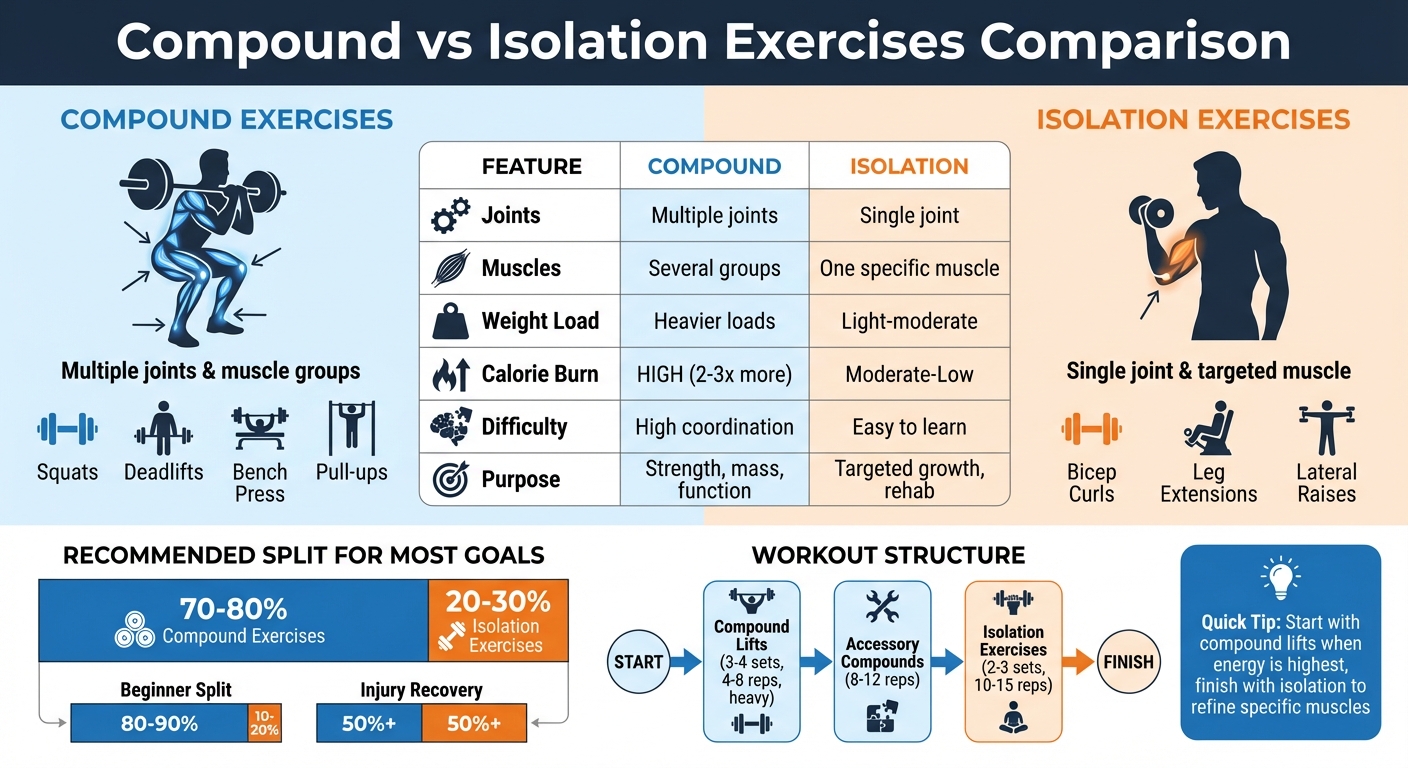
Compound vs Isolation Exercises: Key Differences and Training Ratios
What Are Compound and Isolation Exercises?
Compound Exercises Explained
Compound exercises are movements that engage multiple joints and muscle groups at the same time. Take squats, for example – they activate your quads, glutes, hamstrings, and core all in one motion. Because these exercises recruit more muscle mass, they also lead to a higher release of anabolic hormones like testosterone and growth hormone, which can be further optimized through personalized nutrition coaching compared to isolation exercises. Popular examples include squats, deadlifts, bench presses, pull-ups, and overhead presses.
"Compound exercises are generally more efficient at building strength and muscle mass, while isolation exercises are better for targeted muscle development and injury rehabilitation."
- Coach Horton, Certified Strength and Conditioning Specialist
Now, let’s explore how isolation exercises differ by focusing on specific muscles.
Isolation Exercises Explained
Isolation exercises, on the other hand, are single-joint movements that target one specific muscle group. Picture a bicep curl – only the elbow joint is moving, which ensures the load is concentrated entirely on your biceps. These movements are simpler and allow for better control, which can enhance muscle activation and growth. They’re particularly useful for addressing weaker areas, fixing muscle imbalances, and recovering from injuries. Examples include bicep curls, leg extensions, lateral raises, tricep pushdowns, hamstring curls, and calf raises.
Key Differences Between Compound and Isolation Exercises
Here’s a quick breakdown of how these two types of exercises compare:
| Feature | Compound Exercises | Isolation Exercises |
|---|---|---|
| Joints Involved | Multiple joints | Single joint |
| Muscles Targeted | Several groups simultaneously | Specific, targeted muscle group |
| Weight/Load | Heavier loads | Light to moderate loads |
| Calorie Burn | High | Moderate to low |
| Technical Difficulty | High (requires more coordination) | Low (easier to learn) |
| Primary Purpose | Strength, mass, functional fitness | Targeted growth, correcting imbalances, rehab |
sbb-itb-29cdcd8
When to Use Compound Exercises
Building Strength and Functional Fitness
Compound exercises are a go-to choice when building strength is the main goal. These movements engage multiple joints and muscle groups at the same time, allowing you to lift heavier weights and create more mechanical tension across a wide range of muscle fibers. This tension is a key driver of strength gains.
Additionally, compound lifts mimic everyday movements. For example, squats resemble sitting down and standing up, while deadlifts replicate lifting heavy items from the ground. These natural movement patterns – like bending, lifting, pushing, and pulling – not only improve strength but also increase your ability to perform daily tasks more efficiently. Beyond that, compound exercises enhance coordination, neuromuscular activation, and core stability by training your body to function as a whole rather than in isolated parts. Since heavy lifts demand core engagement, they also help strengthen your trunk and improve posture.
On top of strength benefits, compound exercises are time-efficient and help you burn more calories.
Saving Time and Burning More Calories
Pressed for time? Compound exercises are an efficient solution. A single compound movement can work 4–6 muscle groups at once, potentially replacing 2–3 isolation exercises that target the same muscles.
"A set of heavy squats burns approximately 2-3 times more calories than a set of isolation leg extensions." – TTrening
Using more muscle groups in one exercise naturally increases your heart rate and triggers the EPOC (excess post-exercise oxygen consumption) effect, which keeps your body burning calories even after your workout ends. Research suggests that 70–80% of a workout should focus on compound movements to maximize efficiency. With just three or four major lifts, you can complete a full-body workout in 30–40 minutes.
This makes compound exercises a practical and effective choice for both beginners and experienced athletes.
For Beginners and Athletes
For those just starting out, the American College of Sports Medicine advises focusing on multi-joint movements during the first 6 to 12 months of training. Compound exercises lay the groundwork for strength and muscle development while teaching essential movement patterns that improve coordination and body mechanics. Beginners are often encouraged to structure their workouts with about 80–90% compound exercises and 10–20% isolation exercises. This balance supports functional movement, core stability, and overall progress.
Athletes, too, can reap significant benefits from compound exercises. These lifts mimic real-life motions, enhancing performance by improving force production and neural efficiency – key for activities like powerlifting and Olympic lifting. Additionally, compound exercises stimulate greater anabolic hormone release, promoting faster recovery and muscle growth. For athletes, a training split of roughly 75–80% compound exercises and 20–25% isolation work is often recommended. This approach strengthens supporting muscles and lowers the risk of injury.
When to Use Isolation Exercises
Building Specific Muscles and Fixing Imbalances
Compound lifts are great for overall strength, but they often leave certain muscles underworked. That’s where isolation exercises come in. They target specific muscles like the rear delts, biceps, and calves – areas that compound movements might not hit as effectively. These exercises are also perfect for addressing muscle imbalances. By isolating weaker muscles, like during single-leg curls, you ensure they pull their weight instead of letting stronger muscles dominate.
Recovering from Injuries and Improving Muscle Control
Isolation exercises are a powerful tool for rehabilitation. They let you focus on a single muscle without putting unnecessary strain on injured joints or requiring complex stabilization. This helps retrain underactive muscles and prevents other muscles from compensating. As Vitalscend puts it, "For rehab in injured muscles… isolation is king". Plus, they help improve your mind-muscle connection – the ability to consciously activate and control specific muscles during a workout. For those recovering from injuries, experts often recommend dedicating over 50% of training time to isolation exercises until full recovery is achieved.
Adding Training Volume Without Excess Fatigue
One of the best things about isolation exercises? They let you increase training volume without draining your central nervous system (CNS). Unlike compound lifts, which recruit more muscle mass and place a heavier demand on your CNS, isolation movements allow you to focus on specific muscles without overwhelming your system. This means you can add more sets and reps to your routine without the same level of fatigue. Use compound lifts for building overall strength, then follow up with isolation exercises to fully exhaust target muscles and refine your physique. Another bonus: isolation exercises require shorter rest periods between sets, making them a time-efficient way to boost your training volume. This combination of focus and efficiency makes them an essential part of any well-rounded workout plan.
Combining Both Exercise Types for Better Results
How to Structure Your Workouts
Start your workouts with compound exercises when your energy levels are at their peak. Then, wrap things up with isolation exercises to fully target and fatigue specific muscles.
Here’s a simple structure to follow: Begin with 3–4 sets of heavy compound lifts (like squats or bench presses) in the 4–8 rep range. Next, move on to accessory compound exercises (such as incline presses) for 8–12 reps. Finally, finish with 2–3 sets of isolation exercises (like cable flyes) in the 10–15 rep range. This sequence ensures your big, energy-demanding lifts aren’t compromised by pre-fatigue from smaller movements.
When it comes to balancing workout volume, aim for a 70–80% focus on compound exercises and 20–30% on isolation work. Beginners should prioritize compounds even more, while advanced lifters can tweak the ratio based on their goals . This split allows you to build overall strength with heavy lifts while using isolation exercises to address specific weaknesses. For example, adding tricep-focused work can help you break through a bench press plateau .
With a clear workout structure in place, it’s worth comparing how different training methods align with your goals.
Comparing Different Training Approaches
Not all training styles are created equal. Compound-only routines are fantastic for building raw strength and burning calories – think heavy squats, which can torch 2–3 times more calories than a simple leg extension. But relying solely on compounds might leave weaknesses unaddressed, limiting your progress. On the other hand, isolation-only programs are great for rehab and refining specific muscles but don’t contribute much to overall strength or calorie burn .
Here’s a quick breakdown of how each approach stacks up:
| Training Approach | Primary Goal | Fat Loss Potential | Muscle Gain (Hypertrophy) | Overall Fitness/Function |
|---|---|---|---|---|
| Compound-Only | Raw Strength & Efficiency | High: Maximizes calorie burn and metabolic demand. | Moderate-High: Builds overall mass but can miss smaller muscles. | Excellent: Improves coordination and mimics real-life movements. |
| Isolation-Only | Aesthetics & Rehab | Low: Minimal calorie burn per set. | Moderate: Great for muscle definition but lacks systemic growth. | Poor: Limited impact on functional strength or stability. |
| Combined Routine | Balanced Physique | High: Blends compound calorie burn with added volume. | Excellent: Combines heavy loads with targeted refinement. | Excellent: Builds strength while correcting imbalances. |
A combined routine offers the best of both worlds. Heavy compound lifts provide the calorie burn and hormonal boost needed for growth, while isolation exercises add precision and symmetry to your physique . As Iron Alliances puts it:
"Compounds and isolations are both essential for building a well-rounded physique. Compounds deliver the heavy mechanical tension that drives growth… while isolations add volume, balance symmetry, and target muscles that compounds can miss".
This balanced approach ensures you’re not just building strength but also addressing specific muscle groups for a more tailored and effective fitness strategy. Up next, we’ll dive into how to select the right exercises for your unique goals.
Compound vs Isolation Lifts for Muscle Growth
Choosing the Right Exercises for Your Goals
Tailoring your workout routine to match your fitness goals is all about finding the right balance of exercises. If your focus is on building strength or losing fat, prioritize compound movements – these should make up at least 80% of your training. Why? Compound exercises, like squats or deadlifts, engage multiple muscle groups, helping you burn more calories while building functional strength. For those aiming to enhance muscle size and definition, consider a mix of 60–70% compound exercises and 30–40% isolation exercises. This combination allows you to build overall mass while refining specific muscles.
If you’re a beginner, stick to 80–90% compound exercises during your first 6–12 months of training. This approach helps establish a strong foundation. As you become more experienced, gradually introduce isolation exercises to address weaker areas or improve muscle symmetry. On days when you’re short on time – like squeezing in a workout under 30 minutes – focus on 3–4 impactful compound movements, such as squats, pull-ups, and overhead presses.
Pay attention to your body’s feedback as you train. If you notice a specific muscle group lagging despite consistent compound workouts, try adding 1–2 isolation exercises for that area. Perform 2–3 sets of 10–15 reps at the end of your session. Revisit your progress every 6–12 weeks to adjust the balance between compound and isolation exercises as needed.
Flexibility in your routine is crucial. As Laura Hudson, Founder of N The Mix Nutrition, explains:
"Think of compound exercises as your main course – nutritious, filling, and essential. Isolation exercises? They’re the side dishes".
Start by building your foundation with compound lifts, then strategically incorporate isolation exercises to refine your physique and address imbalances. Keep your goals, schedule, and progress in mind to create a program that works for you without leading to burnout.
FAQs
How do I choose compound vs. isolation for my goal?
When deciding between compound exercises and isolation exercises, it all comes down to your fitness goals. Compound exercises are perfect for improving overall strength, building muscle mass, and enhancing athletic performance since they work multiple muscle groups at once. On the other hand, isolation exercises are great for zeroing in on specific muscles, refining aesthetics, or addressing muscle imbalances. For most people, a well-rounded workout routine that emphasizes compound movements while incorporating some isolation exercises tends to deliver the best results, matching both their goals and experience level.
How many sets of isolation should I add after compounds?
When structuring your workout, it’s a good idea to follow compound movements with 1 to 3 sets of isolation exercises. This approach allows you to focus on specific muscles, helping to strengthen areas that might need extra attention. The exact number of sets can vary depending on your fitness goals and how well your body recovers, so tweak it to suit your needs.
What if a muscle isn’t growing with compound lifts?
If a muscle isn’t showing progress with compound lifts, consider adding isolation exercises that zero in on that specific muscle. You might also try training it more often, changing your technique, or moving it to the start of your workout when your energy is higher. These adjustments can give your muscle the extra push it needs to grow.